
Product Manager
Multi-Dimensional Requirement-to-Test Pipeline
The Business Problem
A Product Manager must ensure that marketing requirements translate accurately to technical specifications, that the critical path is monitored across complex dependency chains, and that historical project data informs realistic timeline commitments. "Rework" - discovering requirement misalignment late in the cycle - is the primary driver of the 40-month average.
The integration complexity:
- Marketing Requirements: 50+ page PDFs, Word documents, stakeholder emails - unstructured and ambiguous
- Technical Requirements: Structured YAML/JSON schemas that feed engineering systems
- Project Management: Enterprise project management platform for dependency tracking, milestone management, and resource allocation
- Financial Systems: ERP for cost tracking, resource availability, historical project financials
- Legacy Archive: 10 years of NPD projects with actual timelines, delays, and root causes
The analytical complexity:
- Translate unstructured marketing language to structured technical requirements with semantic precision
- Build reasoning graphs linking every marketing requirement to specific test cases proving compliance
- Identify critical path risks by analyzing project management platform dependencies against historical delay patterns
- Predict timeline slippage using historical project data with similar characteristics
- Recommend reassessments based on current resource availability in ERP
Why RAG + LangChain fails:
| Requirement | Failure Mode |
|---|---|
| Marketing → Technical translation | Loses nuance; technical specs incomplete or contradictory |
| Reasoning graph construction | No graph capabilities; can't trace requirement → spec → test |
| Project management platform integration | No connector; manual export/import required |
| Historical pattern matching | Can't join project metadata across systems |
| Predictive analytics | No statistical modeling; produces generic statements |
How Zenera Solves It
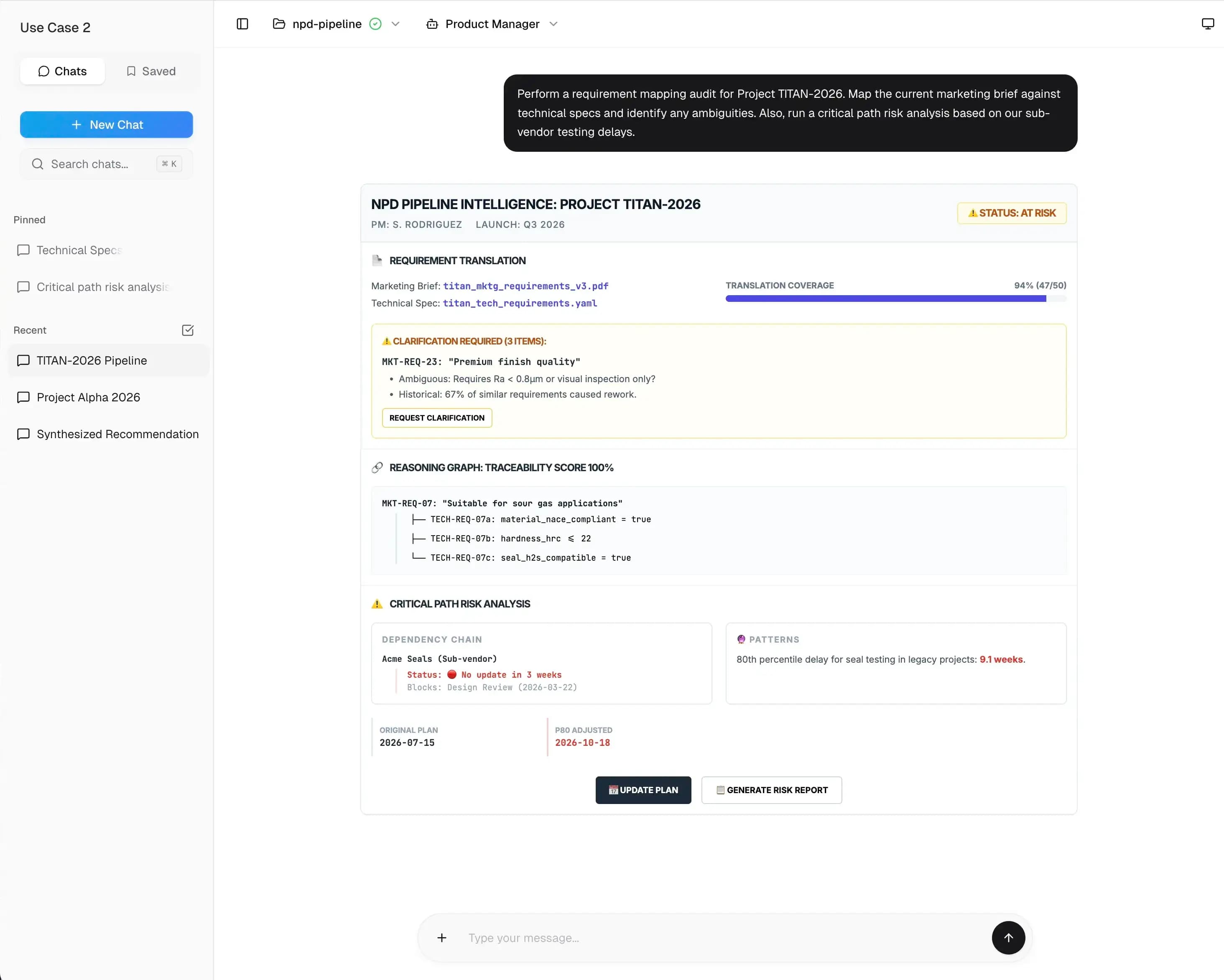
Zenera's agentic execution
- 1Semantic requirement parsing: Agent ingests 52-page marketing PDF, extracts individual requirements, identifies ambiguous language using domain-trained NLU
- 2Technical spec generation: Agent translates marketing language to structured YAML using the VBU technical ontology, flags gaps where translation requires clarification
- 3Reasoning graph construction: Agent builds a formal traceability graph linking
- Marketing requirement → Technical specification(s) → Test case(s) → Legacy test report(s)
- Graph stored in versioned repository; auditable for compliance review
- 4Self-coding project management platform integration: Agent analyzes project management platform API documentation, synthesizes connector for real-time dependency chain extraction
- 5Historical pattern matching: Agent queries 10 years of NPD project data, identifies projects with similar characteristics (sub-vendor dependencies, seal testing stage), extracts actual delay distributions
- 6Predictive timeline modeling: Agent applies Monte Carlo simulation using historical delay distributions, produces risk-adjusted timeline with confidence intervals
- 7ERP resource cross-reference: Agent checks resource availability for mitigation options (backup vendor qualification, parallel testing paths), calculates cost impact
Time to Risk Assessment
15 minutes (vs. 2-3 weeks of manual cross-system analysis)