What Autonomous Agentic Systems Are — and Why Events Are the Key
What Is an Autonomous Agentic System?
An autonomous agentic system is an AI system that acts on its own — without waiting for a human to type a prompt. It watches, decides, and executes.
Think of the difference between a calculator and a thermostat. A calculator does nothing until you press buttons. A thermostat monitors the temperature continuously and acts the moment conditions change — no human intervention required.
Most AI systems today are calculators. You ask a question, you get an answer. You walk away, the system goes idle. Nothing happens until the next prompt.
An autonomous agentic system is the thermostat. It is always on — listening for changes in data, workflows, schedules, and external systems. When something happens, it reasons about what to do, takes action, observes the result, and adapts. It operates in a continuous loop:
Sense — Detect an event (data change, system alert, workflow completion, schedule trigger)
Reason — Analyze the event in context, retrieve relevant knowledge, plan a course of action
Act — Execute tasks across enterprise systems (databases, APIs, CAD tools, ERPs)
Observe — Check the outcome — did it work? Did something unexpected happen?
Adapt — Adjust the plan, retry, escalate, or trigger the next agent in the chain
This loop runs without a human standing at the keyboard. The human defines the goals, sets the boundaries, and reviews critical decisions — but the system operates independently within those guardrails.
Autonomy vs. Human-Prompted: The Simple Difference
The distinction is straightforward:
Human-Prompted Agent
Autonomous Agent
What starts it
A person types a prompt
An event happens in the environment
When it works
Only when someone asks
24/7 — nights, weekends, holidays
What it sees
Whatever the user describes
Everything connected to its event sources
What it does after
Returns an answer and stops
Continues monitoring, chains to next actions
Scope
One task at a time
Orchestrates across multiple workflows
Reaction time
Minutes to hours (human bottleneck)
Milliseconds to seconds
A human-prompted agent is like an expert consultant sitting in a room. Brilliant — but only works when you walk in, describe the problem, and ask for help. If you don't know there's a problem, the consultant sits idle.
An autonomous agent is like an expert who is embedded in your operations. They see changes as they happen. They don't wait to be told — they notice, analyze, and act. When they need approval, they ask. When they don't, they execute.
The practical consequence: human-prompted systems can only respond to problems humans already know about. Autonomous systems find problems — and opportunities — that humans would never notice in time.
The Role of Events in Autonomy
Events are the nervous system of autonomous agents. Without events, there is no autonomy — only a chatbot waiting for input.
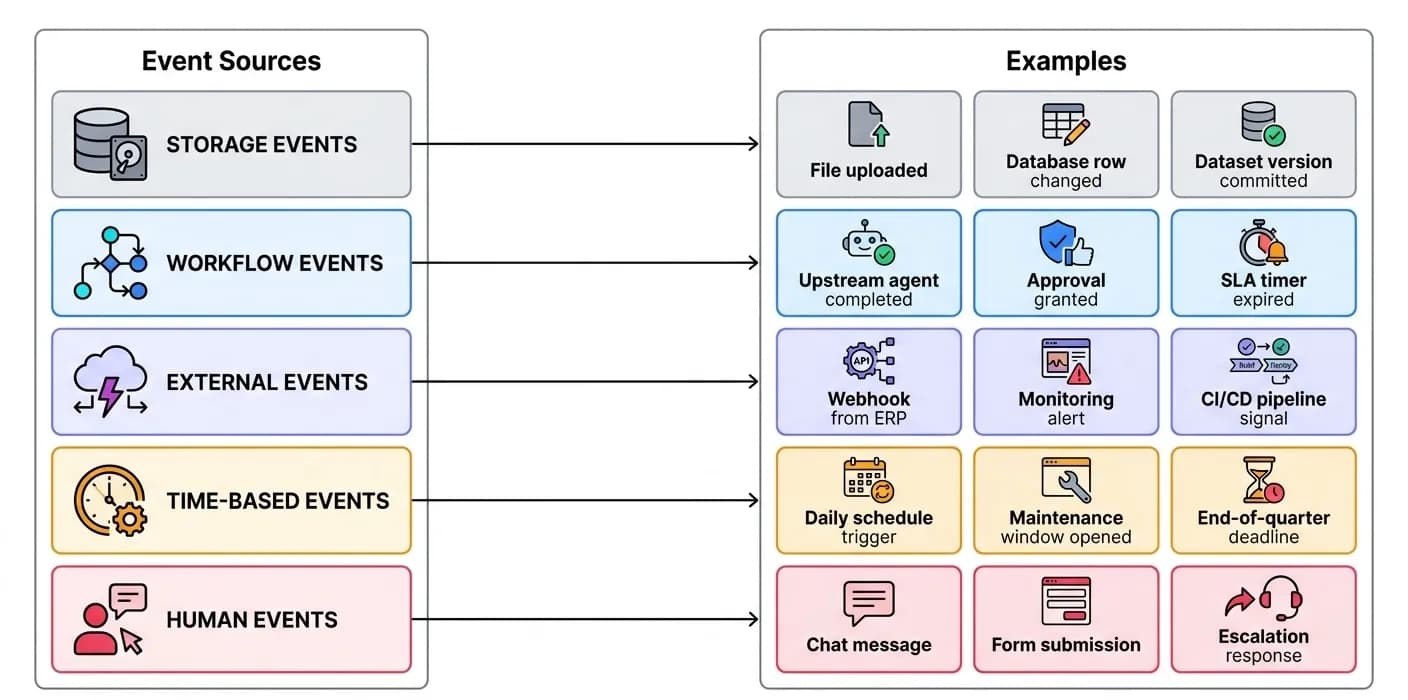
An event is any change in the environment that an agent can detect and respond to. Events are what transform a passive AI system into an active one.
Sources of Events
Every enterprise generates thousands of events per hour. Most are ignored. Files land in SharePoint folders and sit for days. ERP alerts fire and get buried in email. Workflow completions happen at 2 AM when no one is watching.
Autonomous agents turn every event into a potential action. They don't sleep. They don't forget. They don't deprioritize because they're busy with something else.
Why Events Enable What Prompts Cannot
Human prompts are synchronous and singular. One person asks one question at one time.
Events are asynchronous and continuous. They arrive from dozens of systems simultaneously, at any hour, in any combination. The value of autonomy comes from the ability to:
Correlate events across systems — A design change in CAD + a test schedule in the project system + a material availability update in ERP → together, these mean something. Individually, they're just data.
React at machine speed — When the window of opportunity is minutes, not hours, human reaction time is the bottleneck.
Chain reactions — One event triggers an agent, whose output becomes an event for the next agent, whose output triggers a third. Multi-step workflows execute end-to-end without human hand-holding.
What Autonomous Agentic Systems Produce
The outcomes of autonomous agentic systems go far beyond "answers to questions." They produce operational results:
Outcome Type
Description
Example
Optimized Schedules
Resource allocation adjusted in real-time based on upstream changes
Test stand schedules rebalanced when a design iteration completes early
Proactive Alerts
Issues surfaced before humans notice them
Conflict detected between two engineering teams sharing a test facility
Executed Workflows
Multi-step processes completed end-to-end
Procurement triggered, approvals routed, vendor notified — all from a single design change
Generated Artifacts
Documents, reports, code, configurations produced automatically
Test protocols generated from updated design specifications
Coordinated Handoffs
Work passed between teams/systems with full context
Design validation results forwarded to manufacturing planning with impact analysis
Audit Trails
Complete decision lineage for compliance
Every optimization decision traced back to the triggering events and reasoning
The Architecture: How Zenera Achieves Autonomy
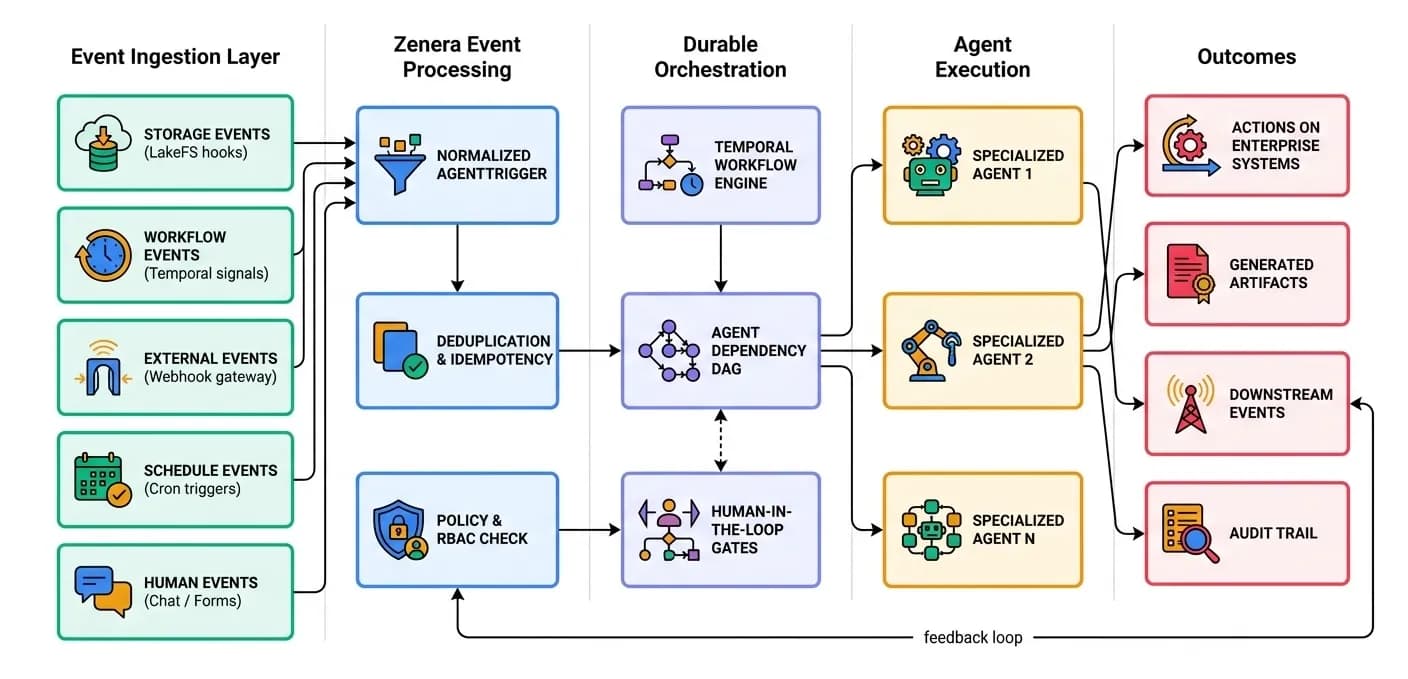
Zenera's autonomous architecture is built on three pillars: event ingestion, durable orchestration, and transactional execution.
What Makes This Different From LangChain or RAG Pipelines
Capability
LangChain / RAG
Zenera Autonomous Architecture
Trigger model
Human prompt only
Events from any source — storage, workflow, external, schedule, human
Execution durability
In-memory; dies with the process
Persisted at every decision point; survives node failures
Multi-agent coordination
Manual wiring; no guarantees
DAG-based orchestration with typed handoffs and conflict resolution
Event processing
Fire-and-forget
Exactly-once semantics with idempotency, replay, and dead-letter handling
State management
Stateless across invocations
Full workflow state preserved across days or weeks
Governance
Application-level only
RBAC, audit trails, and policy checks on every trigger
Feedback loops
None
Agent outputs generate events that activate downstream agents
Case Study: Engineering Test Stand Schedule Optimization
This is where the difference between human-prompted and autonomous becomes undeniable.
The Scenario
A large industrial manufacturer operates 12 high-value test stands — specialized facilities for validating valve designs under extreme conditions (cryogenic temperatures, high pressure, fatigue cycling). Each test stand costs $50,000/day to operate. The test stands are shared across 6 engineering teams working on 40+ active design projects simultaneously.
The current scheduling process:
Design engineers complete a design iteration and email the test lab coordinator
The coordinator manually checks test stand availability in a shared spreadsheet
Scheduling conflicts are resolved in weekly planning meetings
Test protocols are written manually based on the design specifications
If a design changes after scheduling, the entire chain is manually revisited
The brutal reality: Test stands sit idle 30% of the time — not because there's no work, but because the human coordination chain can't react fast enough. Design iterations complete at unpredictable times. Engineers forget to notify the coordinator. Scheduling meetings happen weekly, but design changes happen hourly. By the time a test slot is rescheduled, the window has passed.
Annual waste: ~$6.5M in idle test stand time.
Why a Human-Prompted Agent Cannot Solve This
Imagine giving an engineer a chatbot:
"Hey AI, when is the next available slot on Test Stand 7 for a cryogenic fatigue test?"
The chatbot checks the schedule and answers. Helpful — but fundamentally inadequate. Here's why:
The engineer has to know to ask. If they're deep in a CAD session and their design iteration completes at 11 PM, no one asks the chatbot until morning. The test stand sits idle overnight.
No cross-project visibility. The chatbot answers about one project. It doesn't know that Team B's design review was just rejected, freeing up Test Stand 3 tomorrow — which is compatible with Team A's test requirements.
No cascade awareness. Moving one test affects five others. The chatbot can't reoptimize the entire schedule — it answers point questions.
No artifact generation. Even after finding a slot, someone still has to write the test protocol, configure the data acquisition system, and notify the technicians.
No feedback loop. When a test completes early or a stand goes down for maintenance, nothing happens until a human notices and re-prompts.
A human-prompted agent is a faster way to get answers. An autonomous agent is a fundamentally different way to operate.
How Zenera's Autonomous System Solves This
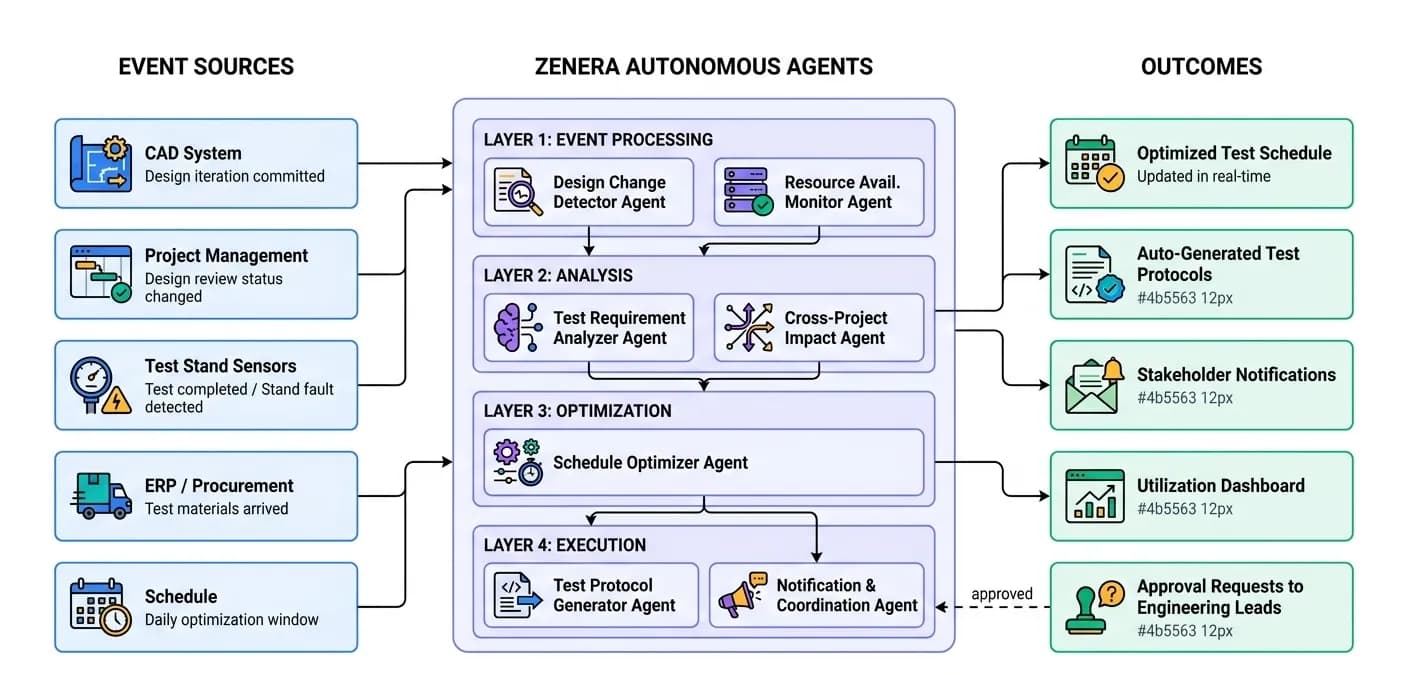
Here is what happens — without any human typing a prompt:
11:47 PM — Design Iteration Completes
Event: Engineer Sarah commits a new valve geometry to the CAD/PDM system and goes home.
The Design Change Detector Agent activates instantly:
Reads the committed geometry and change log
Identifies this as a cryogenic valve design (NiCrMo alloy, -196°C operating temperature)
Determines that the design has reached the "ready for validation" milestone
Extracts test requirements: cryogenic fatigue cycling, pressure integrity at 350 bar, seal leak rate verification
11:48 PM — Cross-Project Impact Analysis
The Cross-Project Impact Agent activates (triggered by the upstream agent's output):
Scans all 40 active projects for test stand dependencies
Discovers that Team B's design review was rejected at 4 PM — their scheduled Test Stand 3 slot (tomorrow, 8 AM–4 PM) is now available
Discovers that Team C's material shipment is delayed — their Test Stand 7 slot (day after tomorrow) can be released
Calculates compatibility: Test Stand 3 has cryogenic capability and is compatible with Sarah's valve geometry
11:49 PM — Schedule Optimization
The Schedule Optimizer Agent activates:
Runs constraint-satisfaction optimization across all 12 test stands, 40 projects, and 3-week scheduling horizon
Proposes: Move Sarah's test to Test Stand 3 tomorrow at 8 AM (the slot freed by Team B's rejection)
Calculates impact: No other project is negatively affected. Total utilization increases by 4.2%.
Flags: This requires engineering lead approval (high-value cryogenic test)
11:50 PM — Approval Request
The Notification Agent sends a structured approval request to Sarah's engineering lead:
Summary of the design change
Proposed test schedule with rationale
Impact analysis on other projects
One-click approve/reject in the Zenera dashboard or Slack
6:15 AM — Approval Granted
The engineering lead approves from their phone over morning coffee.
6:16 AM — Test Protocol Generation & Coordination
The Test Protocol Generator Agent activates:
Generates a complete test protocol based on the valve geometry, material properties, and applicable standards
Configures data acquisition parameters for Test Stand 3's instrumentation
References historical test results from similar cryogenic valve designs in the legacy archive
The Notification Agent:
Sends the test protocol to Test Stand 3's technician team
Updates the project management system
Notifies Sarah that her test is scheduled for 8 AM
8:00 AM — Test Begins
Sarah arrives at work to find her test already running. What would have taken 5-7 business days of email chains, scheduling meetings, and manual protocol writing happened in 6 hours and 29 minutes — mostly while everyone was asleep.
The Numbers
Metric
Human-Prompted System
Zenera Autonomous System
Time from design completion to test start
5–7 business days
6–8 hours
Test stand utilization
~70%
~92%
Schedule conflicts per month
12–15 (resolved in meetings)
0–2 (resolved automatically)
Test protocols written manually
100%
0% (auto-generated, human-reviewed)
Overnight/weekend events captured
0%
100%
Annual idle test stand cost
~$6.5M
~$1.4M
Annual savings
—
~$5.1M
Why This Is Impossible Without Autonomy
The key insight: this optimization requires correlating events across six independent systems in real-time.
No human can:
Monitor 40 projects for design completions 24/7
Instantly cross-reference every design change against every other project's status
Re-solve a 12-stand, 40-project constraint optimization in under 60 seconds
Generate a standards-compliant test protocol in minutes
Do all of this at 11:47 PM on a Tuesday
A human-prompted chatbot can answer questions about the schedule. It cannot operate the schedule. The difference is the difference between a search engine and an autopilot.
The Autonomy Spectrum
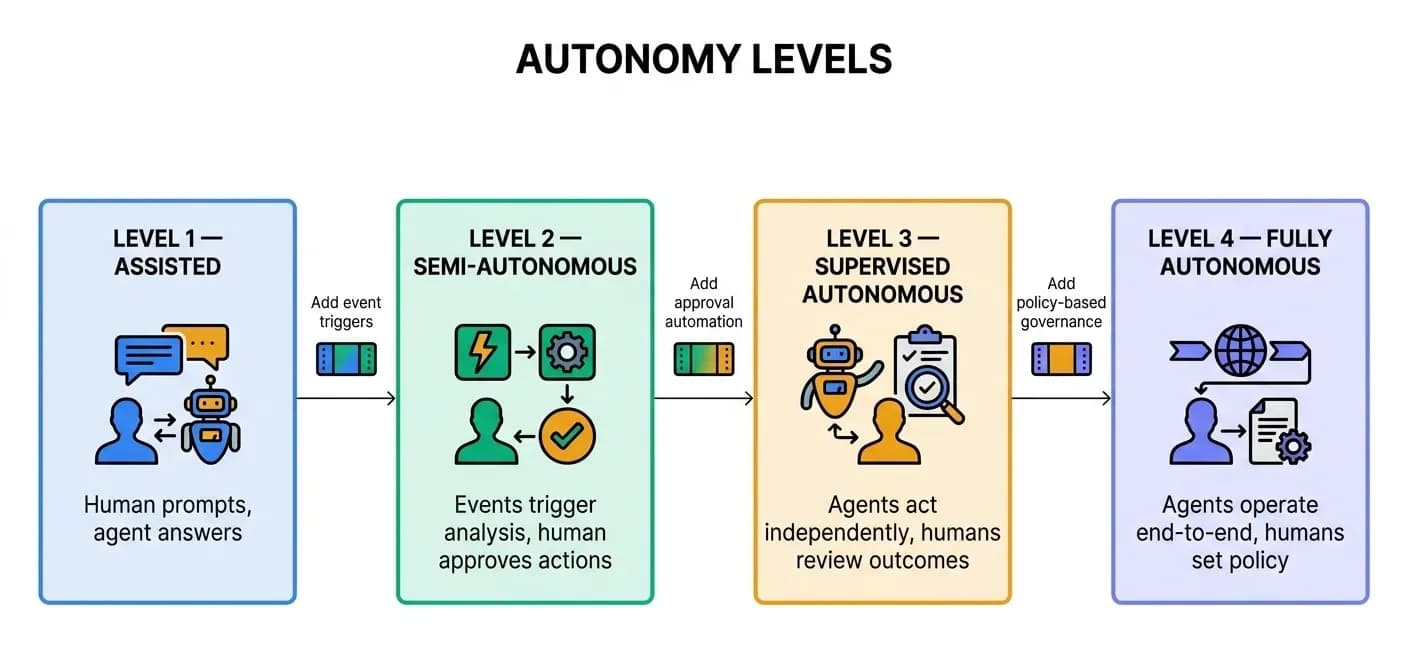
Not every workflow requires full autonomy. Zenera supports a spectrum:
Schedule automatically rebalanced; weekly summary sent to management
Level 4 — Fully Autonomous
Event-driven
Agent operates end-to-end
Set policy, handle exceptions
Entire test lifecycle — from design change to test completion — managed by agents with human intervention only on policy violations
Most enterprises begin at Level 2 and progress to Level 3 as trust is established. The test stand optimization scenario operates at Level 2–3: agents optimize and generate, but engineering leads approve high-value decisions.
How Zenera Makes Autonomy Safe
Autonomy without governance is reckless. Zenera's architecture ensures that autonomous agents are powerful but controlled:
Transactional Guarantees
Every agent action is atomic. If a schedule optimization fails partway through, all changes roll back. No half-updated schedules. No orphaned test protocols. The system is always in a consistent state.
Durable Execution
Workflows survive infrastructure failures. If a Kubernetes node goes down mid-optimization, the workflow resumes exactly where it left off on another node. No lost work. No duplicate actions.
Complete Audit Trail
Every decision is traceable:
What event triggered the agent? (Sarah's design commit at 11:47 PM)
What data did the agent consider? (40 project schedules, 12 test stand states, 3 material shipment statuses)
What alternatives did it evaluate? (7 possible schedule configurations, ranked by utilization impact)
Why did it choose this option? (Reasoning chain preserved with full provenance)
Who approved it? (Engineering lead, 6:15 AM, via Slack)
RBAC and Policy Enforcement
Not every agent can do everything:
Design change detection agents have read-only access to CAD systems
Schedule optimization agents can propose changes but require approval above a cost threshold
Protocol generation agents can write to the test management system but cannot modify active tests
Human-in-the-Loop as a First-Class Pattern
Autonomous does not mean unsupervised. Zenera's workflow engine supports blocking approval gates — the workflow pauses, sends a notification, and resumes the instant a human responds. No polling. No message loss. No timeout unless explicitly configured.
The Bottom Line
The enterprise AI conversation is shifting from "What can I ask the AI?" to "What can the AI do while I'm not looking?"
Human-prompted agents are useful tools. They make knowledge workers faster at tasks they already know to do.
Autonomous agents are a different category. They find work that needs doing, coordinate across systems, act at machine speed, and operate 24/7 — all within enterprise governance guardrails.
The gap between prompted and autonomous is not incremental. It is the gap between a search engine and an operating system. Between asking questions and running operations.
Events are the mechanism. Durable orchestration is the backbone. Transactional safety is the guardrail. And the result is not smarter answers — it is autonomous operations.
Zenera is built for this. Not to answer questions about your enterprise — but to operate within it.
Ready to Move Beyond Prompts?
See how Zenera's autonomous agents can transform your enterprise operations — 24/7, event-driven, and governed.