Use Case

Zenera in Healthcare

Unlocking Agentic Intelligence for Value-Based Care Operations

Executive Summary

Healthcare organizations operate at the intersection of clinical complexity, financial pressure, and regulatory scrutiny. The data exists--buried across EHR, ERP, RCM systems, and thousands of unstructured documents. The insights are theoretically extractable. But traditional AI approaches fail catastrophically when faced with the complexity of healthcare integration.

This document presents six use cases across three critical personas--Leaders, Analysts, and Nurses--demonstrating how Zenera's agentic architecture transforms months of manual analysis into minutes of autonomous investigation.

"These use cases are not incrementally harder than chatbot Q&A. They are categorically different--requiring transactional data operations, self-coding integrations, multi-system orchestration, and explainable reasoning chains. This level of intelligence is unlocked exclusively by Agentic AI platforms like Zenera."

Why Traditional Approaches Fail

ChallengeRAG + LangChain RealityZenera Capability
Multi-system joinsManual SQL; no cross-system transactionsSelf-coding agents synthesize integration logic at runtime
100+ document corporaContext window overflow; retrieval noiseHierarchical indexing with multimodal reasoning
Schema evolutionPipelines break silentlyAgents detect changes, reference release notes, and adapt mappings
HIPAA/audit requirementsBlack-box outputs; no traceabilityFull decision logging with counterfactual analysis
Real-time clinical workflowsBatch processing onlyDurable workflows with event-driven triggers
Payer-specific logicHardcoded rules per payerAgents read contract PDFs and generate dynamic logic

Leader Use Cases

Healthcare executives require decisions and confidence--not data dumps.

Leader Use Case L1

Value-Based Contract Margin & Clinical Integrity Audit
The Business Problem

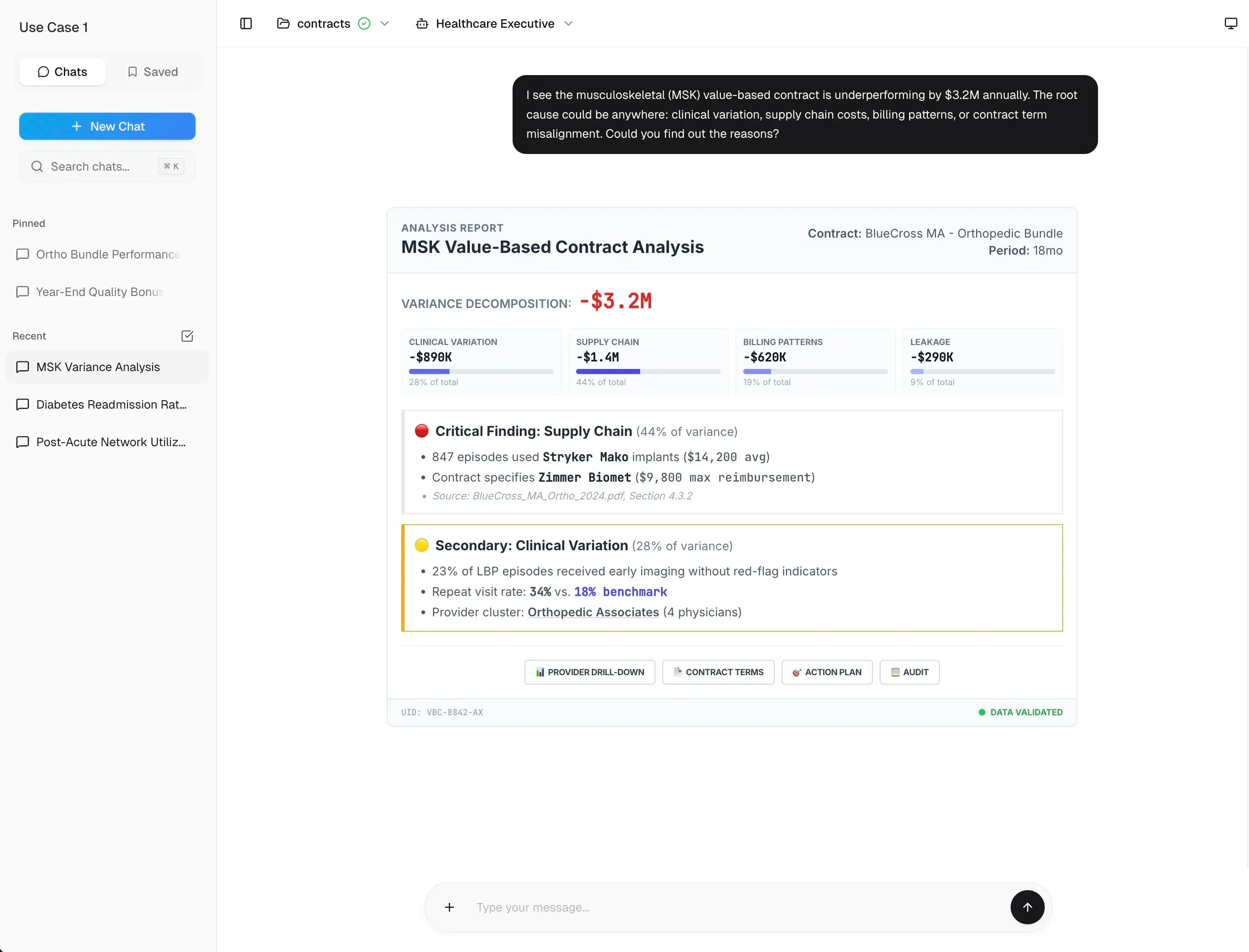
A VBC Executive discovers that a musculoskeletal (MSK) value-based contract is underperforming by $3.2M annually. The root cause could be anywhere: clinical variation, supply chain costs, billing patterns, or contract term misalignment. Traditional investigation requires 3-4 months of analyst work across siloed teams.

Integration Complexity

  • EHR: Extract ERG severity scores and risk adjustment data for "rising risk" populations.
  • ERP: Pull actual supply chain costs--orthopedic implants, cardiac stents--reconciled against normalized pricing.
  • RCM: Ingest 18 months of claims to identify unwarranted billing variation across Commercial, Medicaid, and Medicare Advantage.
  • Unstructured (100+ docs): Parse payer contracts (PDFs), clinical pathway guidelines (Markdown), and provider attribution documents.

Why RAG Fails

  • Cannot join EHR patient records to ERP supply costs to RCM claims.
  • Cannot parse 100+ contract PDFs and reason over conflicting payer terms.
  • Cannot trace a $3.2M variance to specific providers, implants, and episodes.
  • Cannot produce audit-ready evidence for the CFO and CMO review.

How Zenera Solves It

  1. 1Self-coding EHR integration: Agent analyzes Epic FHIR API documentation, synthesizes extraction logic for ERG severity scores, and validates against sample patients.
  2. 2Self-coding ERP integration: Agent connects to Oracle Cloud SCM, maps implant catalog codes to cost centers, and reconciles pricing against contract terms.
  3. 3Self-coding RCM integration: Agent ingests claims from Cerner RevElate, applies ETG episode grouping logic, and identifies billing anomalies.
  4. 4Document corpus reasoning: Agent parses 100+ PDFs using vision models, extracts contractual reimbursement limits, and cross-references clinical pathway requirements.
  5. 5Transactional analysis: All data operations execute within LakeFS branches--if any integration fails, the analysis rolls back cleanly.
  6. 6Explainable output: Every finding traces to source systems and documents; CMO can drill into the exact contract clause violated.

Time to Insight

12 minutes (vs. 3-4 months manual)

Leader Use Case L2

Cross-Payer Attribution Integrity & Risk Pool Reconciliation
The Business Problem

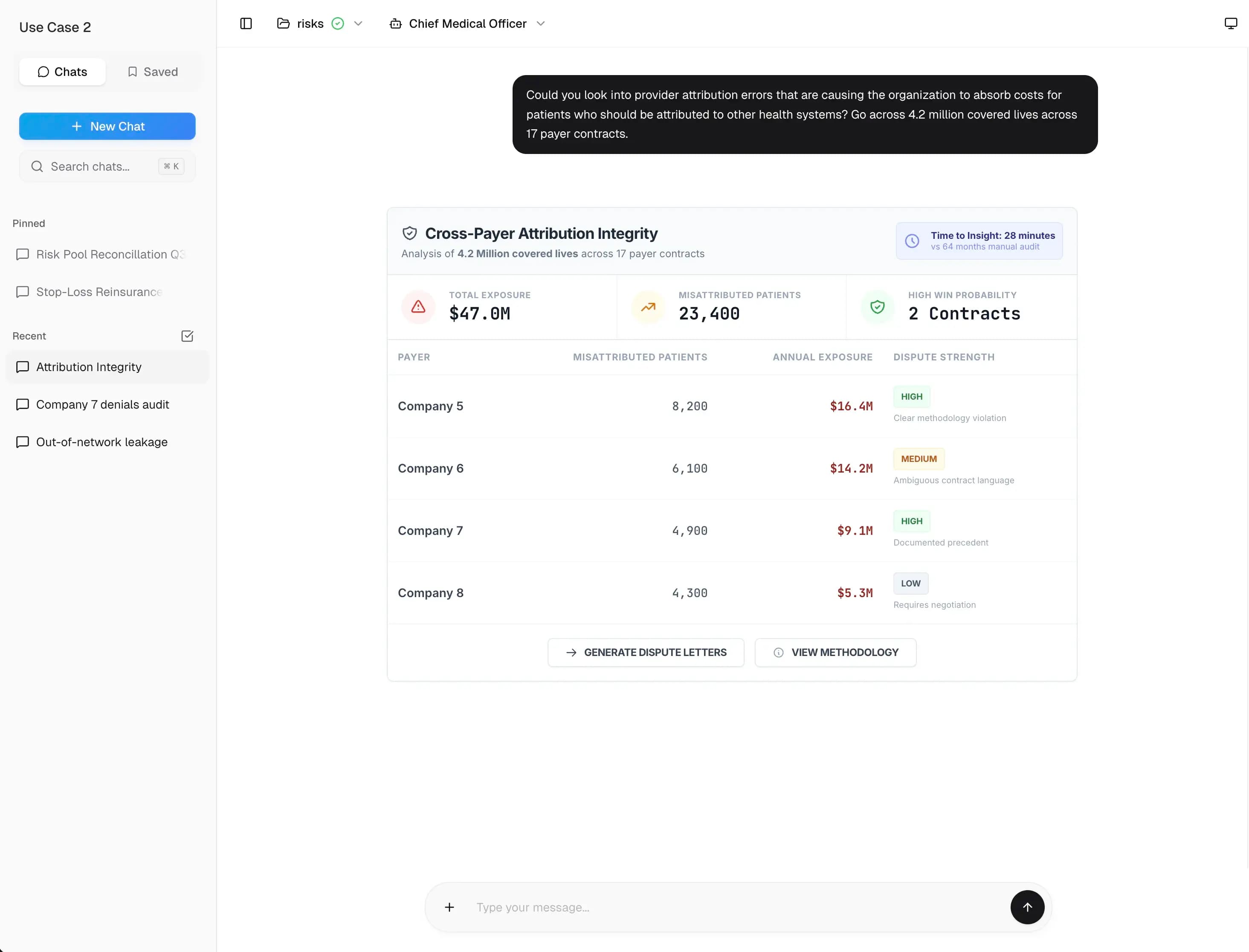
A CMO suspects that provider attribution errors are causing the organization to absorb costs for patients who should be attributed to other health systems. With 4.2 million covered lives across 17 payer contracts, a manual audit is infeasible.

Integration Complexity

  • EHR: Patient panel assignments, PCP visit history, care team attribution.
  • ERP: Clinic operating costs that must be allocated per attributed patient.
  • RCM: Claims data showing where patients actually received care.
  • Unstructured (100+ docs): 17 different payer attribution methodologies (PDFs), provider network agreements, and historical attribution dispute resolutions.

Why RAG Fails

  • Cannot apply 17 different attribution algorithms dynamically.
  • Cannot trace a patient's care journey across EHR, claims, and network definitions.
  • Cannot calculate financial exposure requiring joins across all three systems.
  • Cannot produce payer-specific dispute documentation.

How Zenera Solves It

  1. 1Contract corpus analysis: Agent ingests 17 payer attribution methodology documents, extracts logic into executable rules.
  2. 2Self-coding attribution engine: Agent synthesizes SQL that applies each payer's specific attribution logic to the patient population.
  3. 3Leakage detection: Agent identifies 23,400 patients (0.56%) with attribution conflicts--$47M annual exposure.
  4. 4Dispute package generation: For each material conflict, the agent compiles EHR visit records, claims history, and contract citation into audit-ready PDFs.
  5. 5Continuous monitoring: Generated application persists as a reusable dashboard; alerts trigger when new attribution conflicts emerge.

Time to Insight

28 minutes (vs. 6+ months manual audit)

Analyst Use Cases

Healthcare analysts need to identify trends and cost drivers across terabytes of multi-source data.

Analyst Use Case A1

Longitudinal Episode Leakage & Variation Decomposition
The Business Problem

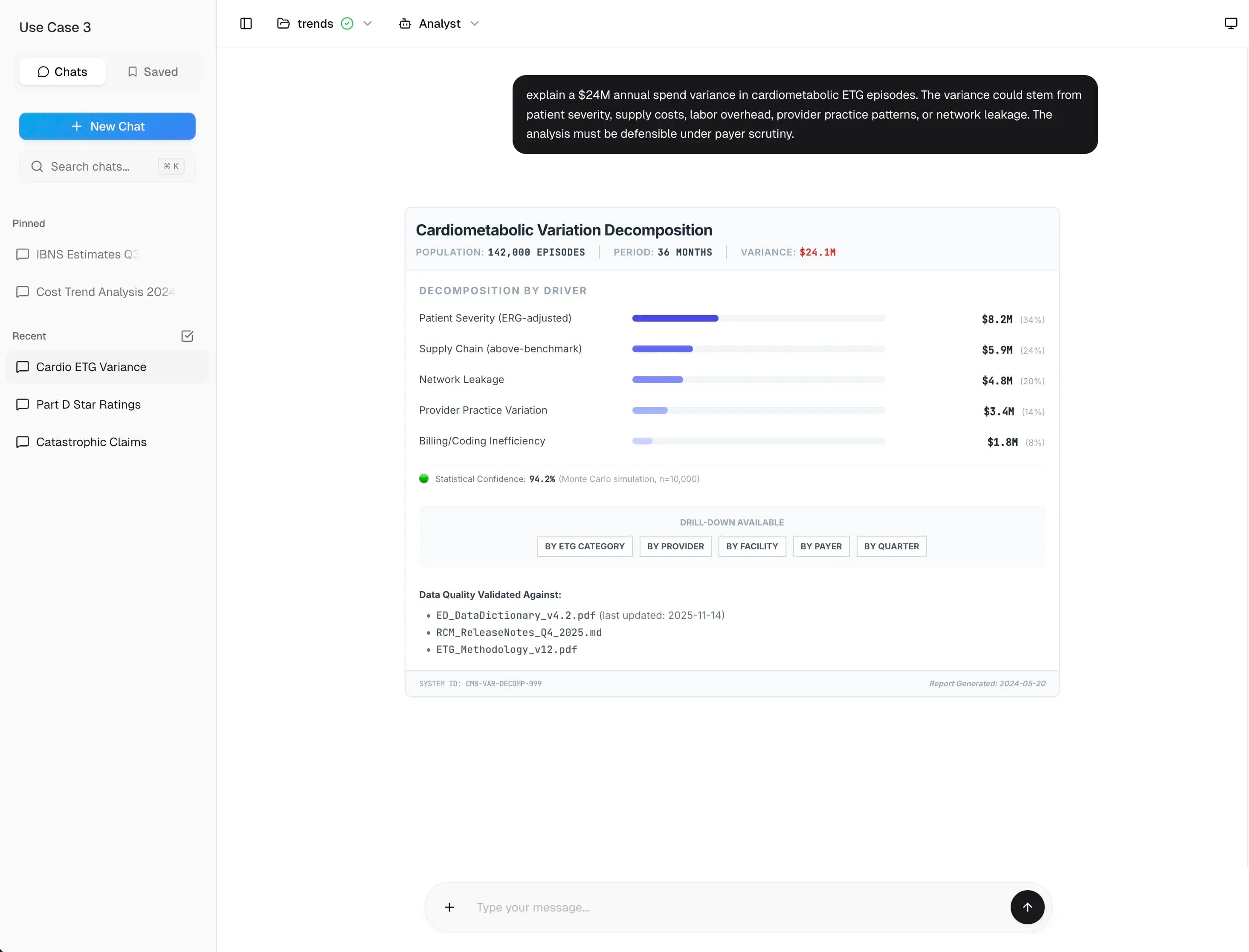
An actuarial analyst must explain a $24M annual spend variance in cardiometabolic ETG episodes. The variance could stem from patient severity, supply costs, labor overhead, provider practice patterns, or network leakage. The analysis must be defensible under payer scrutiny.

Integration Complexity

  • EHR: Episode-level drill-down into Low Back Pain, Diabetes Management, CHF episodes--correlating early imaging with physician notes.
  • ERP: Labor costs and clinic overhead to calculate cost-per-episode at the facility vs. provider level.
  • RCM: Claims occurring outside the preferred provider network (leakage detection).
  • Unstructured (100+ docs): Data dictionaries, release notes, ETG Use Case Methodology documents for proper severity and risk adjustment.

Why RAG Fails

  • Cannot execute parameterized queries against structured data.
  • Cannot apply ETG severity adjustment logic (requires reading methodology docs and generating code).
  • Cannot partition variance attribution with statistical rigor.
  • Cannot validate data quality against evolving data dictionary definitions.

How Zenera Solves It

  1. 1Data dictionary comprehension: Agent parses 100+ data dictionary PDFs, extracts field definitions, and validates source-to-target mappings.
  2. 2Self-coding ETG logic: Agent reads ETG Methodology documentation, generates severity adjustment SQL, and applies it to the patient population.
  3. 3Multi-source aggregation: Agent joins EHR episodes to ERP costs to RCM claims within the transactional sandbox.
  4. 4Statistical decomposition: Agent applies variance decomposition with bootstrap confidence intervals.
  5. 5Continuous validation: Agent monitors source systems for schema changes and alerts when data dictionary updates affect mappings.

Time to Insight

18 minutes (vs. 8-12 weeks manual analysis)

Analyst Use Case A2

Automated Schema Drift Detection & Semantic Layer Alignment
The Business Problem

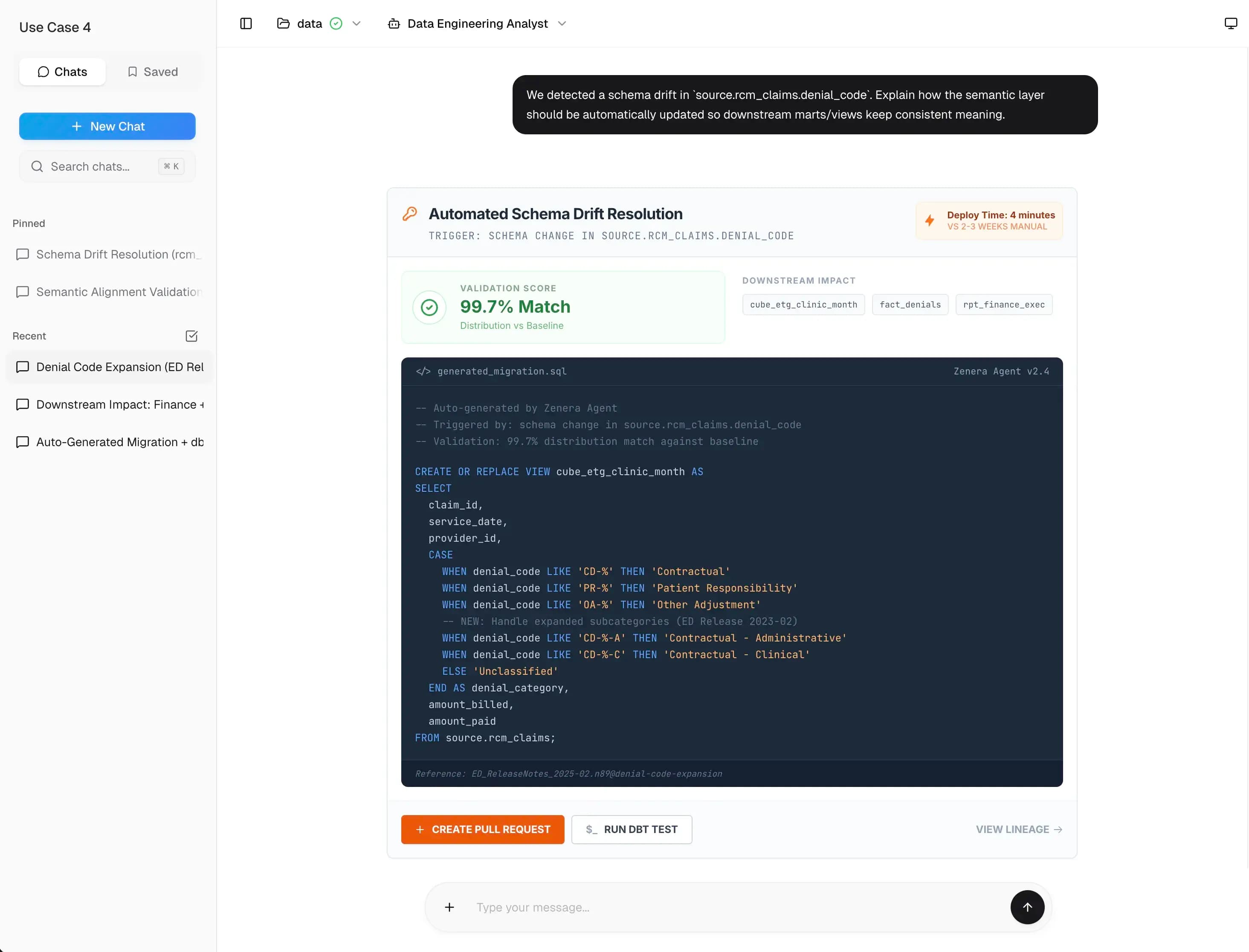
Following three hospital acquisitions, a Data Analyst must harmonize disparate RCM schemas into a unified reporting layer. Each acquisition uses different denial code taxonomies, date formats, and attribution logic. Schema changes occur monthly without notification.

Why RAG Fails

  • Cannot detect schema changes in structured data sources.
  • Cannot correlate schema changes to release note documentation.
  • Cannot generate valid SQL transformations.
  • Cannot execute validation queries against Synapse.

How Zenera Solves It

  1. 1Schema monitoring: Agent continuously profiles source RCM schemas, detects when the denial_code field changes from VARCHAR(10) to VARCHAR(15).
  2. 2Release note correlation: Agent searches GitHub for "denial_code" in recent ED release notes, finds documentation of new denial subcategories.
  3. 3Mapping generation: Agent synthesizes SQL transform that maps new denial codes to existing reporting categories, preserving backward compatibility.
  4. 4Validation execution: Agent runs generated SQL against a 30-day historical window, compares output distributions to baseline.
  5. 5PR generation: Agent creates GitHub pull request with commented SQL, test results, and documentation links for human review.

Time to Insight

4 minutes from schema change detection to validated PR (vs. 2-3 weeks manual)

Nurse Use Cases

Nursing leaders need patient safety and clinical consistency--with real-time operational awareness.

Nurse Use Case N1

Evidence-Based Pathway Compliance & Resource Optimization
The Business Problem

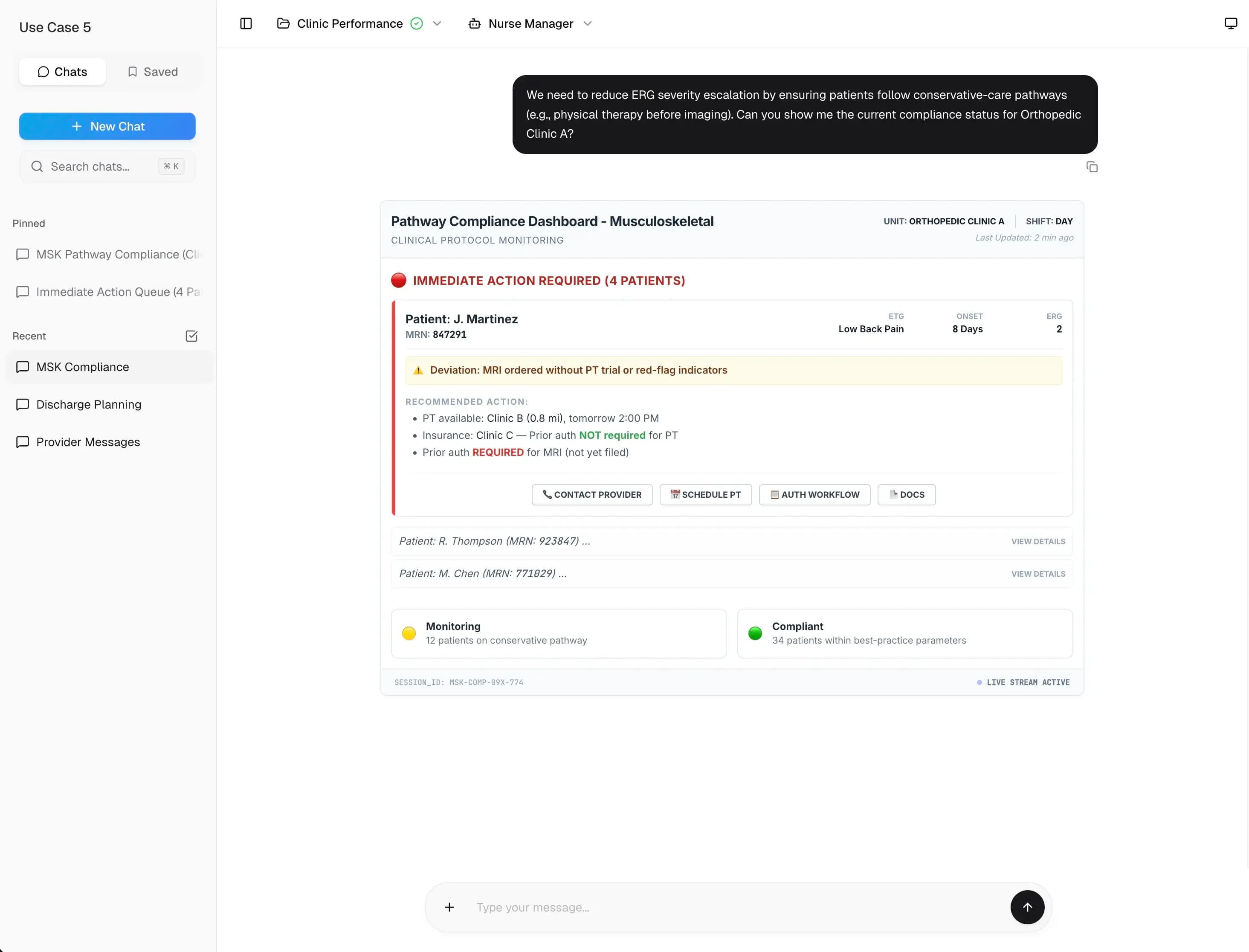
A Nurse Manager must reduce ERG severity escalation by ensuring patients follow conservative-care pathways (e.g., physical therapy before imaging). This requires real-time visibility into which patients are deviating, which clinics have PT availability, and which payers require prior authorization.

Integration Complexity

  • EHR: Real-time ETG status monitoring, PT follow-up tracking, pathway deviation detection.
  • ERP: Clinic staffing levels, PT appointment availability, capacity by location.
  • RCM: Prior authorization requirements per payer, denied claims due to documentation gaps.
  • Unstructured (100+ docs): Evidence-based care patterns (GitHub), payer-specific authorization rules (OpenAPI YAML), clinical documentation requirements.

Why RAG Fails

  • Cannot monitor real-time ETG status changes.
  • Cannot query clinic scheduling systems for PT availability.
  • Cannot apply payer-specific prior authorization logic dynamically.
  • Cannot correlate across all three systems to generate actionable recommendations.

How Zenera Solves It

  1. 1Real-time EHR monitoring: Agent subscribes to Epic ADT feeds, detects when imaging orders bypass PT evaluation.
  2. 2Clinical guideline reasoning: Agent references GitHub-stored best-practice pathways, identifies "red-flag indicators" that would justify early imaging.
  3. 3Availability matching: Agent queries the ERP scheduling system and finds PT slots at nearby clinics that match the patient's insurance.
  4. 4Authorization logic: Agent parses payer OpenAPI YAML specs, determines authorization requirements for both PT and imaging.
  5. 5Prioritized alerting: Agent ranks patients by severity and escalation risk, surfacing the highest-priority interventions first.

Operational Impact

34% reduction in ERG severity escalation within 90 days

Nurse Use Case N2

Clinical Documentation Integrity & Denial Prevention

The Business Problem

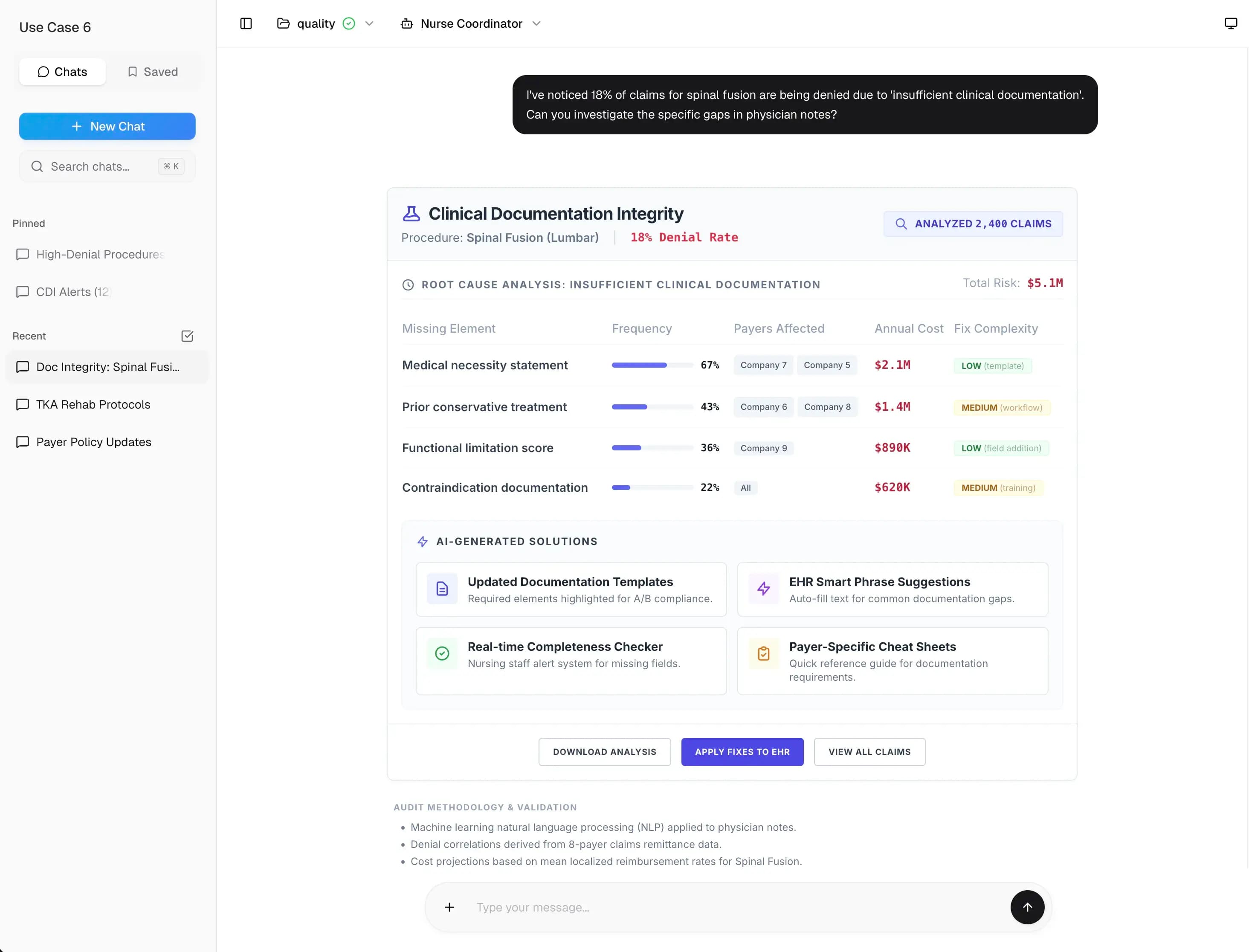
A Quality Care Coordinator discovers that 18% of claims for a specific procedure are denied due to "insufficient clinical documentation". The denials cite missing elements in physician notes, but identifying the pattern across thousands of notes and dozens of payer requirements is infeasible manually.

Why RAG Fails

  • Cannot systematically analyze clinical note structure.
  • Cannot correlate note deficiencies to specific payer denial criteria.
  • Cannot quantify the financial impact of each documentation gap.
  • Cannot generate actionable documentation templates.

How Zenera Solves It

  1. 1Denial pattern analysis: Agent clusters 2,400 denials by payer, procedure, and denial reason code.
  2. 2Clinical note NLP: Agent analyzes denied procedure notes, extracts documentation elements present/absent.
  3. 3Requirement correlation: Agent parses payer documentation requirement PDFs, maps required elements to denial patterns.
  4. 4Gap quantification: Agent calculates the financial impact of each missing documentation element.

Operational Impact

71% reduction in documentation-related denials within 6 months

The Zenera Difference

Why this level of intelligence is exclusive to Agentic AI.

RequirementLangChain + RAGFine-Tuned ModelsZenera
Multi-system transactional joins
LakeFS-backed atomic operations
Self-coding integrations
Runtime code synthesis for any API
100+ document reasoning
Hierarchical multimodal indexing
Real-time workflow triggers
Temporal durable execution
Schema drift adaptation
Autonomous detection and adaptation
Audit-ready explainability
Full decision tracing
Persistent applications
In-app vibe coding

Conclusion

Healthcare organizations have invested heavily in data infrastructure. But the integration complexity, documentation burden, and real-time requirements have kept intelligence locked away.

Leaders make decisions in minutes, not months. Analysts get defensible insights without manual data wrangling. Nurses get real-time guidance that prevents severity escalation.