Enterprise-Grade AI Agent Infrastructure for Mission-Critical Operations
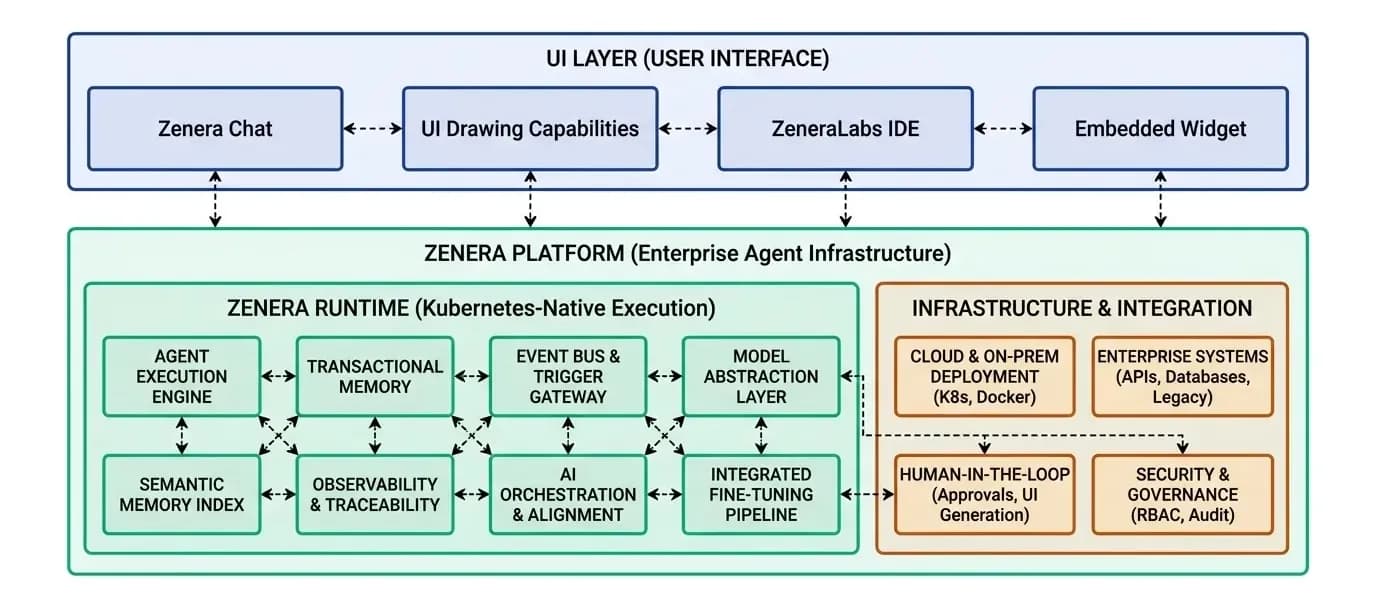
Zenera is a production-ready agentic AI platform engineered for enterprises that demand reliability, scalability, and full operational control. Unlike fragmented AI toolkits, Zenera provides a unified infrastructure layer where autonomous agents operate with transactional guarantees, survive infrastructure failures, and integrate seamlessly with complex enterprise ecosystems.
"The platform eliminates the undifferentiated heavy lifting of agent infrastructure, allowing teams to focus on the business logic that creates competitive advantage."

12 enterprise-grade capabilities engineered for production AI agent deployments.
AI agents operating on enterprise data require ACID-like guarantees. Traditional agent frameworks treat storage as an afterthought, leading to data corruption, race conditions, and unrecoverable states.
Git-like versioning at scale -- Built on LakeFS over MinIO, providing branch/merge semantics for multi-gigabyte datasets
Atomic operations -- Agents read and write to isolated branches; changes are committed atomically or rolled back entirely
Full lineage tracking -- Every data mutation is versioned with complete provenance, enabling audit trails and rollback to any point in time
Concurrent agent safety -- Multiple agents can operate on shared datasets with optimistic concurrency control and conflict resolution
Agents can safely transform terabytes of structured and unstructured data with the same confidence developers have in database transactions.
Complex agent workflows span hours or days, involve external API calls, and must survive node failures, network partitions, and Kubernetes pod migrations without losing state.
Durable execution engine -- Powered by Temporal, workflows persist their execution state to durable storage at every decision point
Automatic retries with exponential backoff -- Failed activities are retried with configurable policies; human escalation paths are first-class citizens
Cross-node migration -- Workflows seamlessly resume on different nodes after failures -- no checkpointing logic required in agent code
Long-running process support -- Workflows can pause for days awaiting human approval, external events, or scheduled triggers
Heterogeneous environment resilience -- Designed for real enterprise Kubernetes deployments where nodes come and go unpredictably
Multi-step agent workflows that would require months of custom infrastructure engineering work out of the box.
Enterprise systems expose thousands of APIs across decades of technology generations. Pre-built integrations cover a fraction; MCP-style tool registries require extensive upfront engineering.
Runtime code synthesis -- Agents dynamically generate, validate, and execute integration code when encountering unfamiliar APIs or data formats
Sandboxed execution -- Generated code runs in isolated containers with strict resource limits and network policies
Learning loop -- Successfully synthesized tools are persisted, reviewed, and promoted to the standard toolchain
Legacy system bridging -- Agents can interface with SOAP services, mainframe terminals, proprietary protocols, and undocumented APIs by reasoning about response patterns
MCP compatibility -- Full support for Model Context Protocol when standardized tools are available and preferred
One agent integrated with a 15-year-old ERP system in hours -- a task that previously required months of dedicated integration development.
As agent swarms grow, emergent conflicts arise: contradictory system prompts, infinite handoff loops, and trajectories that never terminate. Manual alignment doesn't scale.
Trajectory prediction engine -- Before execution, AI analyzes the full graph of possible agent handoffs and tool invocations to identify loops, dead ends, and conflicts
Prompt consistency verification -- System prompts across all agents in a workflow are analyzed for semantic contradictions and ambiguities
Runtime alignment correction -- During execution, the orchestrator can inject clarifying context to prevent detected misalignments
Guaranteed termination -- Trajectories are verified to have well-defined exit conditions; non-terminating patterns are flagged before deployment
Swarm coordination -- Agents operating in parallel are given mutually consistent views of shared state and objectives
The orchestration layer treats agent coordination as a first-class AI problem, not an afterthought requiring manual prompt engineering.
Enterprises cannot depend on generic foundation models for domain-specific tasks. Manual fine-tuning requires ML expertise and disconnected toolchains.
Model abstraction layer -- Agents are decoupled from specific models; the runtime selects optimal models based on task characteristics, latency requirements, and cost constraints
Automatic dataset collection -- Every agent interaction is traced; high-quality examples are automatically curated for fine-tuning datasets
SFT and preference tuning -- Integrated supervised fine-tuning and DPO/RLHF pipelines optimize models on collected trajectories
Performance regression detection -- Fine-tuned models are evaluated against held-out test sets before promotion
Seamless model hot-swap -- Updated models are deployed without agent code changes or workflow restarts
The platform continuously learns from production traffic, automatically improving model performance without dedicated ML operations.
Agents need access to gigabytes of enterprise knowledge -- documents, images, diagrams, tables -- with sub-second retrieval and multimodal reasoning.
Hybrid vector + lexical search -- OpenSearch-based SemanticDB combines dense embeddings with BM25 for optimal recall across query types
Multimodal indexing -- Text, images, diagrams, and scanned documents are indexed with modality-specific encoders
Hierarchical chunking -- Documents are decomposed into semantically coherent chunks with preserved structural relationships
Broad format support -- PDF, DOCX, XLSX, images, CAD files, and proprietary formats ingested through extensible parser pipeline
Real-time sync -- Knowledge bases stay current with incremental indexing from source systems
Agents reason over the complete enterprise knowledge graph, not just recent context windows.
Building, testing, and monitoring agent systems requires jumping between disconnected tools -- chat interfaces, code editors, observability dashboards.
Unified agent IDE -- Edit prompts, tool definitions, and workflow logic in a purpose-built environment
AI-assisted authoring -- Generate agent definitions, system prompts, and tool schemas from natural language specifications
Trajectory visualization -- Graphically explore possible execution paths; identify alignment issues before deployment
Live debugging -- Step through agent execution, inspect intermediate states, and modify behavior in real-time
Version control integration -- All agent artifacts are versioned with Git-compatible semantics
The development experience is engineered for agent builders, not retrofitted from chatbot frameworks.
Production AI systems require the same operational visibility as traditional infrastructure -- but with agent-specific telemetry.
Full Grafana integration -- Pre-built dashboards for agent performance, model latency, error rates, and resource utilization
Distributed tracing -- Every agent decision, tool call, and model invocation is traced with OpenTelemetry compatibility
Log aggregation -- Centralized logging with Loki; structured logs include agent context, session IDs, and correlation tokens
Alerting pipelines -- Configurable alerts for SLA violations, error spikes, and anomalous agent behavior
Cost attribution -- Token usage and compute costs are tracked per agent, per workflow, and per tenant
Operations teams manage agent infrastructure with the same tools and practices they use for traditional services.
Enterprises need deployment flexibility -- from developer laptops to air-gapped private clouds -- without re-architecting the platform.
Kubernetes-native -- Helm charts and operators for production-grade deployment on any conformant cluster
Desktop mode -- Full platform functionality in a single Docker Compose stack for development and edge deployment
Multi-tenancy -- Namespace isolation, resource quotas, and RBAC for shared cluster deployments
Hybrid cloud support -- Agents can execute across cloud boundaries with secure cross-cluster communication
Offline operation -- Core functionality operates without internet connectivity; local models supported
Deploy anywhere -- from a MacBook to a private Kubernetes cluster in a regulated data center.
Regulated industries require AI systems to justify every decision. Black-box agents are non-starters for compliance.
Decision logging -- Every agent decision captures the reasoning chain, retrieved context, and selected action with confidence scores
Audit trails -- Immutable logs satisfy SOC 2, HIPAA, and financial services audit requirements
Counterfactual analysis -- Replay decisions with modified context to understand sensitivity to inputs
Human-readable explanations -- Agents generate plain-language justifications suitable for non-technical stakeholders
Regulatory report generation -- Automated extraction of decision logs into compliance-ready formats
Agents operating in Zenera are not black boxes -- every decision is traceable to source context and reasoning.
Most agent platforms are chat-first, forcing users into conversational interfaces for tasks better served by structured UIs.
Dynamic interface synthesis -- Agents generate interactive forms, tables, charts, and dashboards tailored to the task at hand
Component library -- Rich widget set including data grids, visualization components, input forms, and approval workflows
Real-time binding -- Generated UIs are live-bound to agent state; updates propagate instantly
Responsive design -- Interfaces adapt to desktop, tablet, and mobile form factors
Embedding support -- Generated UIs can be embedded in existing enterprise portals and applications
Zenera agents are not chatbots -- they deliver purpose-built interfaces that match the complexity of enterprise workflows.
Business users want to go beyond one-off tasks -- they want to create reusable applications without waiting for IT development cycles.
Natural language application definition -- Users describe desired functionality; the platform synthesizes complete applications
Enterprise integration -- Generated applications connect to live data sources, respecting existing access controls
Persistence and sharing -- Applications are saved, versioned, and shareable across the organization
Live data binding -- Applications always display current data; no stale exports or manual refreshes
Governance integration -- Generated applications are subject to the same approval and audit workflows as IT-delivered software
Users don't just run agents -- they create production applications that integrate seamlessly into enterprise systems and remain current automatically.
Zenera is infrastructure for enterprises that treat AI agents as production systems, not experiments. Every capability -- from transactional storage to automatic fine-tuning -- is engineered for the operational realities of heterogeneous enterprise environments.
The platform eliminates the undifferentiated heavy lifting of agent infrastructure, allowing teams to focus on the business logic that creates competitive advantage.
Request a Demo