
Zenera in Insurance & Risk Management
Transforming Risk Platforms into Proactive Decision Engines
Executive Summary
Insurance and risk management operate at the intersection of regulatory complexity, multi-jurisdictional compliance, and strategic financial optimization. The data exists - scattered across claims systems, policy archives, regulatory filings, and external market feeds. The analytical potential is enormous. But traditional AI approaches fail catastrophically when faced with insurance's integration complexity and visual document processing requirements.
This document presents three complex use cases demonstrating how Zenera's Intelligent Assist architecture transforms existing risk management and claims platforms from reactive data repositories into proactive decision engines - delivering insights in minutes that previously required weeks of analyst work.
The core insight: Zenera is not a text chatbot - it is an insurance AI platform with native document vision, regulatory reasoning, and cross-system integration capabilities. These use cases demand capabilities that LangChain, RAG pipelines, and fine-tuned models cannot provide - visual extraction from decades of policy PDFs, self-coding integrations with legacy XML systems, and reasoning graphs that trace recommendations through regulatory requirements. Only Zenera's agentic architecture delivers this level of insurance intelligence.
Insurance AI: Beyond Text Chatbots
Insurance intelligence lives in complex documents and structured data: policy schedules, claims forms, regulatory filings, loss runs, XML transaction records, and actuarial models. Text-based AI systems are fundamentally inadequate for this domain.
| Capability | Description |
|---|---|
| Policy Document Vision | Extract limits, deductibles, exclusions, and endorsements from scanned policy schedules and declarations pages |
| Claims Form Processing | Parse ACORD forms, loss runs, and claims documentation with structured data extraction |
| Regulatory Filing Interpretation | Understand FROI/SROI XML structures, state-specific requirements, and compliance rules |
| Multi-Format Synthesis | Correlate PDF policy archives with real-time XML feeds and API data sources |
| Visual Dashboard Generation | Output executive-ready visualizations, not just text recommendations |
| Reasoning Graph Transparency | Trace every recommendation to specific policy clauses, regulations, and data sources |
| Cross-Jurisdictional Logic | Apply different regulatory requirements dynamically based on state/jurisdiction |
"Insurance professionals don't work in chat interfaces. They work with policy documents, regulatory filings, and complex data integrations. Zenera reasons natively across all these modalities."
Why LLM + Open-Source Libraries Fail in Insurance
| Insurance Requirement | LangChain + RAG Reality | Zenera Capability |
|---|---|---|
| Policy document extraction | Text-only; can't parse tables, schedules, or endorsement structures | Native vision models extract structured data from any policy format |
| XML filing interpretation | Cannot parse FROI/SROI XML; requires manual mapping | Self-coding agents synthesize XML parsers at runtime |
| Multi-jurisdictional compliance | Static rules; can't adapt to 50+ state variations | Dynamic regulatory reasoning from ingested compliance corpora |
| Decade-spanning archive analysis | Context overflow; can't reason across 10,000+ policy PDFs | Hierarchical multimodal indexing with temporal awareness |
| Real-time carrier API integration | No pre-built connectors; months of custom development | Self-coding agents synthesize API integrations on demand |
| TCOR optimization modeling | No actuarial capabilities; generic calculations only | Constraint-based simulation with Monte Carlo confidence intervals |
| Claims pattern correlation | Text matching; misses structured data relationships | Cross-modal joins between documents, XML, and transactional data |
| Regulatory audit trails | Black-box outputs; no traceability | Full reasoning graphs with citation to specific clauses and regulations |
Use Cases
Choose a persona to jump into its dedicated deep-dive page with the full scenario breakdown.
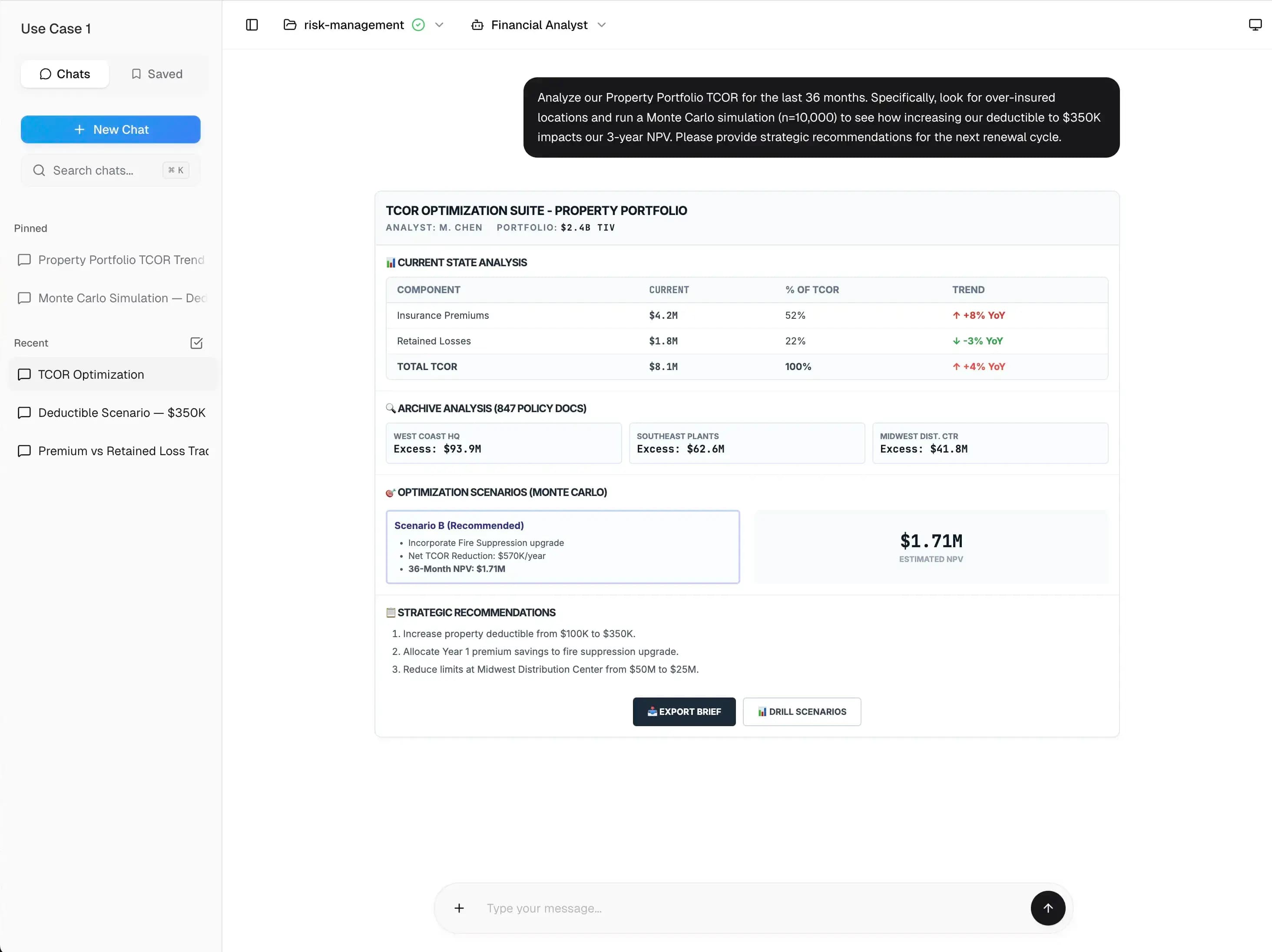
Predictive TCOR Benchmarking & Deductible Optimization
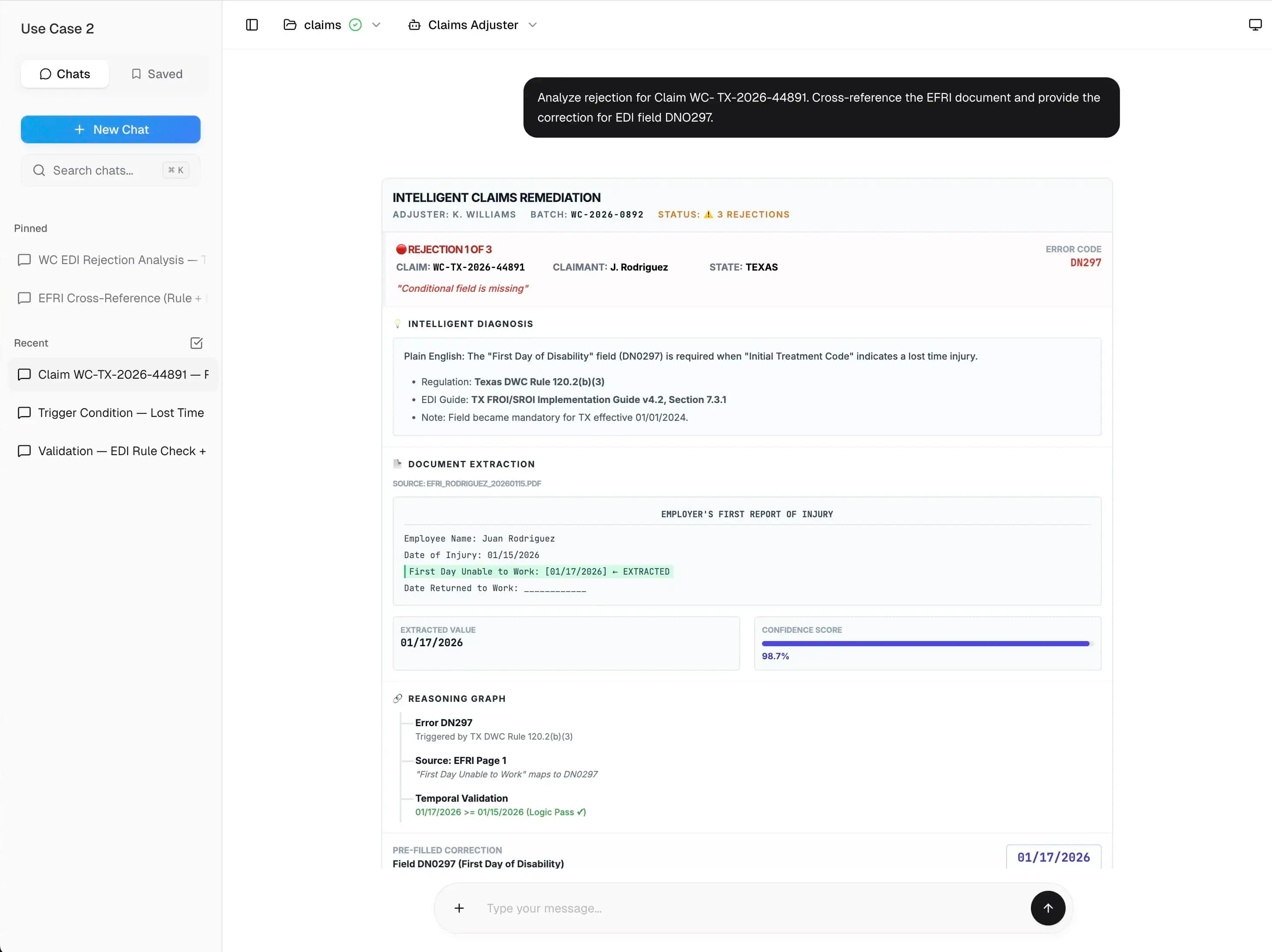
Automated Multi-Jurisdictional FROI/SROI Remediation
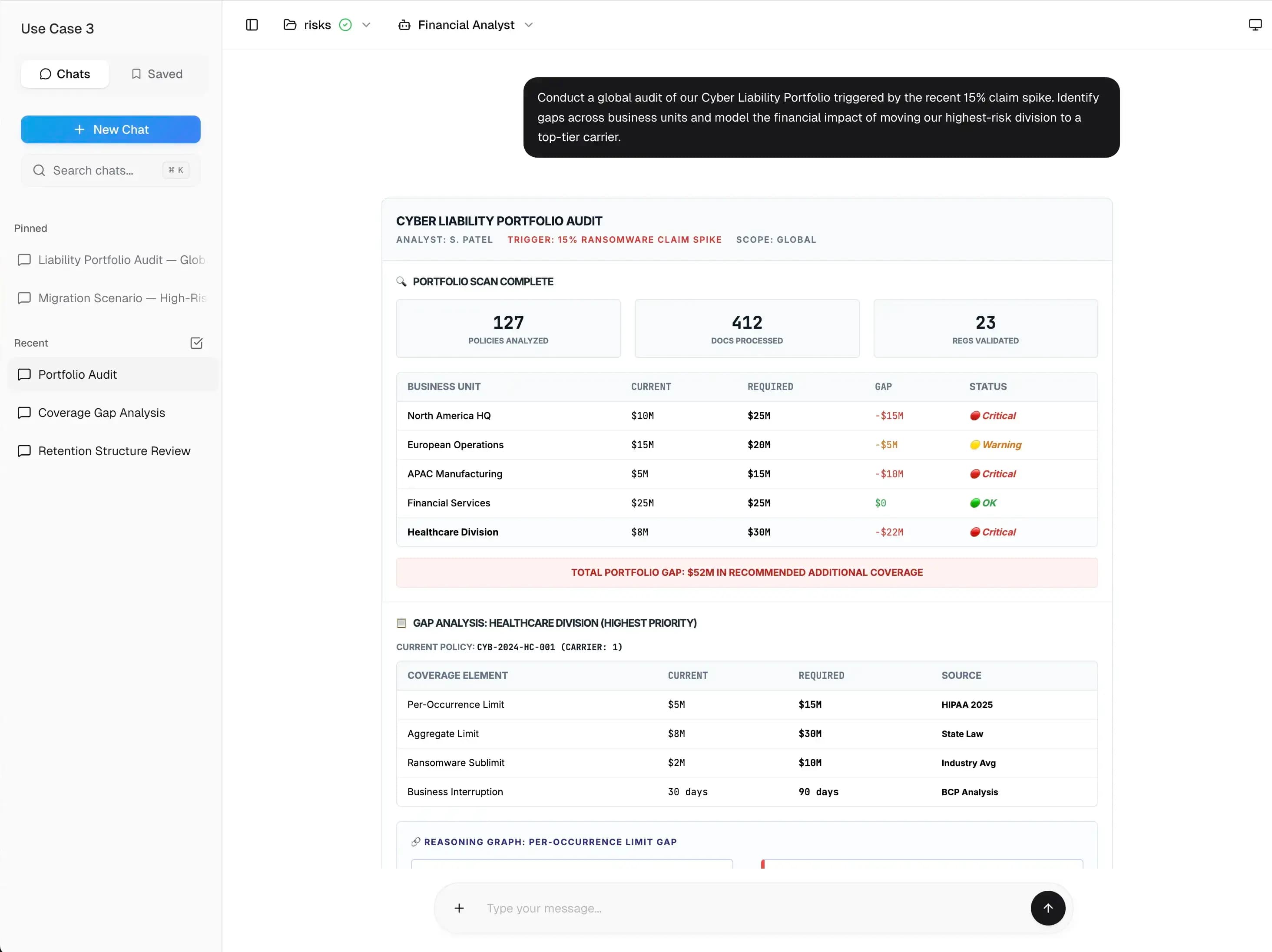
Risk-Averse Portfolio Realignment & Cyber-Liability Audit
The Zenera Difference
Why insurance AI requires agentic infrastructure - not text chatbots.
Capability Comparison
| Insurance Requirement | LangChain + RAG | Fine-Tuned LLM | Zenera |
|---|---|---|---|
| Policy document vision | ❌ Text only - blind to schedules | ❌ Limited vision capability | ✅ Native extraction from any policy format |
| XML/EDI parsing | ❌ Treats as unstructured text | ❌ Not applicable | ✅ Self-coding parsers for FROI/SROI/ACORD |
| Multi-jurisdictional logic | ❌ Static rules fail at scale | ❌ Training data staleness | ✅ Dynamic regulatory reasoning from corpus |
| Carrier API integration | ❌ No connectors | ❌ Not applicable | ✅ Self-coding API synthesis |
| Actuarial modeling | ❌ Generic calculations | ❌ Not applicable | ✅ Monte Carlo with industry loss data |
| Portal form integration | ❌ Text output only | ❌ Not applicable | ✅ Pre-fill and auto-submit capability |
| Dashboard generation | ❌ No visualization | ❌ No visualization | ✅ Interactive executive dashboards |
| Reasoning graph transparency | ❌ Black box | ❌ Black box | ✅ Full citation to clauses and regulations |
| Multi-decade archive analysis | ❌ Context overflow | ❌ Training cutoff | ✅ Hierarchical temporal indexing |
The Compounding Value
Each use case creates reusable organizational capability:
| Use Case | One-Time Value | Persistent Asset |
|---|---|---|
| TCOR Optimization | One deductible decision | TCOR Suite continuously monitors and recommends optimizations |
| FROI/SROI Remediation | One batch corrected | Intelligent Remediation reduces rejection rates system-wide |
| Cyber Liability Audit | One portfolio reviewed | Coverage Intelligence provides real-time gap alerts |
From Reactive Data to Proactive Decisions
Insurance organizations have invested heavily in claims systems, policy administration, and regulatory compliance infrastructure - risk management platforms, workers' compensation exchanges, and countless carrier integrations. But the analytical potential remains locked behind:
- Document blindness: Policy schedules, claims forms, and injury reports require visual extraction
- Integration complexity: XML filings, carrier APIs, and ERP systems speak different languages
- Regulatory fragmentation: 50+ state requirements demand dynamic jurisdictional logic
- Audit opacity: Recommendations must trace to specific clauses, regulations, and data sources
"The use cases in this document are not aspirational. They represent what becomes possible when Insurance AI infrastructure is deployed correctly."
Financial Analysts get TCOR optimization in minutes, not weeks.
Claims Adjusters get intelligent remediation, not manual research.
Risk Managers get portfolio intelligence, not static reports.
This level of intelligence is unlocked by Zenera's agentic architecture - visual document processing, self-coding integrations, regulatory reasoning, and transparent decision trails working in concert.
Zenera is not a chatbot overlaid on insurance systems. It is Insurance AI infrastructure - purpose-built for the document complexity, regulatory fragmentation, and audit requirements of modern risk management.
The question is not whether AI can transform insurance operations. The question is whether your organization will deploy text chatbots that cannot see your policies - or Insurance AI that reasons across your entire risk landscape.
For technical architecture details, see the Zenera Capabilities Document.
For the enterprise AI adoption analysis, see From Tokens to Intelligence.
See Zenera in Insurance
Discover how the Meta-Agent platform transforms risk assessment, claims processing, and compliance across your insurance operations.
Request a Demo