
Zenera in Network Security Operations
Intelligent Assist for Broadcom Security Services Platform
Executive Summary
Network security operations teams face an impossible challenge: managing increasingly sophisticated threats across complex, distributed infrastructure - while documentation spans thousands of pages and platform APIs expose hundreds of methods. Security analysts spend more time searching documentation and writing scripts than actually defending the network.
Intelligent Assist, powered by Zenera, transforms this operational model. By combining intelligent knowledge retrieval with real-time code generation and live system correlation, it delivers instant answers and automated remediation - turning hours of manual work into seconds of natural language interaction.
"Production Results: Security teams report 100x productivity gains on routine operations - from policy cleanup scripts that previously took weeks completed in minutes, to troubleshooting workflows that compress multi-hour investigations into single queries."
How Intelligent Assist Works
Unlike simple chatbots that only retrieve documents, Intelligent Assist combines three deeply integrated capabilities:
| Capability | Description |
|---|---|
| Knowledge-Grounded Q&A | Deep index of KB articles, reference designs, and official documentation - with version-aware retrieval tailored to the customer's environment |
| Real-Time API Code Generation | Understands 100-1000+ API methods per platform; translates natural language into validated Shell, Python, Ansible, or Terraform incorporating best-practice patterns |
| Live System Interrogation | Queries live telemetry, logs, and configuration state; correlates symptoms across infrastructure layers to identify root causes and guide remediation |
"Security teams don't work in documentation portals. They work at the intersection of live infrastructure, evolving threats, and complex APIs. Intelligent Assist reasons natively across all three."
Why Traditional Approaches Fail in Security Operations
| Challenge | Simple Chatbot / RAG Reality | Zenera Intelligent Assist |
|---|---|---|
| Version-specific guidance | Generic answers; ignores environment version | Version-aware retrieval scoped to customer's exact software release |
| 100-1000+ API methods | Cannot reason over full API surface | Comprehends complete API documentation; generates validated, tested code |
| Live system correlation | Static answers from documentation only | Direct telemetry access; cross-layer correlation in real time |
| Script generation | Code snippets without error handling or best practices | Validated automation with rate limiting, logging, and dependency ordering |
| Multi-layer troubleshooting | Single-source answers; misses cross-layer root causes | Correlates 700+ telemetry points across virtual service, pool, network, and SE layers |
| Threat triage | Retrieves documents; cannot correlate with environment topology | Synthesizes threat intelligence with live topology and version-specific guidance |
Use Cases
These use cases demonstrate how Zenera's agentic architecture transforms hours of manual work into minutes or seconds of intelligent assistance across vDefend (firewall) and AVI (load balancer) operations.
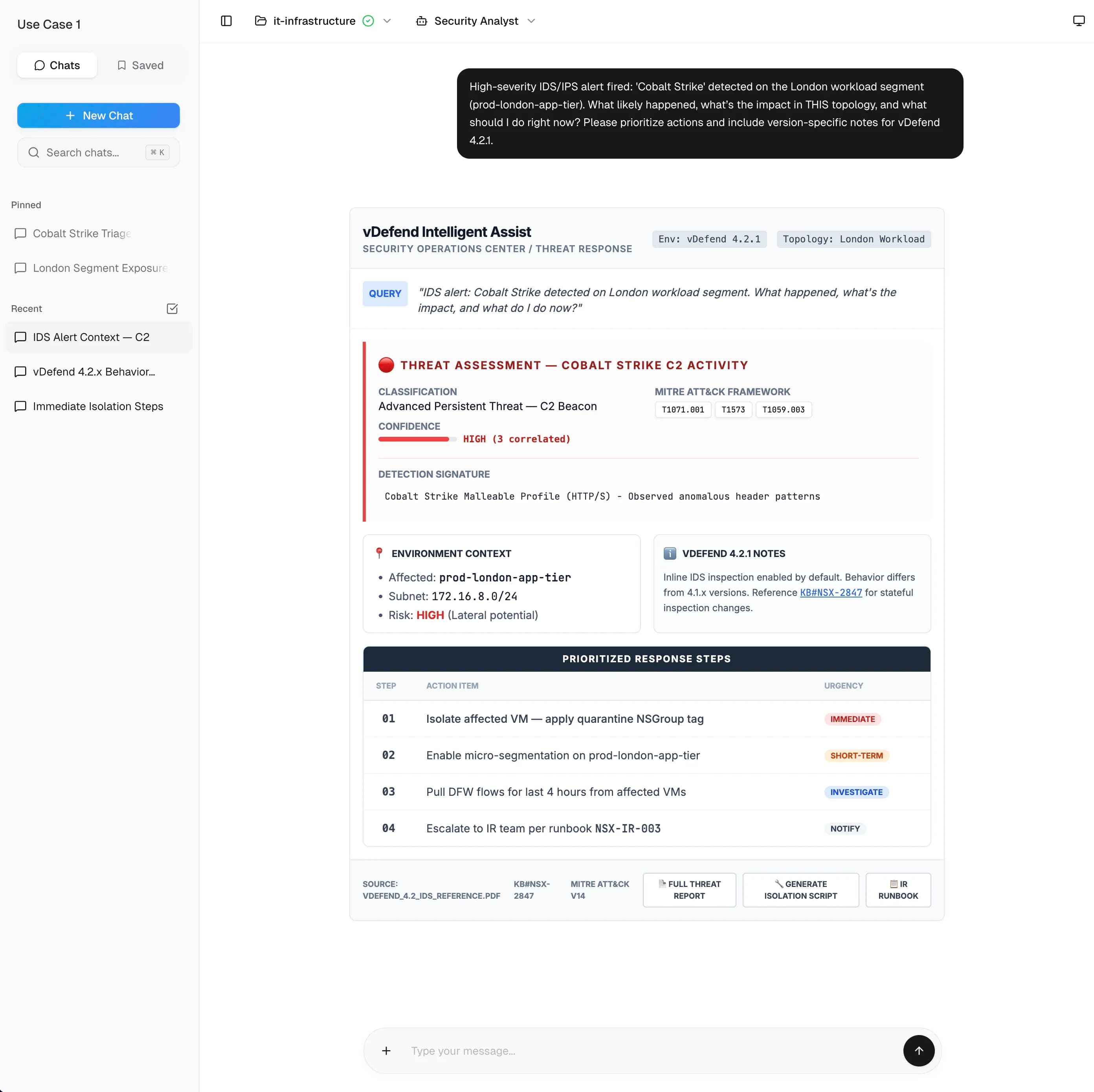
Knowledge Assist - Triage of Sophisticated Threat Alerts
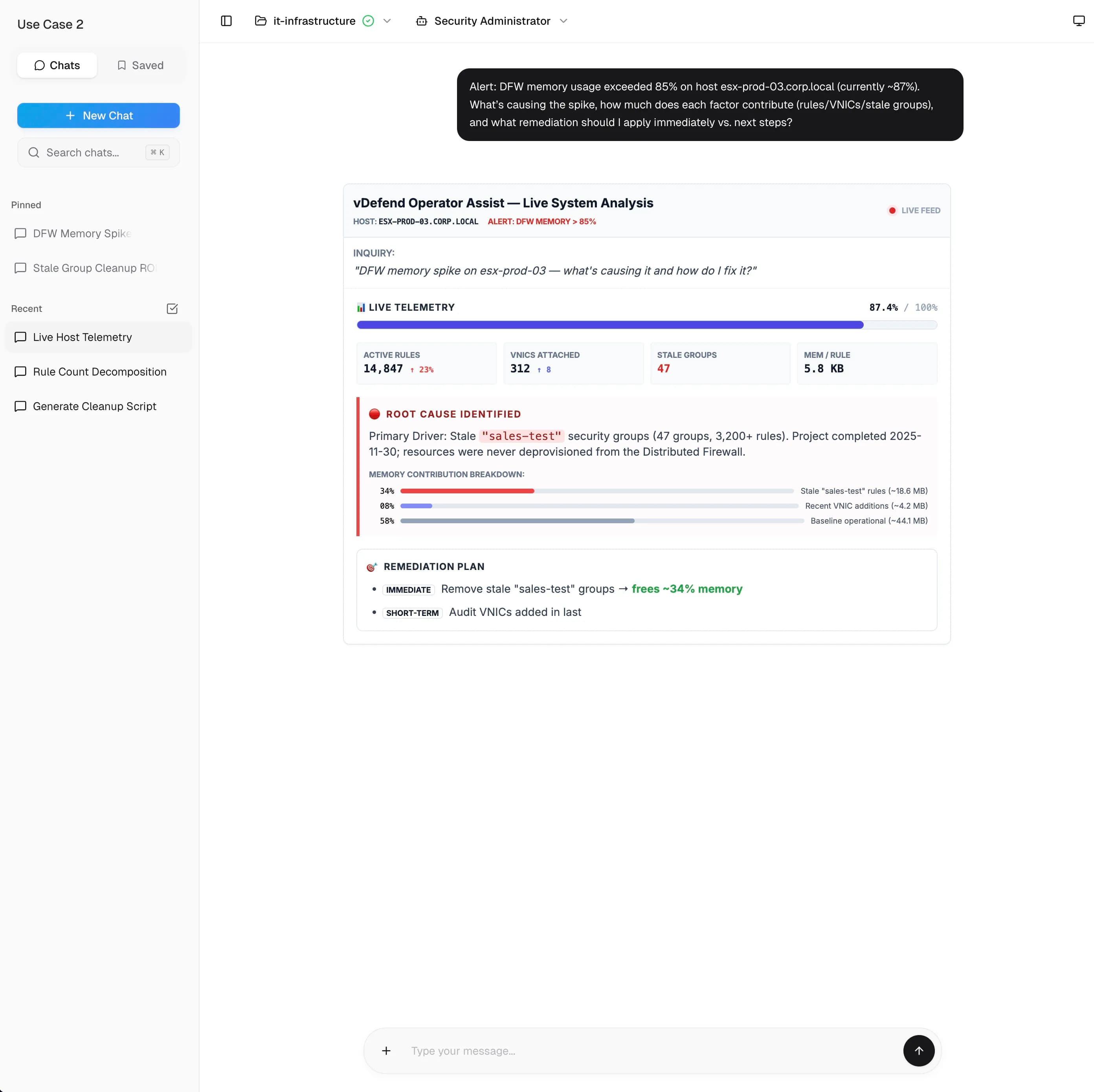
Operator Assist - Real-Time Remediation of Resource Anomalies
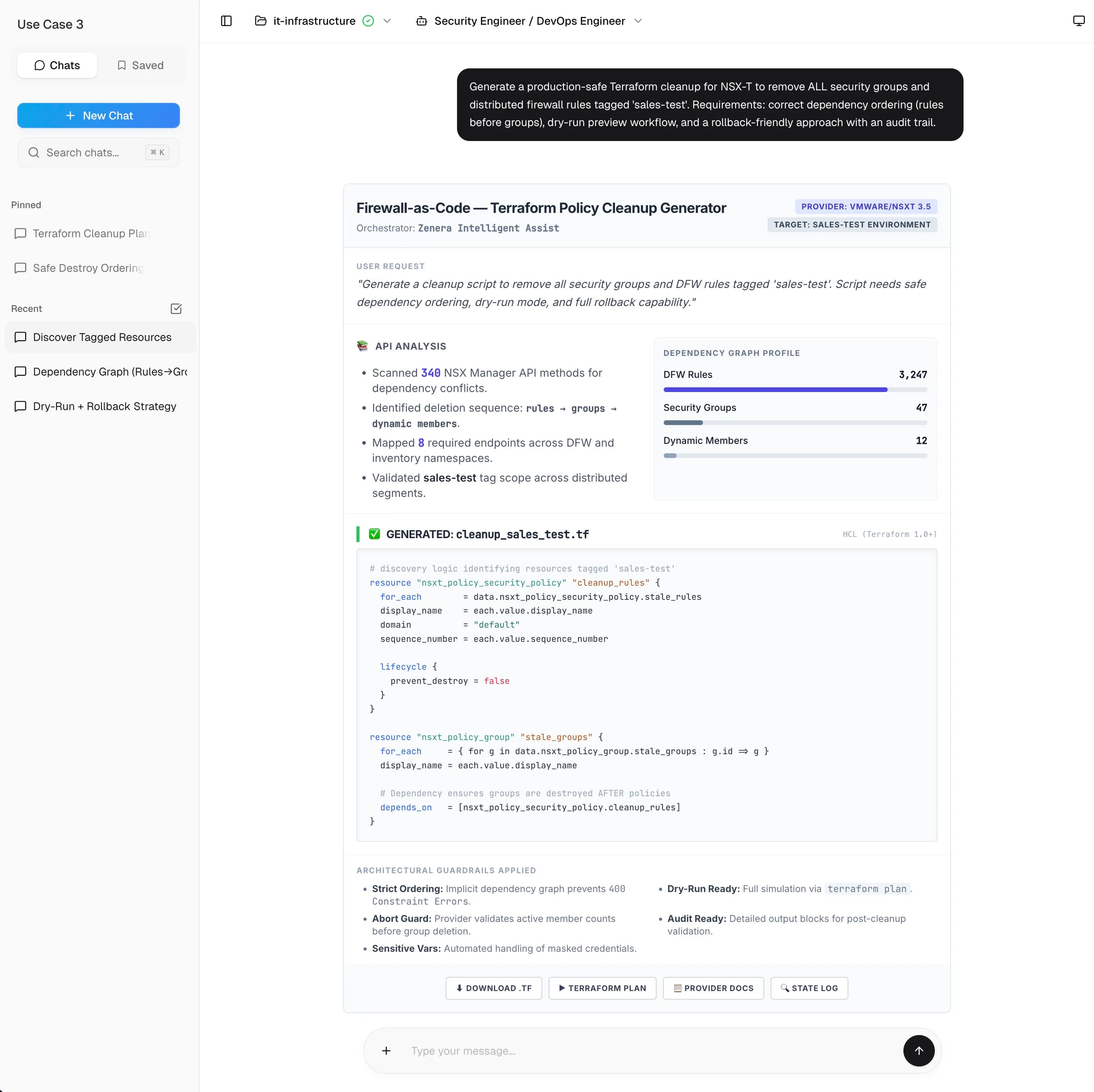
Firewall-as-Code - Automated Policy Cleanup
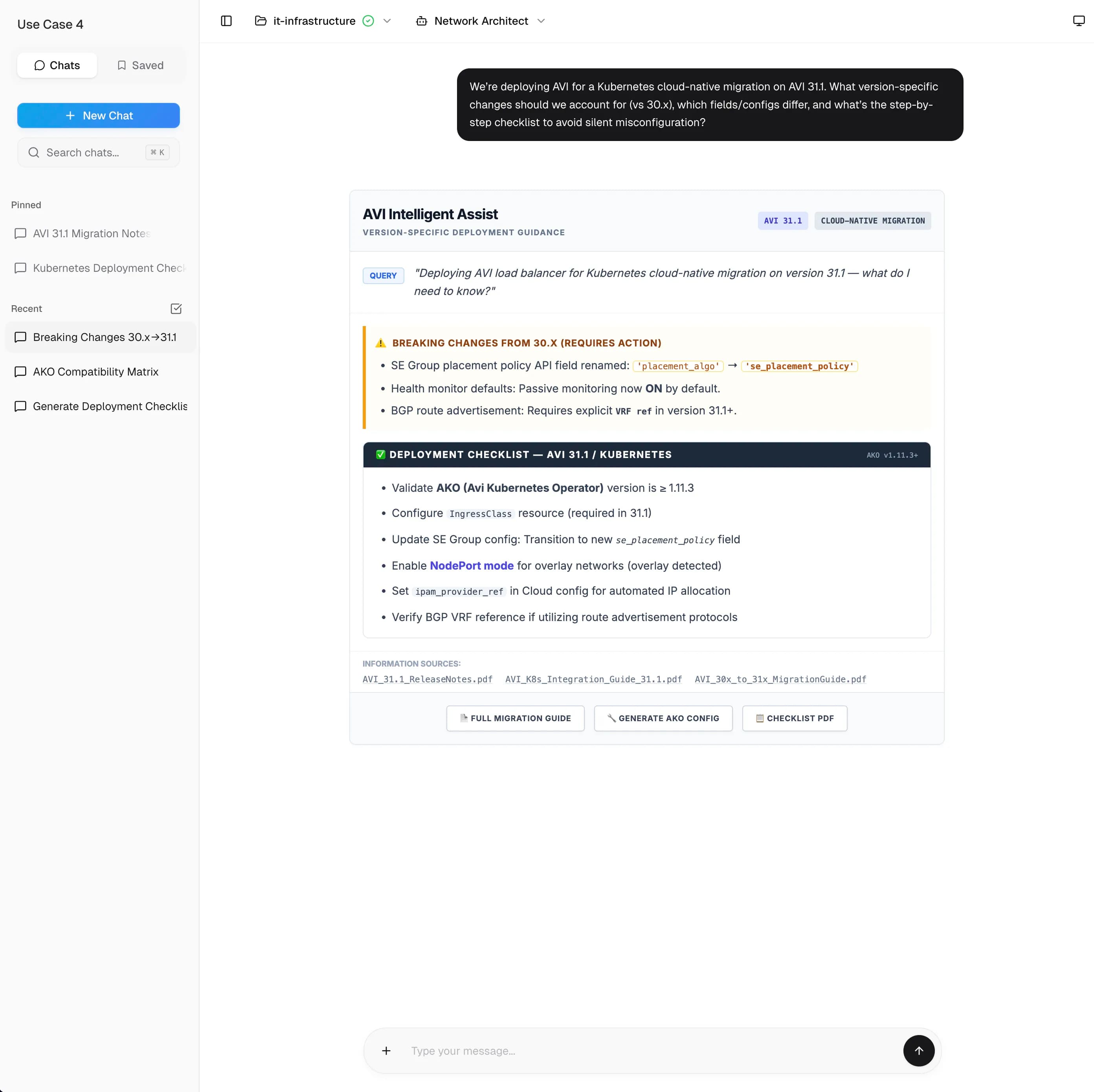
Knowledge Insights - Version-Specific Deployment Guidance
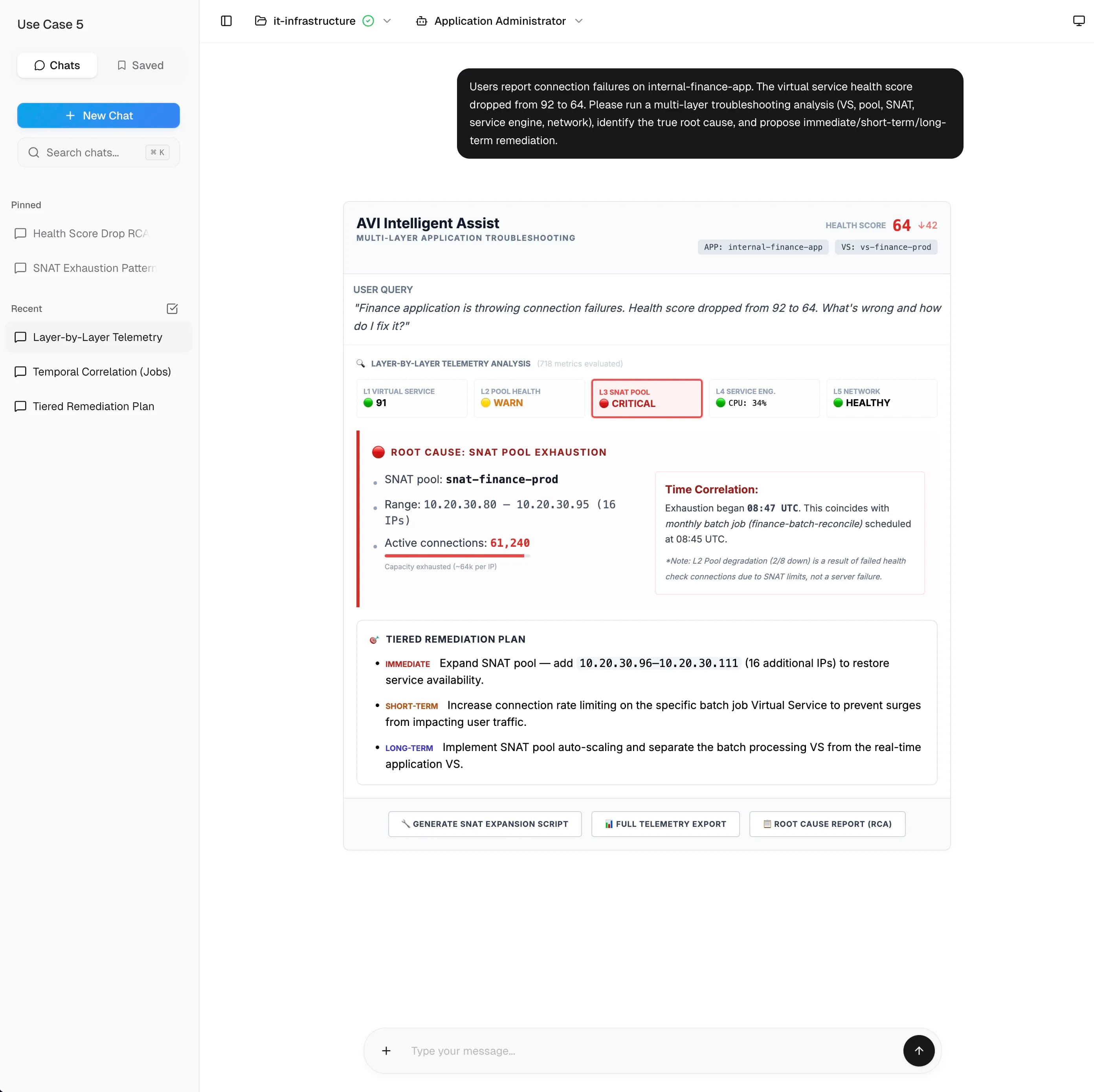
Assisted Troubleshooting - Root Cause Analysis for Application Failures
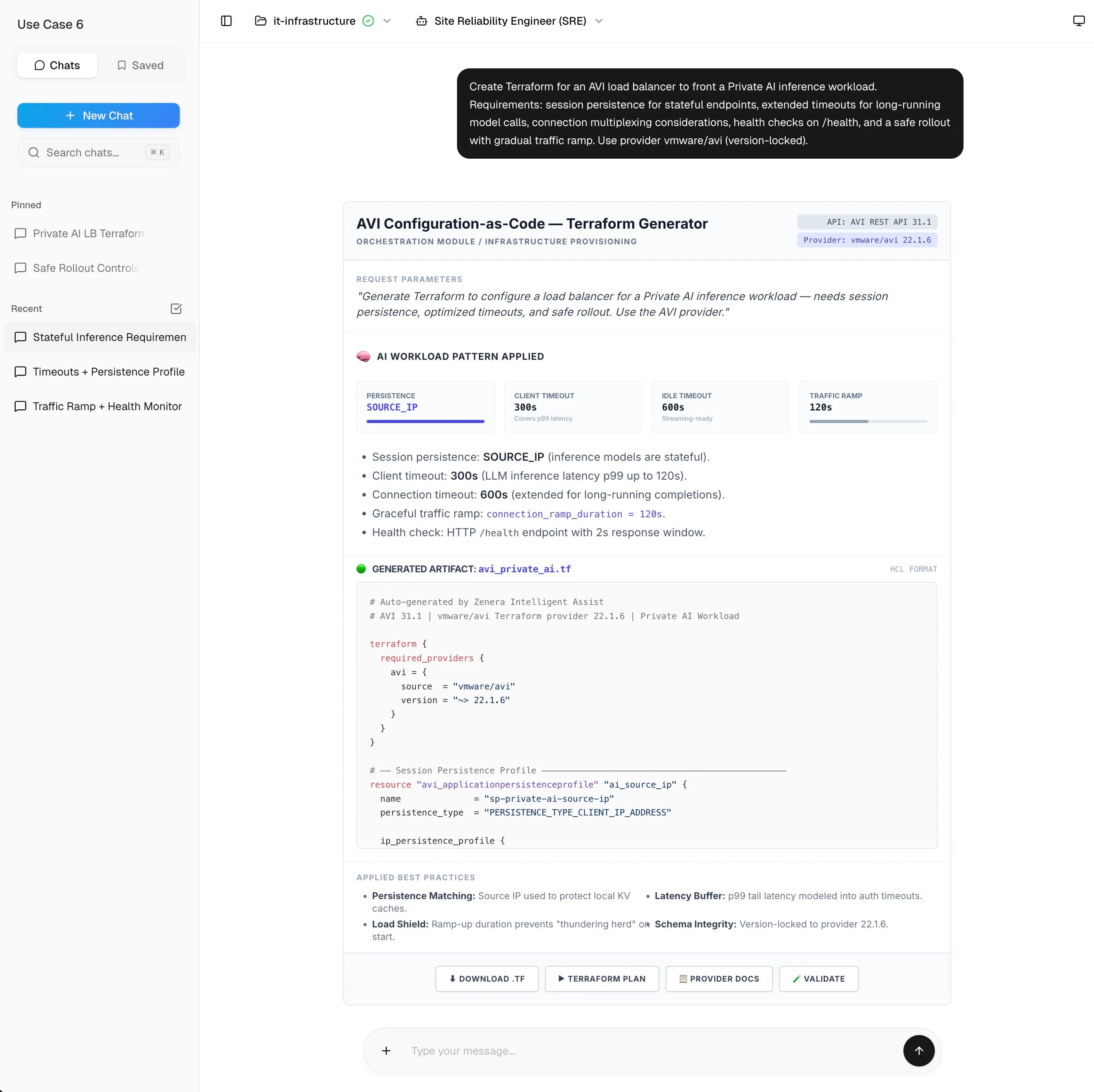
Configuration-as-Code - Terraform Deployment for AI Workloads
Production Impact Summary
| Use Case | Traditional Time | With Intelligent Assist | Improvement |
|---|---|---|---|
| Threat alert triage | 30-60 minutes | 30 seconds | 60-120x |
| Performance root cause | 2-4 hours | 45 seconds | 160-320x |
| Terraform policy cleanup | 1-2 weeks | 2 minutes | 500-1000x |
| Version-specific guidance | 30+ minutes | 15 seconds | 120x |
| Multi-layer troubleshooting | 2-4 hours | 1 minute | 120-240x |
| Terraform config generation | 2-3 days | 3 minutes | 400-700x |
~100x
aggregate productivity gain across routine security operations
Why This Works: Zenera's Approach
Intelligent Assist delivers these results through three deeply integrated capabilities that no simpler system can replicate:
| Capability | What It Delivers |
|---|---|
| Deep Knowledge Integration | Comprehensive ingestion of official documentation, KBs, and reference architectures - with version-aware retrieval that ensures guidance matches the customer's actual environment. Continuously updated as documentation evolves. |
| Real-Time Code Generation | Comprehension of 100-1000+ API methods and data types per platform. Generated code follows best practices, includes proper error handling, and is validated against current API schemas to prevent runtime failures. |
| Live System Correlation | Direct telemetry access provides real-time infrastructure visibility. Cross-layer correlation identifies root causes that span infrastructure boundaries. Context-aware responses incorporate actual system state - not just documentation. |
The Compounding Value
Each Intelligent Assist deployment creates reusable operational intelligence:
- Threat triage responses become standing runbooks linked to your environment topology
- Policy cleanup scripts become lifecycle management automation that runs on schedule
- Troubleshooting analysis becomes automated health monitoring with pre-built remediation workflows
- Configuration automation becomes a library of validated deployment patterns for new workloads
Traditional tools produce answers. Intelligent Assist produces capabilities.
Conclusion
Security operations teams are overwhelmed by sophisticated threats, complex distributed infrastructure, and documentation spanning thousands of pages. Traditional approaches - manual log analysis, documentation searches, custom scripting - don't scale to the pace of modern threats or the complexity of modern infrastructure.
Intelligent Assist transforms this model across three dimensions:
- Knowledge that finds you: Relevant, version-aware guidance surfaced instantly - without documentation searches
- Code that writes itself: Validated automation scripts from natural language - without deep API expertise
- Troubleshooting that correlates: Multi-layer root cause analysis in seconds - without manual log parsing
For Broadcom Security Services Platform users, this translates to 100x productivity gains on routine operations - freeing security teams to focus on what matters: defending the enterprise against the threats that actually require human judgment.
*For technical architecture details, see the Zenera Capabilities Document.*
*For the enterprise AI adoption analysis, see From Tokens to Intelligence.*
See Zenera in Network Security Operations
Discover how the Meta-Agent platform transforms threat detection, incident response, and infrastructure management across your IT operations.
Request a Demo