Zenera Logo
Specialized Agents

From General Assistants to Specialized Agentic Systems

How enterprise agents turn broad intelligence into repeatable, governed work through specialized tools, fine-tuning, and smaller models.

A Broad Capability vs. an Operational System

"ChatGPT gives people broad intelligence on demand. A specialized agentic system turns intelligence into repeatable, governed work - and, once fine-tuned, can often run that work on much smaller models."

General-purpose assistants and specialized agents can look almost identical from the outside. Both may have a chat interface, call an LLM, and use tools. But the resemblance ends at the interface.

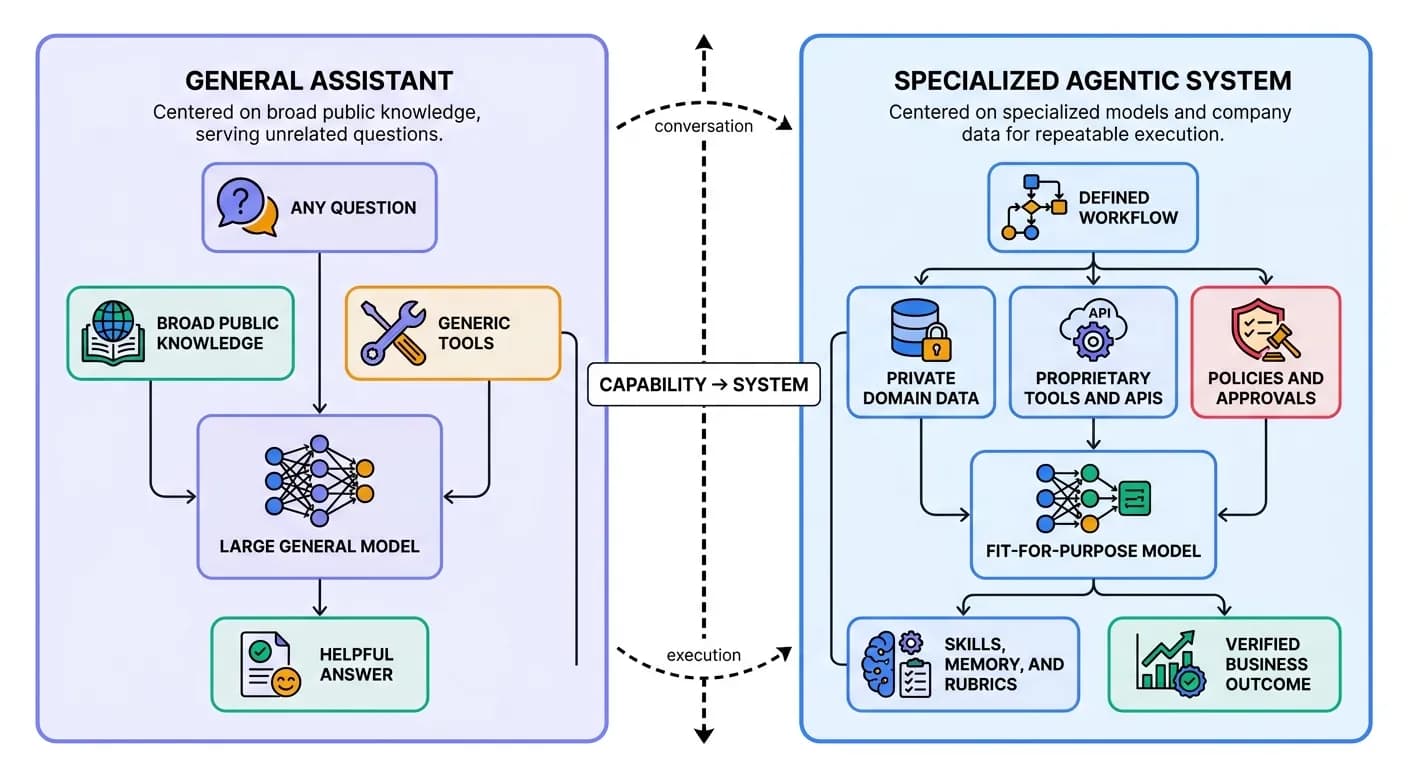
A general assistant is designed to be useful across millions of unrelated questions. A specialized agentic system is engineered to execute a defined workflow inside a particular organization: with its data, APIs, policies, approvals, quality standards, and operational constraints.

That is the central distinction: a general assistant is a broad capability. A specialized agent is an operational system.

General assistant vs. specialized agentic system

General Intelligence Is Not Operational Specialization

General assistants are remarkable because they work on familiar ground. Their tools are common, their knowledge largely reflects public training data, and their target is broad: produce a useful response for the average user.

Specialized agents work under very different conditions:

  • The domain is private and fast-moving. Internal manuals, customer records, product versions, and operating procedures were not in the model's training set.
  • The tools are unfamiliar. The model has never seen the company's internal CLI, proprietary API, database schema, or approval system. It must learn them from precise descriptions and examples.
  • The rules are organization-specific. The agent must know what it may access, which actions require approval, which sources are authoritative, and what must be recorded for audit.
  • Correctness is workflow-specific. A plausible answer is not enough. Success may require calling two systems in parallel, preserving transaction boundaries, escalating an exception, and producing a result in an exact schema.
  • The work must be repeatable. The system must perform reliably across users, sessions, and changing data - not simply produce one impressive response.
DimensionGeneral assistant, such as ChatGPTSpecialized agentic system
Primary goalHelp with many kinds of questionsComplete a defined business workflow
KnowledgeBroad public and conversational knowledgeCurated private documents, schemas, and operational context
ToolsGeneric, familiar tool setProprietary APIs, enterprise systems, sandboxes, and workflows
PoliciesVendor-defined safety and behaviorOrganization-defined permissions, approvals, and governance
MemoryConversation context and user preferencesDurable procedural memory with provenance and expiration
Quality targetHelpful and plausibleRubric-verified, auditable, and repeatable
OptimizationBetter answers across broad use casesHigher task success with fewer calls, tokens, and delays

The model is therefore only one component. Specialization lives in the system around it.

Why Specialized Agents Are Difficult to Build by Hand

An agentic system is software, but much of its source code is prose:

  • System prompts and shared operating rules
  • Skills and reusable procedures
  • Tool descriptions and invocation conditions
  • Memory policies and data retention rules
  • Document and API indexes
  • Agent handoffs, forks, and escalation paths
  • Sandbox, security, and deployment configuration

This prose has no conventional compiler. A path the agent cannot access still reads correctly. Two versions of a policy can drift without producing a merge error. An exception such as "only when necessary" can quietly cancel the rule before it. A tool can be described perfectly and still be missing from the agent that needs it.

Conventional codeAgent instructions
Undefined names fail to compileUnreachable resources fail only during execution
Duplicate definitions are visibleDuplicate policies drift and compete for attention
Conditions evaluate deterministicallyAmbiguous prose is interpreted differently across runs
Profilers expose wasted computationWasteful LLM calls can look like diligence
Unit tests isolate functionsEnd-to-end trajectories reveal interaction failures
"The difficult work is not writing a clever prompt. It is discovering and maintaining a coherent operating policy across hundreds of interacting instructions."

The Meta-Agent Builds the Specialized System

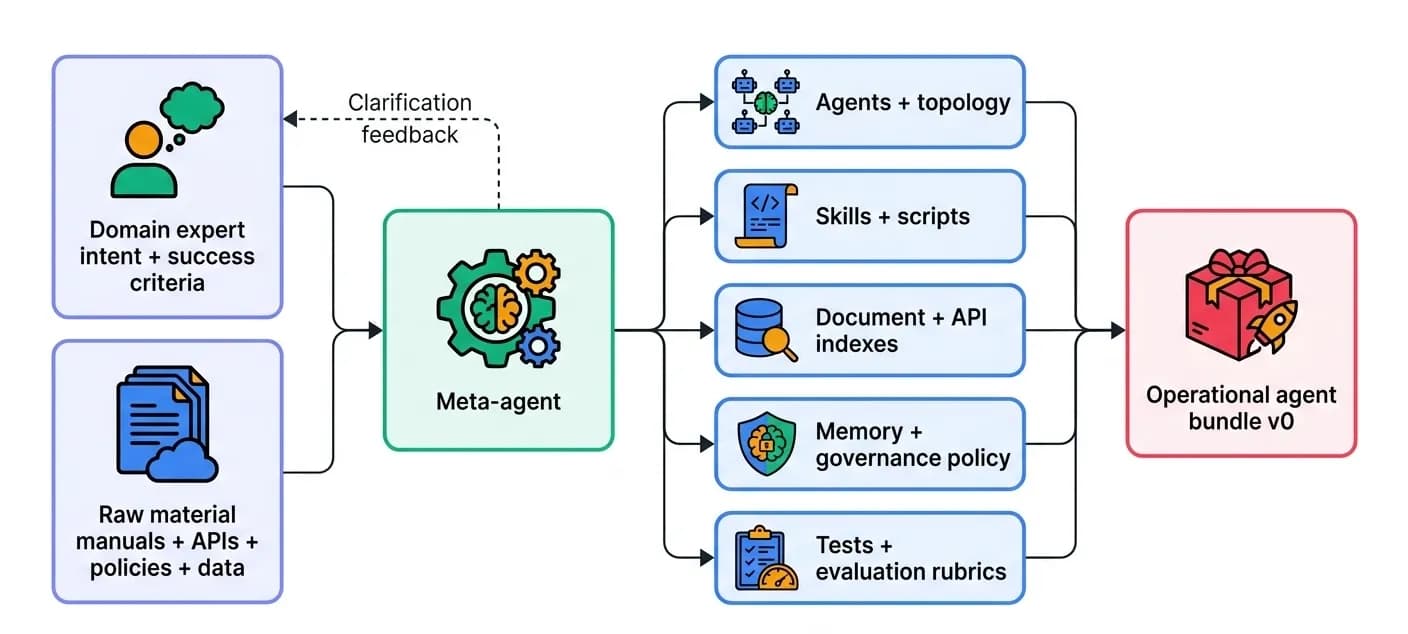
Zenera changes the authoring model. A person defines the intent, domain boundaries, and success conditions. A meta-agent builds and maintains the implementation.

The inputs

  • A plain-language specification describing the system's purpose, agents, permissions, data, and definition of done
  • Raw domain material such as manuals, PDFs, API specifications, internal notes, and sample data
  • Representative cases with rubrics describing both the expected answer and the acceptable execution path

The agent bundle it produces

  • Agents, prompts, roles, handoffs, and tool bindings
  • Searchable document and API indexes
  • Reusable skills and executable scripts
  • Memory rules with provenance and invalidation
  • Sandbox and runtime configuration
  • Evaluation cases and deployment checks

When the source material is incomplete or contradictory, the meta-agent does not silently invent a policy. It returns structured feedback for the domain expert, records the decision, and updates the specification.

The meta-agent builds a specialized agentic system

The first bundle works, but working is not the same as optimized. It may make too many model calls, rediscover the same API on every run, serialize tasks that could execute in parallel, or use an expensive model where a smaller one would succeed. Those issues become visible only through execution.

Fine-Tuning the System, Not Just the Model

In this process, fine-tuning means optimizing the complete agentic harness: prompts, skills, tools, memory, topology, and model selection. Weight fine-tuning may be used, but it is optional. The essential evidence comes from trajectories.

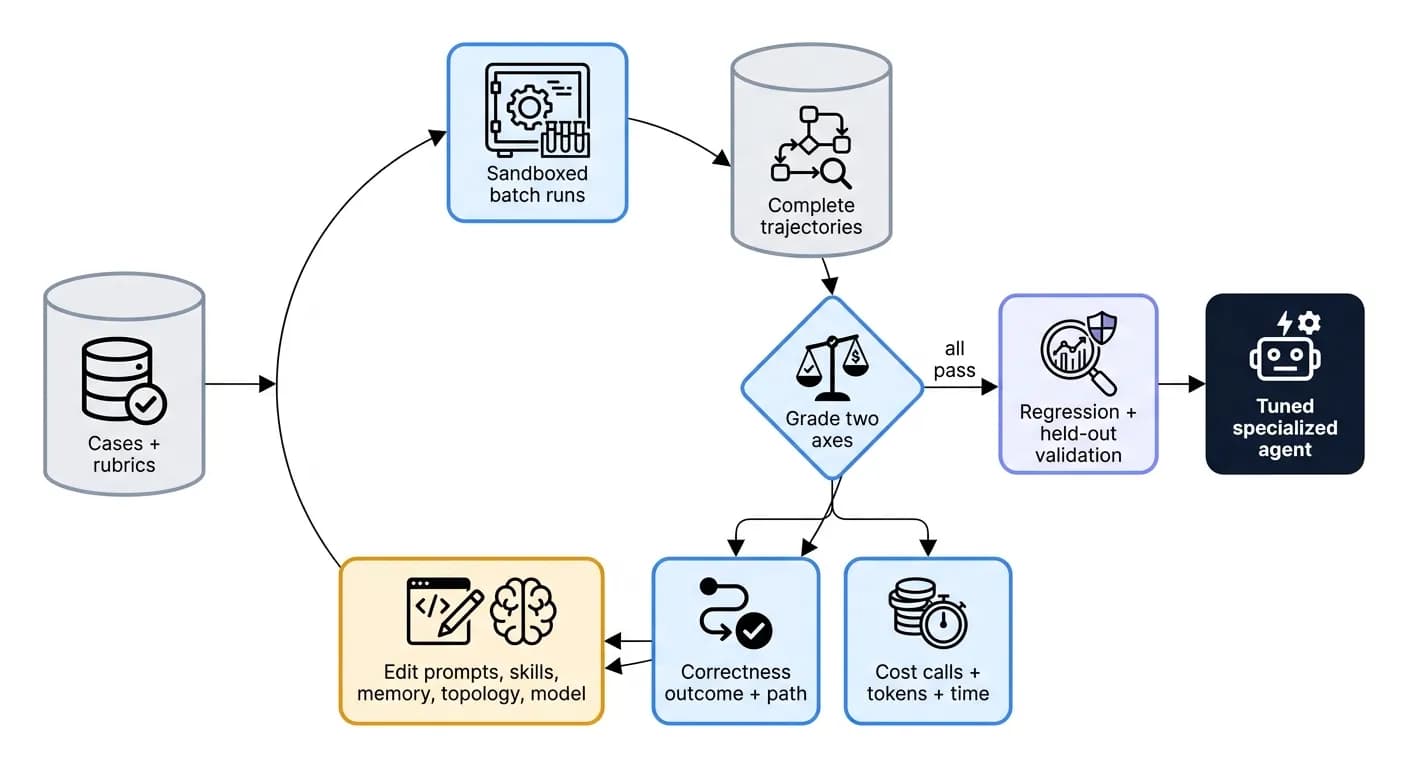
A trajectory records every model call, tool invocation, fork, handoff, memory operation, token, duration, and result. The meta-agent runs a controlled loop:

  1. 1Run a batch of representative cases in isolated sandboxes.
  2. 2Grade both the outcome and the execution path against each rubric.
  3. 3Measure cost: model calls, tokens, repeated discovery, missed parallelism, and latency.
  4. 4Diagnose the instruction, tool description, skill, memory rule, or model choice that caused the defect.
  5. 5Update the bundle and rerun the same cases.
  6. 6Recheck previously passing cases and validate against held-out cases.

A case passes only when the outcome is correct and the execution path contains no unnecessary work.

Circular optimization loop for specialized agents
"This is how tacit expert judgment becomes executable policy. Each failed case contributes a durable improvement to the system instead of another one-off correction in a chat transcript."

Why Fine-Tuned Specialized Agents Can Run on Small Models

Frontier models are valuable when a task is genuinely novel, ambiguous, or reasoning-intensive. But many enterprise workflows become predictable after specialization.

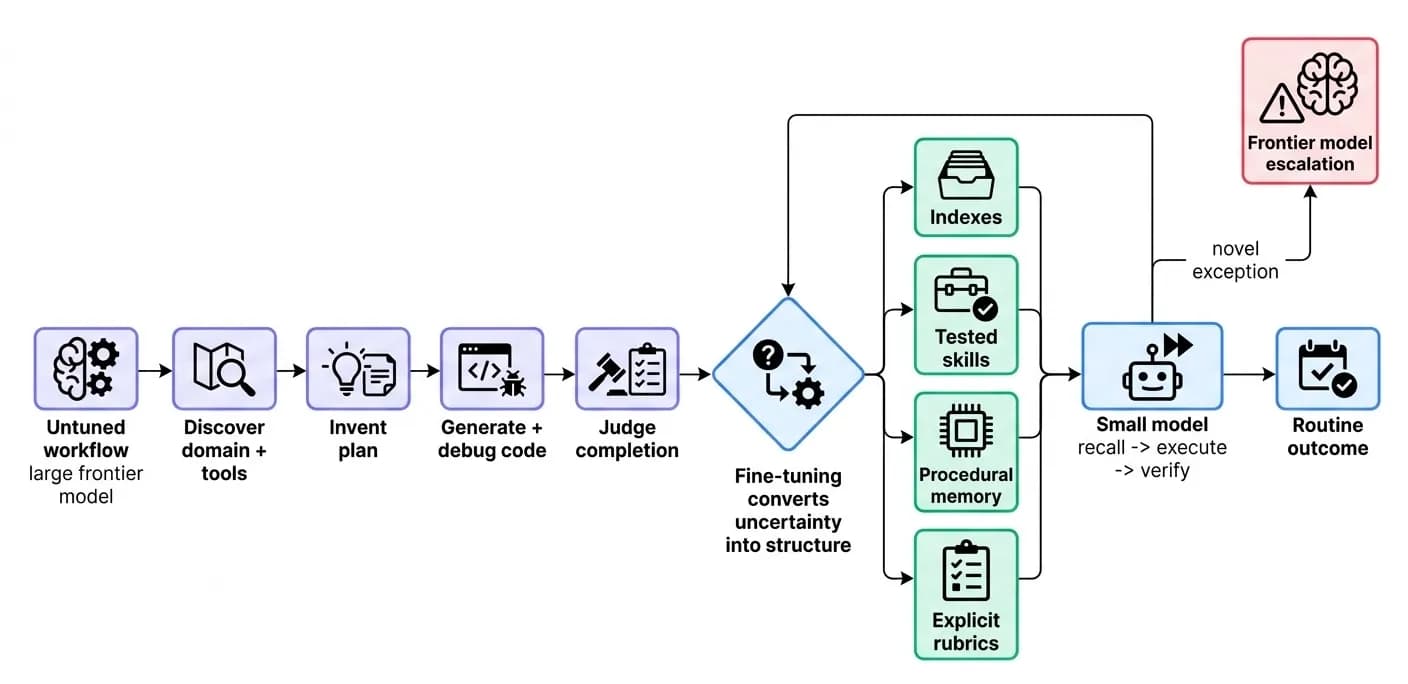
Before tuning, the model must discover the domain, choose among unfamiliar tools, invent a plan, write integration code, debug it, and decide whether the result is complete. That uncertainty rewards a large model. After tuning, much of that reasoning has been converted into infrastructure:

Before tuningAfter tuning, it becomes
API discoveryA searchable schema index
Repeated planningA tested skill
Generated integration codeA parameterized script
Ambiguous judgmentAn explicit policy
Repeated investigationProcedural memory
Open-ended completionA measurable rubric

The model now operates inside a narrower decision space. It retrieves the right procedure, fills parameters, executes tools, checks the result, and escalates only when the case falls outside known boundaries.

That makes small-model execution practical. A compact model can handle frequent, well-bounded workflows at lower cost and latency, while complex or novel cases route to a larger model. Model size becomes a policy decision per step, not a permanent requirement for the whole system.

From frontier-model reasoning to small-model execution

Three advantages

  1. 1Lower operating cost. Routine work consumes fewer tokens on less expensive models.
  2. 2Lower latency. The system skips rediscovery and reduces multi-turn reasoning.
  3. 3Greater deployment freedom. Smaller models can run on private infrastructure, at the edge, or in constrained environments where frontier models are impractical.
"The claim is not that every specialized task belongs on a small model. The claim is stronger and more useful: a tuned agentic system can prove which tasks do not require a large one."

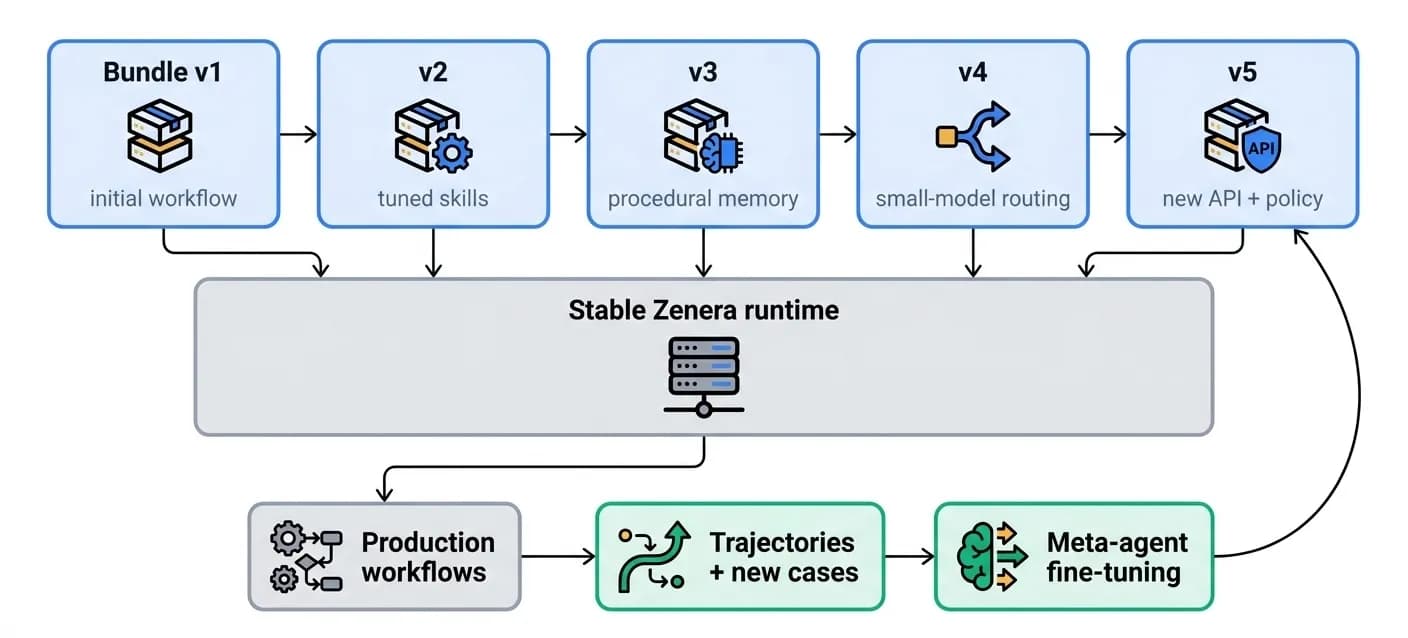
A Stable Runtime and Fast-Moving Agent Bundles

At deployment, Zenera separates the general runtime from specialized behavior.

The runtime - stable infrastructure

Shared across use cases, it provides:

  • Durable agent loop
  • Model adapters
  • Tool execution
  • Sandbox management
  • Retrieval
  • Memory
  • Tracing
  • Security controls

The agent bundle - the behavior

Versioned and specific to each workflow, it carries:

  • Prompts and operating rules
  • Skills and scripts
  • Agent topology and tool bindings
  • Document and API indexes
  • Memory and governance policies
  • Model-routing rules
  • Evaluation and release metadata

Because behavior ships as data, a specialized agent can improve without rebuilding the runtime. New documents, API versions, policies, memories, scripts, and model assignments become versioned bundle updates that can be validated, deployed, and rolled back independently.

Stable runtime and fast-moving agent bundles
"The runtime earns trust by changing slowly. The bundle earns value by improving continuously."

The Strategic Result

The decisive advantage in enterprise AI will not come from giving every employee the same general chatbot. Every organization can access broadly capable models. The advantage comes from converting an organization's private expertise into systems that execute its work reliably.

Specialized agentic systems capture what general assistants do not:

  • How this company defines a correct outcome
  • How its systems must be used together
  • Which shortcuts are prohibited
  • When a human must approve an action
  • What a successful execution teaches the next one
  • Which work can move from a frontier model to a smaller, faster, private model

That knowledge compounds. Every evaluated trajectory can become a better instruction, a reusable skill, a trusted script, a sharper rubric, or a cheaper model route. The system improves while the underlying runtime stays stable.

"General assistants make intelligence available. Specialized agentic systems make it operational. Once an enterprise can build, measure, and fine-tune those systems continuously, AI stops being a conversation layer and becomes an execution layer - one that gets more accurate, faster, and less expensive with every validated run."

Ready to Specialize Your Agents?

See how Zenera's meta-agent builds, measures, and fine-tunes specialized agentic systems on your data, tools, and policies.

Request a Demo