
Design Engineer
Automated Legacy-Informed Design Synthesis & Verification
The Business Problem
A Design Engineer is tasked with creating a valve for a novel cryogenic application. The design must avoid 80 years of documented failure modes, comply with current VBU standards, and pass stress simulation - all while compressing what was traditionally a 6-month research phase into days. The institutional knowledge exists: test reports from the 1940s, manual design guides, legacy PDM files, historical simulation results. But it is scattered across paper archives, PDF scans, SharePoint folders, and multiple CAD systems.
The integration complexity:
- Legacy Archives: 80 years of PDF/paper archives - test reports, design guides, legacy PDM exports - spanning 50,000+ documents
- Engineering Drawings: Thousands of scanned blueprints, assembly drawings, and P&ID diagrams with handwritten annotations requiring visual AI interpretation
- CAD Systems: Real-time bidirectional connection to an enterprise CAD/PDM platform for geometry retrieval, analysis, and design injection
- Visual Artifacts: Failure photographs, weld inspection images, metallurgical analysis micrographs linked to design records
- Simulation Tools: Python-based FEA stress analysis requiring domain-specific code generation
- Security: PBAC enforcement via the enterprise identity provider - engineers see only corpora for their product lines
The analytical complexity:
- Search 80 years of archives to identify every cryogenic stress failure since 1945
- Visually analyze failure photographs and metallurgical images to identify fracture patterns
- Extract material selection patterns that correlated with failures from both text reports and drawing callouts
- Parse legacy blueprints to extract dimensions, tolerances, and design intent from hand-drawn annotations
- Cross-reference current VBU standards with historical test reports and engineering drawings
- Synthesize 3D CAD geometry recommendations grounded in successful designs - not just text descriptions
- Generate annotated engineering drawings showing critical dimensions and GD&T requirements
- Generate simulation code that validates against historical benchmark results
- Compare new design against “best-practice pathways” from internal design guides
Why RAG + LangChain fails:
| Requirement | Failure Mode |
|---|---|
| Blueprint & drawing interpretation | Completely blind - text-only models cannot see engineering drawings |
| Failure photograph analysis | Cannot correlate visual fracture patterns with design features |
| CAD geometry synthesis | Cannot generate or modify 3D models; text output only |
| 50,000+ document reasoning | Context window overflow; retrieval returns irrelevant chunks |
| CAD/PDM integration | No pre-built connector; would require months of custom development |
| FEA code generation | Generic Python; doesn't understand material properties, boundary conditions, or VBU validation criteria |
| Historical failure correlation | Can't join structured CAD metadata to unstructured test reports |
| Standards compliance verification | Text matching misses semantic equivalence; no formal traceability |
How Zenera Solves It
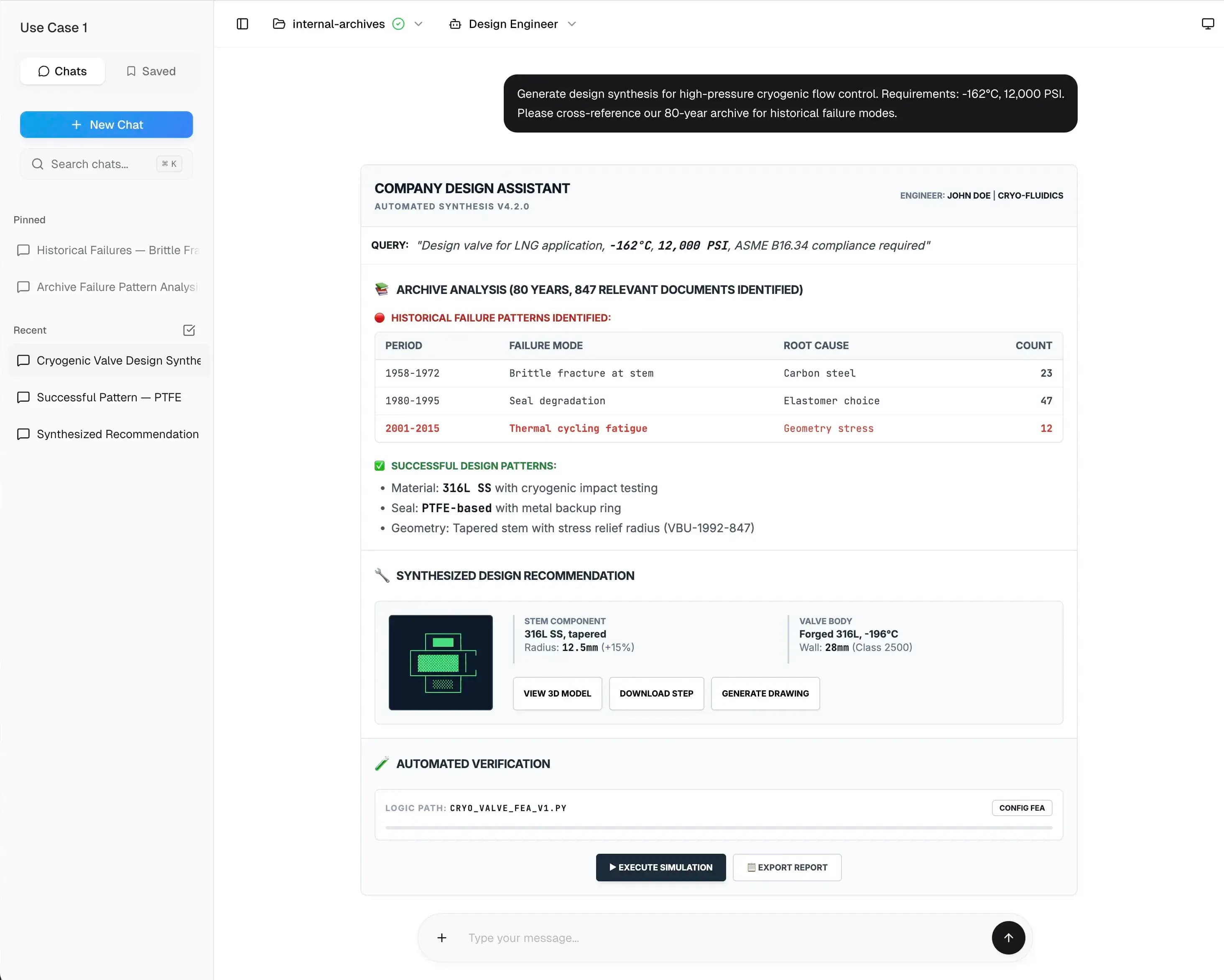
Zenera's agentic execution
- 1Visual corpus ingestion at scale: 50,000+ legacy documents indexed with multimodal parsing - PDFs, scanned blueprints, engineering drawings, CAD metadata, handwritten notes, and failure photographs all processed via vision models
- 2Blueprint and drawing recognition: Agent extracts dimensions, tolerances, material callouts, and GD&T symbols from scanned engineering drawings spanning 80 years of format evolution
- 3Self-coding CAD/PDM integration: Agent analyzes enterprise CAD/PDM API documentation and synthesizes a bidirectional connector for geometry retrieval, modification, and injection
- 4Semantic archive search: Agent constructs multi-hop reasoning queries - cryogenic → low temperature → LNG → brittle fracture - capturing terminology drift across 80 years
- 5Visual failure pattern extraction: Agent analyzes failure photographs and metallurgical images, correlates visual fracture patterns with design features, and joins them to structured CAD metadata within a transactional sandbox
- 6Standards compliance mapping: Agent builds a reasoning graph linking current ASME B16.34 requirements to equivalent historical VBU standards, ensuring selected design patterns satisfy modern compliance
- 7CAD geometry synthesis: Agent generates modified 3D geometry based on successful historical designs and outputs STEP files ready for CAD/PDM import - not just text recommendations
- 8Engineering drawing generation: Agent produces annotated 2D drawings with critical dimensions, GD&T callouts, and revision annotations per VBU drafting standards
- 9Domain-grounded code generation: Agent synthesizes FEA simulation code using
- Physical constants from materials databases
- Boundary conditions from application requirements
- Validation criteria from VBU standards corpus
- Benchmark thresholds from historical test results
- 10PBAC enforcement: All corpus access filtered through the enterprise identity provider - engineer sees only high-pressure cryogenic documents, not unrelated product lines
Time to Validated Design
4 hours (vs. 4-6 months traditional)