
Data Engineering Analyst
Automated Schema Drift Detection & Semantic Layer Alignment
The Business Problem
Following three hospital acquisitions, a Data Analyst must harmonize disparate RCM schemas into a unified reporting layer. Each acquisition uses different denial code taxonomies, date formats, and attribution logic. Schema changes occur monthly without notification.
The integration complexity:
- Documentation: ED data dictionaries (PDF→JSDoc), OpenAPI YAML specs, release notes in GitHub
- Source systems: Three different RCM platforms from multiple enterprise vendors in cloud data lake storage
- Target structure: Unified
cube_etg_provider_monthandcube_etg_clinic_monthcloud analytics warehouse views
The analytical complexity:
- Detect schema drift when source systems change denial code taxonomies
- Reference updated release notes to understand semantic meaning of changes
- Generate new mapping SQL that preserves business logic
- Validate transformations against historical data before deployment
Why RAG + LangChain fails:
| Requirement | Failure Mode |
|---|---|
| Schema monitoring | Cannot detect schema changes in structured data sources |
| Documentation linkage | Cannot correlate schema changes to release note documentation |
| Mapping synthesis | Cannot generate valid SQL transformations |
| Validation | Cannot execute validation queries against the cloud analytics warehouse |
How Zenera Solves It
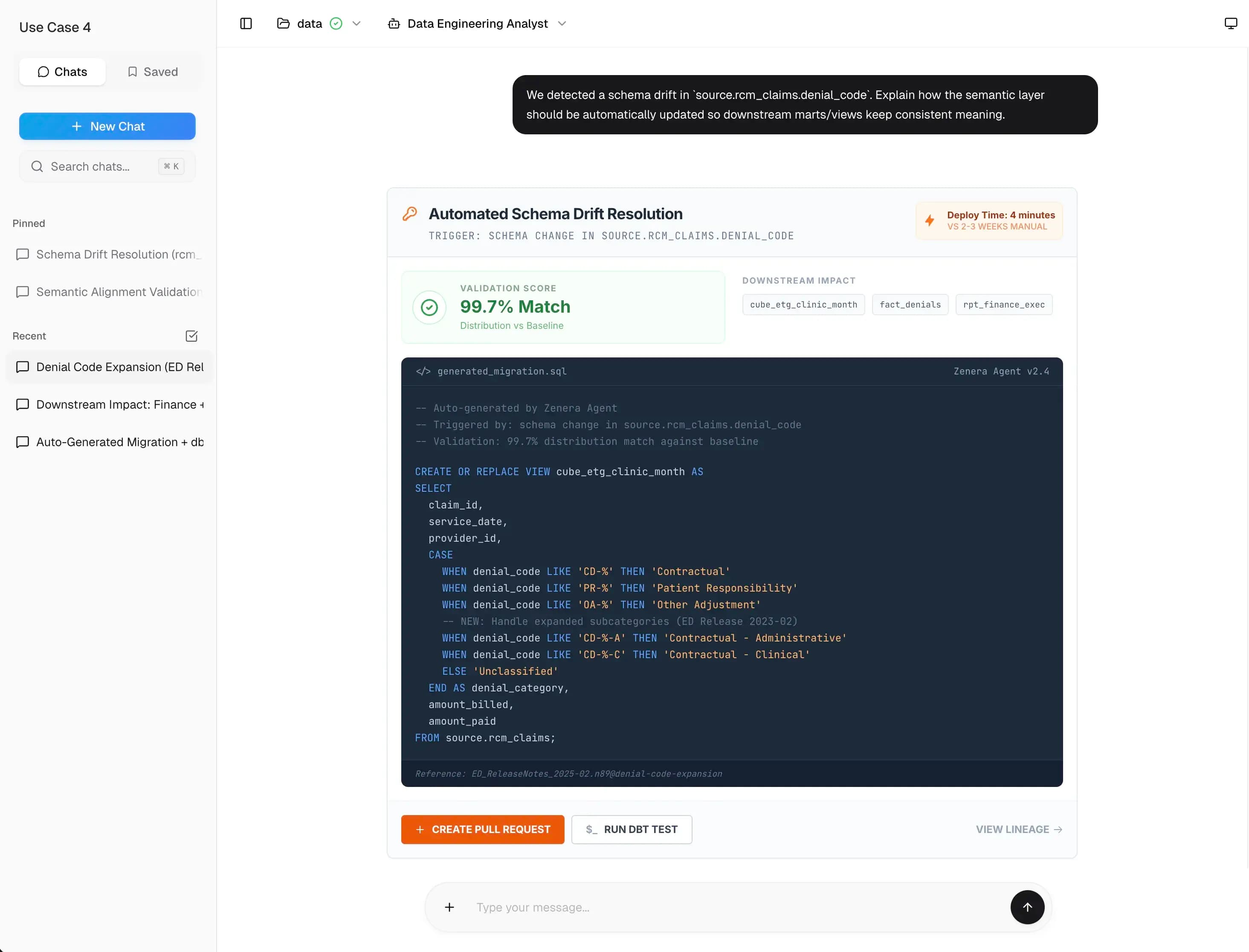
Zenera's agentic execution
- 1Schema monitoring: Agent continuously profiles source RCM schemas, detects when <code>denial_code</code> field changes from VARCHAR(10) to VARCHAR(15)
- 2Release note correlation: Agent searches GitHub for "denial_code" in recent ED release notes, finds documentation of new denial subcategories
- 3Mapping generation: Agent synthesizes SQL transform that maps new denial codes to existing reporting categories, preserving backward compatibility
- 4Validation execution: Agent runs generated SQL against 30-day historical window, compares output distributions to baseline
- 5PR generation: Agent creates GitHub pull request with commented SQL, test results, and documentation links for human review
Time to Deployment
4 minutes from schema change detection to validated PR (vs. 2-3 weeks manual)