
The Rise of Open-Weight Models: Five Lessons We've Learned Building Enterprise AI for Mission-Critical Industries
Only a year ago, enterprise AI strategy revolved around one question: Which foundation model should we choose? Should we standardize on OpenAI? Claude? Gemini? Llama? Today, that question is becoming far less important.
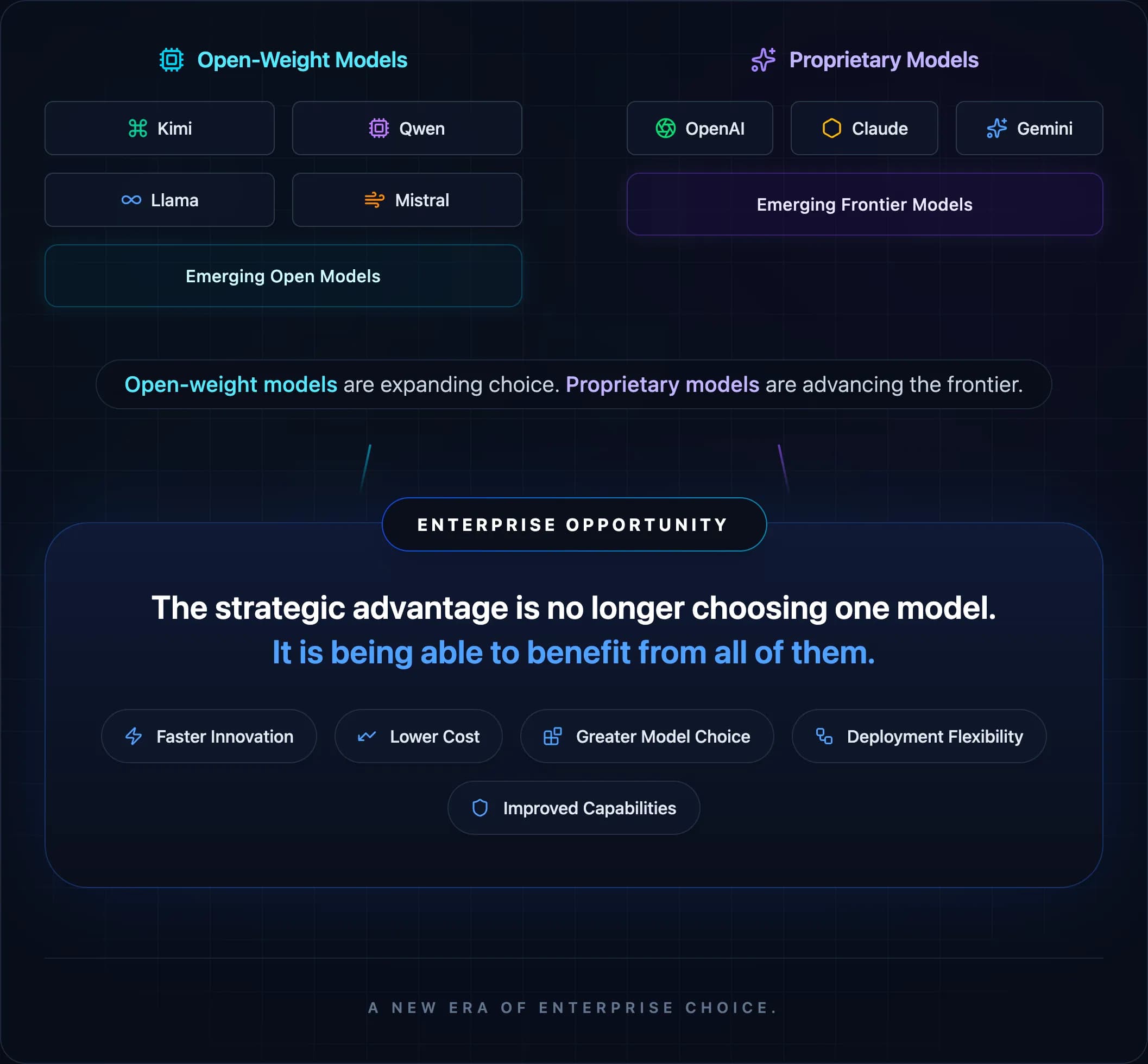
The pace of innovation in artificial intelligence is unlike anything we've seen before. Every few weeks, a new model pushes the boundaries of reasoning, coding, multimodal understanding, or cost efficiency. OpenAI, Anthropic, Google, Meta, Alibaba, Mistral, and, more recently, Moonshot AI with Kimi have all demonstrated that innovation is no longer confined to a handful of providers. Perhaps the biggest story isn't that open-weight models are catching up - it's that both open-weight and proprietary models are evolving at extraordinary speed.
For enterprise leaders, that's very good news (here is the LLM Leaderboard). More competition means faster innovation, lower costs, and greater flexibility. But it also changes how organizations should think about enterprise AI.
The strategic question is no longer:
Which model should we choose?
Instead, it has become:
How do we build enterprise AI systems that continuously benefit from whichever models become the best tomorrow?
That's no longer a model selection problem. It's an enterprise architecture problem.
The AI Race Is Creating Enterprise Choice
Technology history follows a familiar pattern:
- Competition creates innovation.
- Innovation drives commoditization.
- Commoditization shifts value higher in the technology stack.
We've seen this happen with servers, databases, virtualization, and cloud infrastructure. Foundation models are beginning the same transition. Every advance in proprietary models encourages open-weight models to improve. Every breakthrough in open-weight models forces proprietary providers to innovate faster and compete more aggressively on price. Everyone benefits - especially enterprise customers.
As models become increasingly interchangeable, long-term competitive advantage shifts away from the model itself and toward the platform that securely integrates AI into business operations. The organizations that succeed won't necessarily deploy the smartest model. They'll deploy the platform that allows them to continuously adopt the smartest model.
Five Lessons from Building Enterprise AI
Over the past several years, we've worked with organizations across IT Operations, Healthcare, Government, Manufacturing, and Financial Services. Different industries. Different regulations. Different business processes. Yet the same architectural principles consistently determine whether enterprise AI scales successfully.
1. Security Must Be an Architectural Choice
Enterprise AI should run wherever the business requires - on-premises, private cloud, public cloud, edge, or completely air-gapped environments. Supporting both open-weight and proprietary models gives organizations the freedom to choose the deployment architecture that satisfies their security and regulatory requirements, rather than adapting their security policies to a model provider.
2. AI Economics Matter
The most cost-effective AI strategy isn't selecting one model - it's selecting the right model for each workload. Routine, high-volume tasks can leverage efficient open-weight models, while complex reasoning tasks use frontier proprietary models only when they provide measurable business value. This hybrid approach delivers predictable operating costs while maintaining access to the latest AI capabilities.
3. Reliability Comes From the Platform
Foundation models are probabilistic. Enterprise operations cannot be. Reliable enterprise AI requires governance, validation, business rules, observability, auditability, human approvals, and a Model of Constraints that grounds autonomous agents in the enterprise's policies, data relationships, and operational boundaries. Those capabilities belong to the platform - not the model.
4. Flexibility Protects Your Investment
The AI landscape will continue changing. Organizations shouldn't have to redesign business applications every time a better model appears. A model-agnostic platform protects long-term investments by allowing enterprises to adopt new models while preserving existing workflows and user experiences.
5. Your Enterprise Data Is Your Competitive Advantage
Every organization has access to foundation models. No organization has access to your institutional knowledge:
- Your operational procedures.
- Your engineering documentation.
- Your manufacturing processes.
- Your clinical workflows.
- Your financial controls.
Enterprise AI creates the greatest value when it transforms proprietary knowledge into differentiated business capabilities.
Three Architectural Principles Behind the Zenera Platform

As we worked with enterprise customers, one insight became increasingly clear: the biggest challenge wasn't choosing a foundation model. It was building enterprise AI systems that could continuously evolve as models, enterprise systems, and business processes changed around them. That realization shaped the Zenera Platform around three fundamental ideas.
1. Use AI to Build AI
Reliable multi-agent systems are difficult to engineer manually. They require specialized agents, orchestration logic, business rules, governance policies, and continuous refinement. Rather than expecting development teams to build these systems by hand, Zenera introduced the Meta-Agent - an AI-powered systems architect that uses AI to build AI.
Through natural language conversations with enterprise experts, the Meta-Agent designs the multi-agent architecture, generates system instructions, defines collaboration patterns between agents, establishes governance policies, and continuously improves the solution as enterprise requirements evolve. Instead of writing thousands of lines of orchestration code, organizations describe the business problem. The Meta-Agent designs the solution.
2. Build a Model of Constraints from the Enterprise
Every enterprise has a unique digital footprint built over decades - applications, APIs, databases, documents, knowledge repositories, and legacy systems. Together, they define how the enterprise operates: its data, business rules, policies, workflows, and operational constraints. Most AI platforms view these systems simply as data sources to retrieve information. Zenera takes a fundamentally different approach.
The platform dynamically discovers enterprise applications, APIs, schemas, repositories, and business metadata, then generates self-coding connectors that continuously build a Model of Constraints unique to each enterprise deployment. This model goes far beyond integration. It captures the relationships between enterprise data, business processes, operational policies, security boundaries, regulatory requirements, and system dependencies. It defines what autonomous agents are allowed to access, what actions they may perform, and how those actions are validated before execution.
As enterprise systems evolve, the self-coding connectors continuously update the Model of Constraints, ensuring that AI agents always operate using the latest understanding of the enterprise. Rather than relying solely on the probabilistic reasoning of a language model, Zenera grounds autonomous agents in the enterprise's own operational reality - enabling secure, governed, and dependable execution for mission-critical applications.
3. Use AI to Build Dynamic Applications
Employees shouldn't need to know which foundation model or autonomous agent is performing a task - they simply need applications that help them do their jobs. Zenera automatically generates Dynamic Applications tailored to each enterprise workflow. Rather than presenting a generic conversational interface, these applications provide structured forms, dashboards, business workflows, approvals, and visualizations designed specifically for each role and process.
Behind every application, specialized reasoning, planning, integration, validation, and analytics agents collaborate within a governed execution framework. Users experience a single intuitive application; behind the scenes, autonomous agents perform the complexity. This creates a true human-in-the-loop experience where people remain in control while AI handles reasoning, orchestration, and execution.
Together, these three principles allow organizations to adopt both open-weight and proprietary models without rebuilding enterprise applications as technology evolves.
Looking Ahead
The headlines will continue celebrating the latest foundation model. Those breakthroughs matter. But they are not what creates lasting enterprise value. Lasting value comes from platforms that transform rapid AI innovation into secure, governed, mission-critical enterprise applications.
Open-weight models are expanding enterprise choice. Proprietary models continue advancing the frontier. Together they are accelerating a new generation of enterprise AI. The organizations that thrive won't be the ones that guessed which model would win - they'll be the ones that built on a platform capable of benefiting from them all.
That's the future we envisioned when we built Zenera. One platform. Any model. Mission-critical enterprise AI.
#OpenWeightModels #EnterpriseAI #AgenticAI #AIGovernance #AIPlatform #ModelAgnosticAI #ArtificialIntelligence #Zenera