
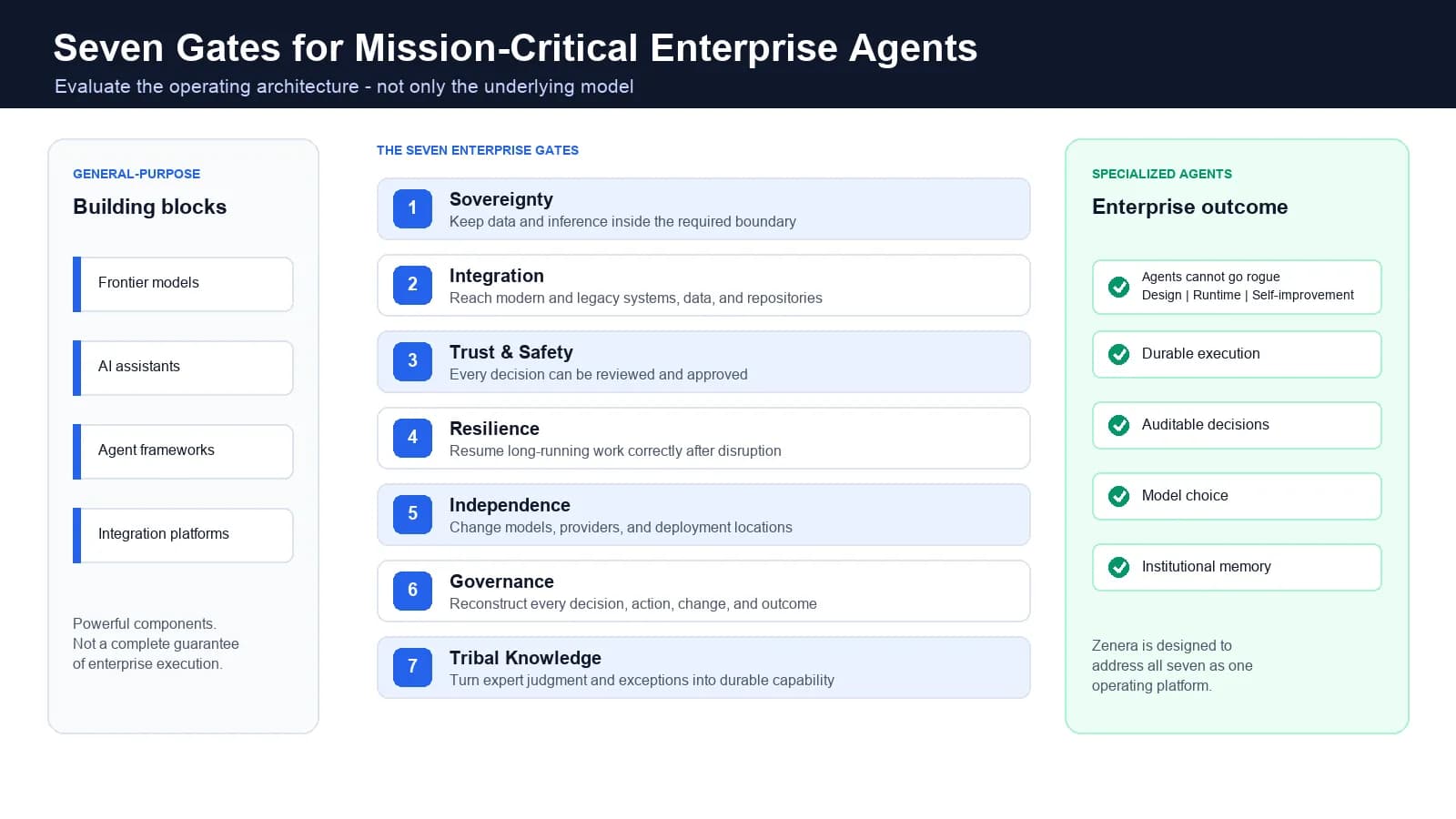
Generic Agents Are Not Enterprise Grade: Seven Gates for Mission-Critical AI
Powerful models and agent frameworks are valuable building blocks. Enterprise autonomy requires an operating architecture that governs how agents integrate, act, recover, improve, and remain accountable.
Reasoning is not the same as reliably finishing the job
General-purpose AI can reason. Enterprise-grade AI must reliably finish the job. That difference matters.
Frontier models from providers such as OpenAI and Anthropic can interpret complex requests, generate content, write code, and reason across unfamiliar material. AI assistants package broad capabilities for users. Agent frameworks help developers assemble tools and workflows. Integration platforms connect applications and automate defined processes. Each category is valuable, and each can contribute to an enterprise solution.
None of those components, by itself, guarantees that an autonomous enterprise process will be safe, durable, governed, portable, and able to work across decades of systems and institutional knowledge. A model may produce an excellent next step without knowing whether the action is authorized. A framework may call tools without guaranteeing recovery after a failure. A connector may reach an application without understanding the organization's local schemas, exceptions, or operating rules.
This distinction becomes critical when AI moves from advising a person to acting inside a business process. Drafting an email is different from changing a customer record. Summarizing a policy is different from approving a claim. Suggesting code is different from deploying it. Once an agent can create real consequences, model capability is only one part of the system that must be evaluated.
The model is a component, not the enterprise system
The market often discusses AI agents as though they were a single category. They are not. A general-purpose model, an assistant product, a developer framework, an integration platform, and a specialized enterprise agent solve different layers of the problem.
General-purpose agents are optimized for breadth. That makes them strong tools for research, drafting, exploration, and low-risk knowledge work. Enterprise operations impose a different standard. An agent trusted to run a consequential workflow must use the right information, remain inside authorized boundaries, survive interruptions, preserve exact process state, explain what happened, and continue to work as models, systems, and personnel change.
The practical question is therefore not whether a model is intelligent enough. It is whether the complete agentic system can satisfy seven enterprise operating requirements: Sovereignty, Integration, Trust and Safety, Resilience, Independence, Governance, and Tribal Knowledge. Sovereignty may depend on the organization and use case. The other six are foundational whenever an agent is trusted to act.

Seven operating requirements separate a generic agent from an enterprise-grade agentic system.
Gate 1: Sovereignty
Can sensitive data stay inside the enterprise boundary when required?
Sovereignty is the ability to control where enterprise data is processed, what infrastructure executes the model, and who can access prompts, context, telemetry, and outputs. For defense, financial services, healthcare, government, and other regulated environments, this may require zero egress, an air-gapped deployment, or operation entirely inside an enterprise-controlled VPC. Other organizations may accept a managed cloud service after reviewing its controls and contractual terms.
The important requirement is deployment choice. A cloud-only agent can be appropriate for many workloads, but it cannot satisfy a requirement that sensitive data never leave a controlled environment. A sovereign architecture must support approved open-weight or privately hosted models without abandoning the operational controls that make the agent dependable.
Zenera is designed to support model and deployment choices, including open-weight models inside an enterprise environment. The purpose is not to assume that every workload needs isolation. It is to ensure that a sovereignty requirement does not force the organization to give up the rest of the agent architecture.
Gate 2: Integration
Can the agent reach legacy systems and repositories, including those without modern APIs?
An agent can only act on the information and systems it can reach. Real enterprises are heterogeneous. Modern SaaS applications sit beside customized ERP systems, mainframes, databases, file shares, repositories, and internal applications whose interfaces may be incomplete, poorly documented, or nonexistent.
Prebuilt connectors and integration platforms are useful, but they do not eliminate the long tail. A connector still has to understand local schemas, custom fields, permissions, business rules, data quality, and failure behavior. When every missing interface becomes a bespoke development project, the agent program inherits the same integration backlog it was intended to overcome.
Zenera uses AI-assisted integration to inspect available metadata, interface descriptions, repository structures, and system behavior, then create the connections required by the specialized agent. The objective is not to bypass enterprise integration discipline. It is to reduce manual discovery and coding while making local systems part of the governed agent workflow.
Gate 3: Trust and Safety
Can every decision be reviewed and approved while ensuring agents cannot go rogue at design time, runtime, or during self-improvement?
A fluent answer is not the same as a safe action. Once an agent can issue a refund, modify a record, trigger a payment, change infrastructure, or communicate a binding decision, trust must be enforced at the action layer. Prompts and model policies contribute to safety, but the enterprise also needs explicit boundaries that remain active throughout the agent lifecycle.
Zenera's System of Constraints defines the specialized job and the conditions under which the agent may operate. It can specify allowed information, permitted actions, transaction limits, required process steps, proof obligations, escalation conditions, and human approval gates. A Meta-Agent challenges and validates the design before release using normal cases, edge cases, and failure scenarios.
At runtime, trajectory checks monitor the agent step by step rather than evaluating only the final output. Important facts, calculations, code, or proposed actions can receive independent proof checks through source reconciliation, deterministic calculation, sandbox execution, or a separate review mechanism. Actions outside approved boundaries can be stopped or escalated.
The same controls must govern improvement. Human corrections should refine performance without silently weakening core safeguards. Material changes need testing, review, versioning, and approval. An agent goes rogue whenever it moves outside approved enterprise intent or authority, even if the model considers its action reasonable.
Gate 4: Resilience
Can a process resume correctly after an outage, timeout, or week-long human delay?
Enterprise work rarely fits inside one chat session. A claim, investigation, onboarding process, procurement cycle, remediation, or reconciliation may require thousands of operations and may pause while waiting for an employee, partner, system, or external event.
That work must survive API timeouts, service restarts, infrastructure failures, unavailable people, expiring credentials, and partial results. Resilience is more than storing conversational history. The platform must preserve exact execution state, completed actions, intermediate data, constraints, approvals, and recovery logic. It must resume safely without duplicating a payment, repeating a side effect, or forgetting a compliance step.
Zenera combines durable Transactional Memory with versioned storage to preserve process state and the context accumulated along the way. The agent can resume a long-running workflow at the correct point after an interruption. Reliable completion becomes an architectural property rather than a hope that the original session remains available.
Gate 5: Independence
Can the enterprise change models, including moving to open-weight models, deployment locations, and providers without rebuilding the workflow?
The model market changes quickly. Quality, latency, price, deployment options, context limits, and provider policies continue to evolve. An enterprise that embeds one model's assumptions throughout its workflow may discover that changing providers requires redesigning the application and revalidating the entire process.
Model independence does not mean that all models behave identically or can be exchanged without testing. It means the workflow, constraints, tests, integrations, and governance remain stable while the enterprise selects and validates the model appropriate for each task. A small local model may be sufficient for extraction. A frontier model may be justified for complex reasoning. A sensitive workload may permit only an approved privately hosted model.
Zenera is LLM-agnostic. Its System of Constraints and controlled refinement process provide a stable operating layer across model and deployment choices. The enterprise can optimize tasks for accuracy, latency, cost, and sovereignty without surrendering the workflow to one model vendor.
Gate 6: Governance
Can every decision, action, change, and outcome be reviewed and audited?
Traditional logs may be sufficient when deterministic software executes a known rule. Agentic work creates a richer chain. The agent retrieves context, chooses a tool, proposes an action, receives an approval or correction, and may use the outcome to improve later behavior. Governance must capture that complete process rather than only the final result.
An enterprise should be able to answer: What did the agent know? Which sources and tools did it use? What action did it propose? Which constraint allowed or blocked it? What checks were performed? Who approved an exception? What changed during refinement? What outcome followed? The record must be reviewable and, where required, retained in a tamper-resistant form.
Zenera records steps, decisions, checks, changes, approvals, and outcomes so users and administrators can reconstruct the workflow. Corrections feed a governed refinement process rather than silently changing production behavior. This creates accountability for the current execution and a controlled path for improving the next one.
Gate 7: Tribal Knowledge
Can the system capture how experts actually work, including exceptions that were never documented?
Some of the most valuable enterprise knowledge is absent from the knowledge base. It lives in the sequence an expert follows when the documented procedure fails, the exception that changes a decision, the warning sign recognized from experience, and the judgment used when information is incomplete. Retrieval can surface what was written down. It does not automatically capture why an expert chose one action over another.
A specialized agent can make that knowledge durable in two complementary ways. First, it captures the enterprise process and uses human review plus governed refinement to identify the right actions, including exceptions. Second, deep integration gives the agent access to historical information embedded in operational and legacy systems. Together, these mechanisms connect expert judgment with the data and process context in which it matters.
Zenera incorporates human corrections into the System of Constraints through a controlled refinement process. As experts review actions, their operational judgment becomes part of the enterprise system. Knowledge remains available when roles change, employees retire, a business is reorganized, or a new owner must understand how work is actually performed.
Why the seven gates must operate as one system
These gates are related. Integration without Trust and Safety gives an agent reach without sufficient control. Governance without Resilience may explain why a process failed but cannot ensure that it finishes. Independence without validation can make model switching operationally dangerous. Tribal Knowledge without governance can turn individual corrections into unreviewed production behavior.
This is why the seven gates are not optional product features assembled from disconnected tools. They are operating requirements for AI trusted to act. The specialized job, integrations, constraints, runtime state, checks, approvals, decision history, and refinements must remain aligned throughout the lifecycle.
Most generic agents and their build frameworks were not designed to satisfy all seven as one operating system. They can still be important components. The architectural mistake is treating the component that reasons as though it were already the complete enterprise system that acts, recovers, proves, and remains accountable.
How to evaluate an enterprise agent
A useful evaluation should begin with the workflow, not a model benchmark. Select a consequential process and ask where its data may be processed, which systems the agent must reach, what actions it may take, which decisions require proof or approval, and what happens when a dependency fails.
Then test continuity. Interrupt the workflow. Delay a human response. Make a system unavailable. Change a permission. Introduce conflicting data. The evaluation should show whether the agent preserves exact state, avoids duplicate side effects, applies the same constraints after recovery, and produces a complete history of the decisions made.
Finally, test change. Replace a model, update a policy, correct the agent's behavior, and introduce a new exception. The enterprise should see how the change is evaluated, who approves it, which scenarios are repeated, how the version is recorded, and whether prior behavior can be reconstructed or restored.
A credible evaluation should produce inspectable artifacts rather than only a successful demonstration. Reviewers should be able to examine the specialized job definition, constraints, integration behavior, validation scenarios, proof results, approval records, recovery state, and change history. Those artifacts show whether the controls are part of the operating architecture or were added as narration around a favorable test.
Operational ownership matters as much as technical performance. The enterprise should identify who owns the workflow, who approves its boundaries, who reviews exceptions, who authorizes model or policy changes, and who responds when execution is stopped. It should also define service expectations for recovery, escalation, audit requests, and the correction of an unsafe or inaccurate behavior. An agent without explicit owners can pass a technical evaluation while remaining unfit for production responsibility.
Cost and speed should be measured at the system level. A less expensive model does not necessarily create a less expensive process if failures require extensive review, integrations remain manual, or every model change triggers a rebuild. The relevant measures include successful process completion, human intervention, recovery effort, verification cost, change effort, and the operational consequence of error.
These tests reveal the difference between an impressive demonstration and an enterprise operating capability. The question is not only whether the agent can complete the happy path. It is whether the system remains dependable when real operations introduce uncertainty, delay, failure, and change.
It is our experience that no agent or agent framework out there satisfy a priori the seven gates.
Zenera: the agentic enterprise system is the product
Zenera does ensure that the seven gates can be satisfied by any systems built on it.
Zenera is designed around these seven gates. Its specialized agents combine AI-assisted integration, a System of Constraints, Meta-Agent validation, human review, durable execution, complete governance, controlled refinement, and model independence to turn enterprise knowledge into reliable action.
General-purpose models remain essential. They provide the reasoning capability that makes modern agents possible. Frameworks, assistants, and integration platforms also remain valuable. Zenera's distinction is the operating architecture that connects those capabilities to the requirements of a consequential enterprise process.
The model is one component. The agentic enterprise system is the product.
Editorial note on product comparisons
Vendor capabilities, deployment terms, and product boundaries change frequently. This article compares architectural categories and enterprise evaluation requirements rather than asserting that every product in a category has identical capabilities. Organizations should validate current data-use terms, hosting options, integration coverage, controls, recovery behavior, auditability, and model portability directly with each provider.