
Closing the Gap - Episode 6 of 8
Deciding where the freed hours go before anyone calls them savings.
The planner who has typed schedule changes into the ERP every morning for eleven years asks the question in the break room, loud enough for the supervisors to hear. If the agent is doing the typing now, and it is building the 6:10 plans before anyone gets in, what exactly is he here for? Nobody answers right away, partly because nobody has decided, and that silence is the real problem this episode is about.

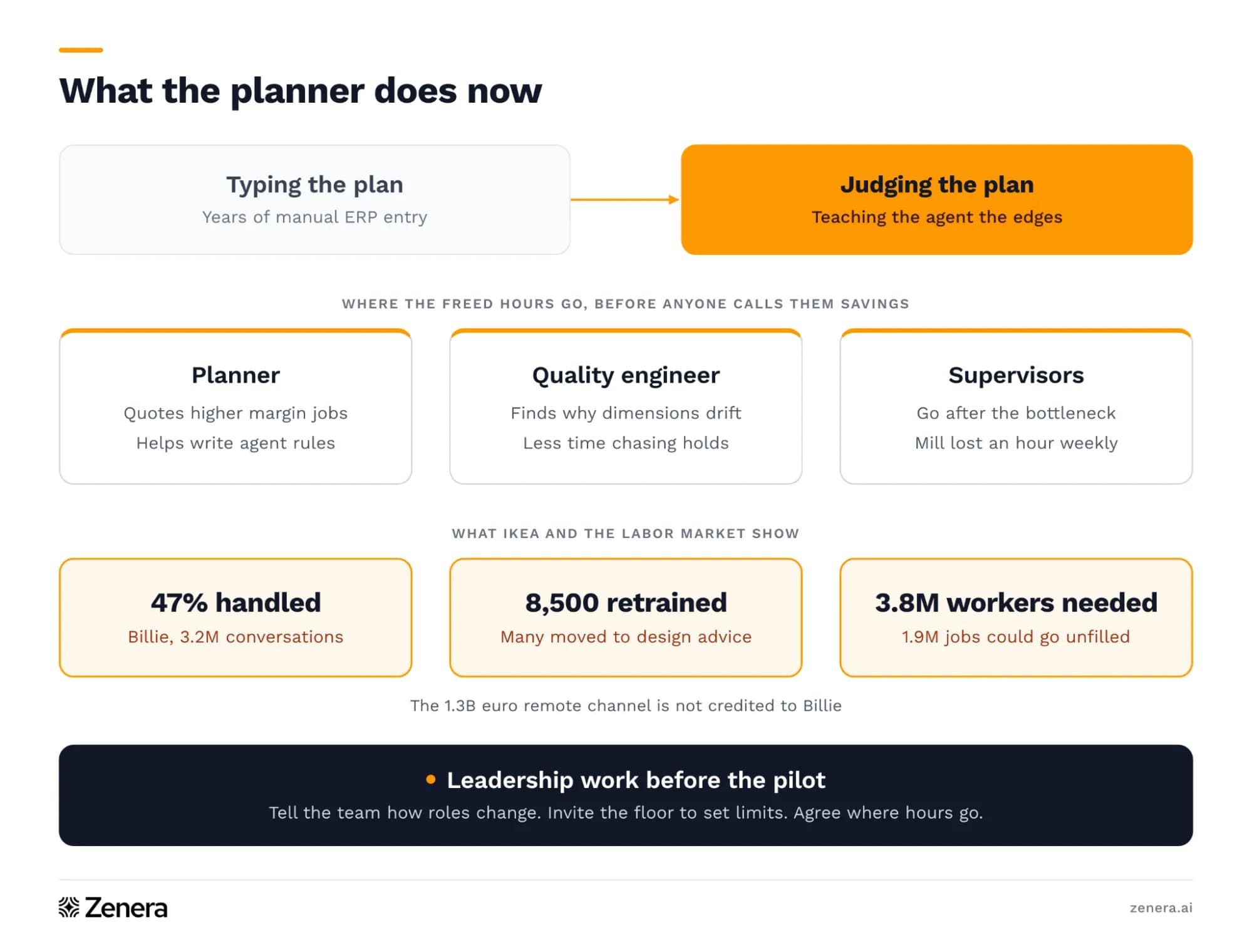
It helps to look at a company that faced the same question in a very different building. Between 2021 and 2023, IKEA's customer-service assistant, a piece of software called Billie, handled roughly 47 percent of routine customer questions, about 3.2 million conversations, with nearly thirteen million euros in reported savings. The number worth remembering is a different one, though. Over the same period, Ingka Group, which runs most IKEA stores, retrained about 8,500 call-center staff, and many of them moved into remote interior design advice, helping customers plan kitchens and rooms over video. By its 2022 fiscal year, that remote channel was bringing in about 1.3 billion euros, roughly 3.3 percent of sales, and we are careful not to credit that figure to Billie, because a lot else went into it. What IKEA shows is that the software freed the time and leadership decided where the time went, before anyone booked it as a saving.
A plant has the same choice, and it has a stronger reason to get it right. The Manufacturing Institute and Deloitte estimate that U.S. manufacturers will need about 3.8 million workers through 2033 and that close to 1.9 million of those jobs could go unfilled, which is a projection rather than a promise but matches what most plant managers already feel when they try to hire. In that kind of market, the planner in the break room is not a cost to be cut. He is eleven years of knowing which customer will accept a split shipment, which fixture always sticks, and which operator can run the older machine, and the plant cannot hire that back off the street.
So the practical question is where his hours go, and the plant should answer it out loud before the agent goes live. In most of the plants we talk to, the answers are sitting in plain sight. The planner can spend the morning quoting the higher-margin jobs sales keeps asking about. The quality engineer who no longer spends Tuesday chasing a held batch can work out why that dimension keeps drifting to the edge of its tolerance in the first place. The supervisors can go after the bottleneck that has eaten an hour of the mill every week for two years. Each of those shows up somewhere finance can see, which is what turns freed time into the capacity and cost numbers from the second episode instead of a vague line about hours saved.
There is also a part of the job the agent makes more important rather than less. In the fourth episode, the agent learned that the first-shift operator wasn't trained on the older machine's fixture, and it learned that only because the plant manager overrode its plan and said why. The rules from the fifth episode, which say what the agent may touch and what it must hand back, should be written with the people who know where the edges really are. The planner who asked the question in the break room is exactly the person who should be helping write those rules, and telling him that plainly is the best answer anyone can give him.
That takes a little leadership work that no software does. Someone has to tell the team how the roles will change before the pilot starts, invite the people on the floor to help set the limits, and agree where the freed hours go before anyone counts them as savings. When that happens, the agent handles the coordination, and the planner makes the call and gets an hour back to do work that actually grows the plant.
So the answer for the planner is that his job moves from typing the plan to judging it and teaching the agent where the edges are, and the plant decides in advance what his recovered hours are for. Once the team believes that, the CEO usually asks the question that turns all of this into a project. Out of all the disruptions in the building, which one workflow do we start with, who owns it, and what single number will tell us whether it worked? The next episode is about choosing that one workflow well, because picking the right first fight decides most of what happens in the ninety days after.
Book a demo. Ramu Sunkara, our CEO, and Dr. Sudesh Kannan offer a complimentary evaluation of one workflow, in which we map the disruption with the people who handle it today and work out with you where their recovered hours would create the most value.
If you would rather follow along first, join the mailing list and we will send each of the last two episodes as it is published.
For more information and to download the white paper, The Zenera AI Playbook White Paper, go to zenera.ai/use-cases/manufacturing/ai-playbook.