
Closing the Gap - Episode 1 of 8
Where a plant quietly loses its morning, and why the data was never the problem.
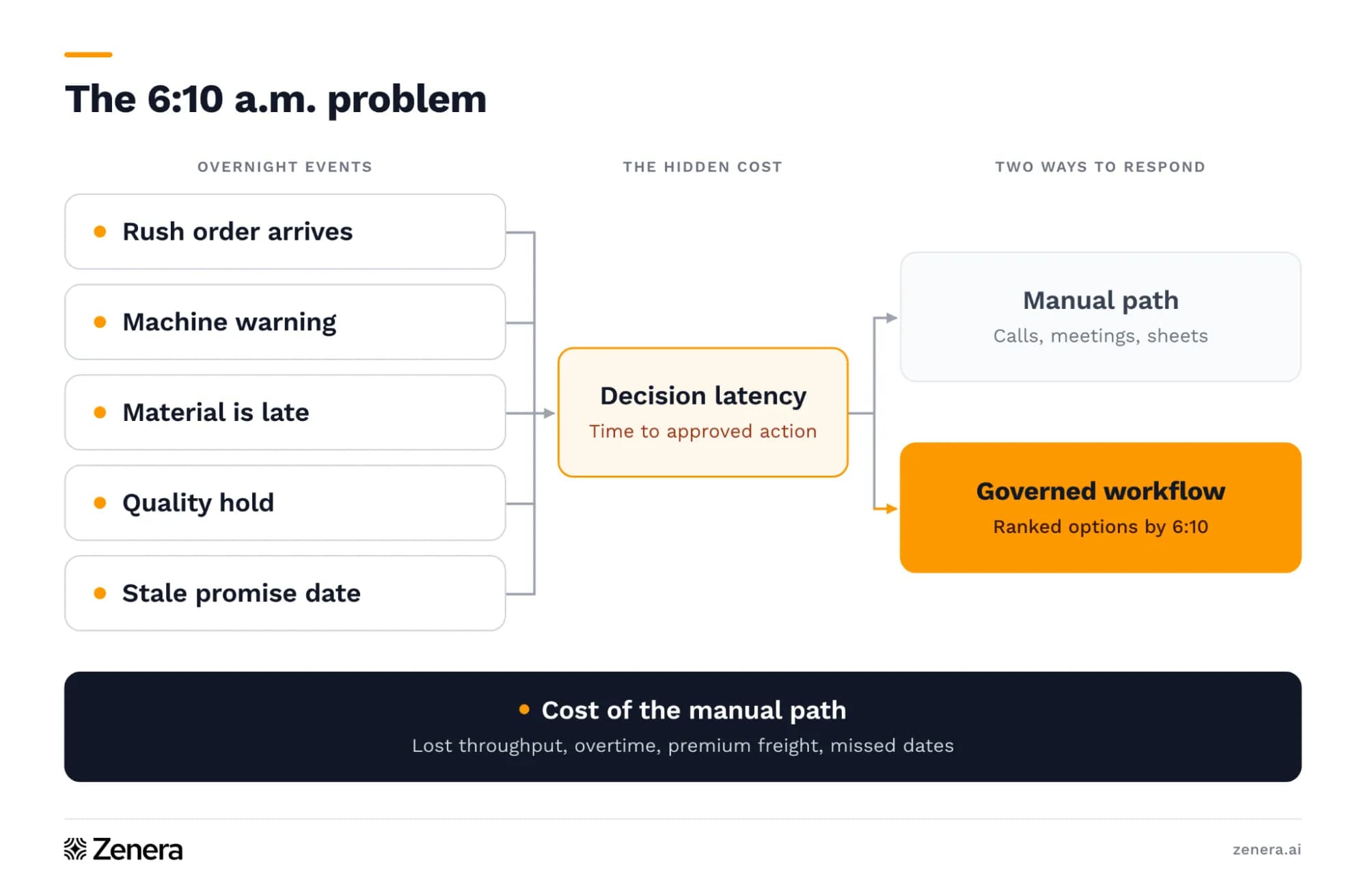
It is 6:10 on a Tuesday morning, and the plant manager has not finished her first coffee when she opens the schedule and realizes the day is already in trouble. A rush order came in overnight from a customer nobody wants to disappoint. The horizontal mill on line three threw a spindle vibration alert at four o'clock, and maintenance wants it down for an inspection. The bar stock for two jobs that were supposed to start at seven is still on a truck somewhere outside the city, and a batch of housings is sitting on quality hold because one dimension came in right at the edge of the tolerance on the drawing. On top of all that, sales promised a ship date yesterday afternoon based on capacity that no longer exists.

Anyone who has run a floor knows that none of these problems is unusual on its own. What makes the morning hard is that they collide, because every fix for one of them makes another one worse. If she pulls the rush order forward, she pays for an extra changeover and pushes two other jobs late. If she moves work off the mill onto the older machine in the next bay, somebody has to confirm that the machine has the right tooling and that the customer has actually approved it for that part. If she releases the held batch to make the date, she is betting the customer relationship on a measurement that nobody has looked at twice.
So she does what every plant does. She calls the maintenance lead, walks over to quality, messages the buyer about the truck, opens the spreadsheet that really runs the schedule, and pulls the supervisors into a stand-up at seven-thirty. By around ten o'clock there is a plan everybody can live with, and someone types the changes into the ERP by hand. The plan is fine, but the morning is gone, the mill sat idle while people talked about it, and the Saturday overtime sheet is already filling up.
That stretch of time, between the moment something goes wrong and the moment someone with authority says "do this," is what we call decision latency, which is just a formal name for the gap between the alert and the command.
In the plants we have worked with, it is the largest loss that people could realistically avoid, and we offer that as a directional observation rather than a figure to carry into a budget meeting, because published results from other plants are directional at best and the only number that matters is the one your own finance team will validate. The gap never appears on a report as its own line. Finance sees it weeks later, dressed up as lost throughput, premium freight, expedite charges, and a late shipment the customer will remember.
The point of this first episode is simple, and it is a little uncomfortable once you see it. Every piece of information she needed at 6:10 already existed at four in the morning. The vibration alert was in the maintenance system, the hold was in the quality records, the truck status was in the buyer's inbox, the tolerance was on the drawing, and the real capacity was in that spreadsheet. The plant was not short of data. It was short of anyone, or anything, putting those pieces together while the building slept, so the plant manager had to become the connection between all of those systems herself, at six in the morning, with a phone in one hand.
That is also why a bigger dashboard is not the answer. A dashboard shows you the fire, but it does not tell you which of the three ways to put it out is safe and which one is cheapest. What would actually help is software that watches those systems overnight, reads the drawing the way a quality engineer would, knows which machine is certified for which part, works out two or three plans that respect those limits, and has them ranked and waiting with the reasoning attached when she walks in. In this series we call that kind of software an agent, and the agents we mean can see drawings and live events, write their own connections into the systems you already run, and act only inside rules that your people set, starting with recommending rather than doing anything on their own. She still makes the call. She just makes it at 6:15 instead of ten o'clock.
So the morning was not lost because the people in that plant were slow or careless, since they did exactly what good people do with the tools they have. It was lost in the gap, and once you can name the gap, you can start to shrink it. Before anyone in your building gets excited about software, though, your CFO is going to ask a fair question, which is how much that gap actually costs in money finance would sign off on, and "hours saved" will not survive that conversation. The next episode answers it by showing how to put an honest, defensible number on the 6:10 problem in your own plant.
Book a demo. If your plant has its own version of 6:10, Ramu Sunkara, our CEO, and Dr. Sudesh Kannan will sit down with your team for a complimentary evaluation of one workflow, so you can see what that gap looks like in your systems and what it would take to close it.
If you would rather follow along first, join the mailing list and we will send each of the next seven episodes as it is published.
For more information and to download the white paper, The Zenera AI Playbook White Paper, go to zenera.ai/use-cases/manufacturing/ai-playbook.