
Closing the Gap - Episode 3 of 8
Why you don't need an eighteen-month integration project before agents can see your plant.
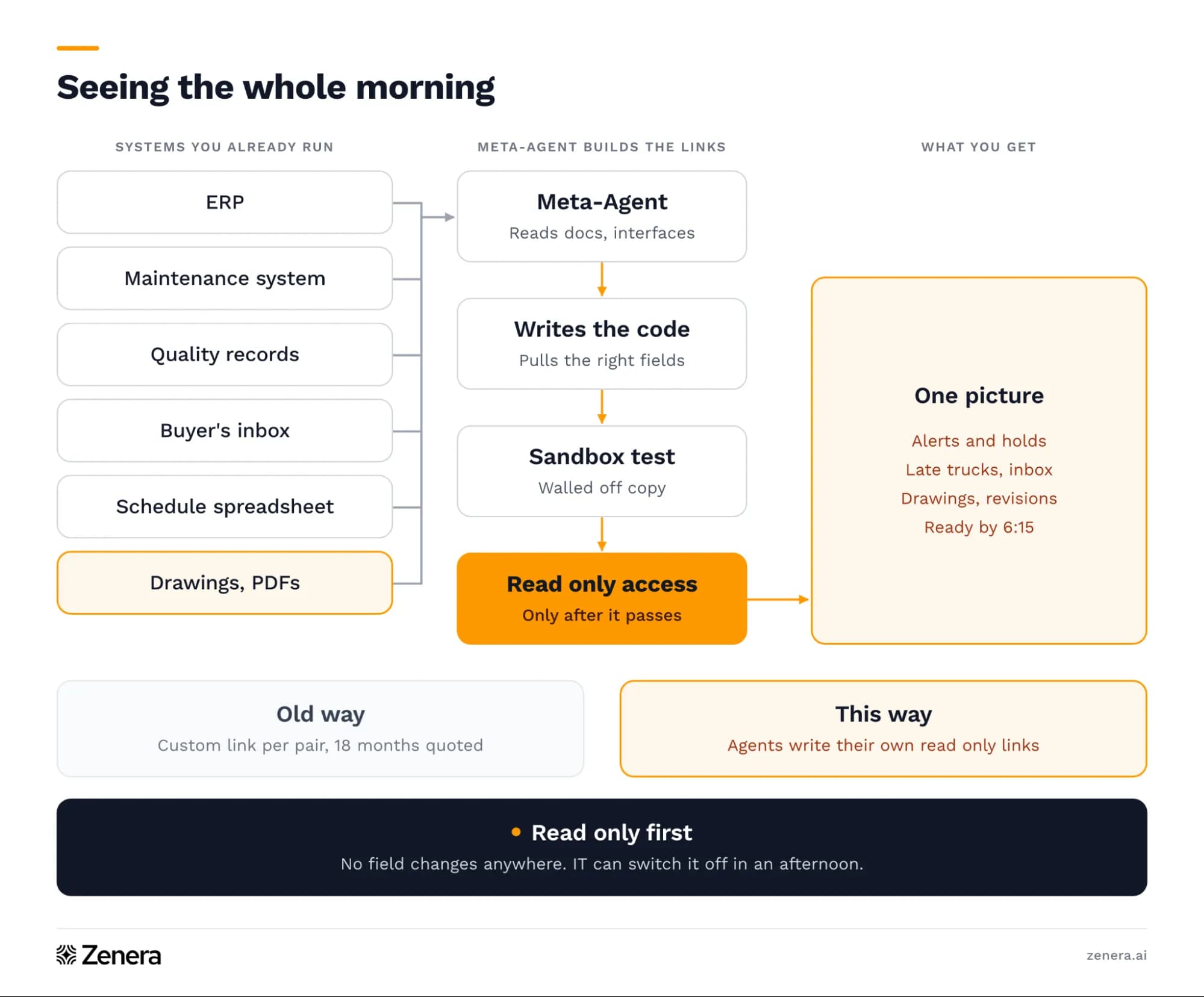
The IT director came to the Monday meeting with a slide of his own, and it showed why the CFO's question from last week was harder than it sounded. For the plant manager's 6:10 plan to be ready at 6:15, something would have to read from the ERP, the maintenance system on line three, the quality records, the buyer's inbox, and the scheduling spreadsheet that everyone pretends isn't the real schedule. Two of those systems are more than fifteen years old, one has no published interface at all, and the vendor's quote for connecting them came to eighteen months. The CFO looked at that number and asked the plant manager whether the whole idea was already dead.

It isn't, but the IT director is right about how this has usually gone. The traditional way to connect plant systems is to pay someone to build and maintain a custom link between each pair of them, and each link tends to break the next time anyone upgrades either end. That is how plants end up with ten years of half-finished integration projects and a planner who still retypes schedule changes into the ERP by hand.
The first thing the agents in this series do differently is look at what your people look at. Last Tuesday, the batch of housings was on hold because one dimension sat right at the edge of its tolerance, and the only place that tolerance lives is on a drawing, which is a PDF with a title block, a revision letter, and a callout in the corner that a quality engineer reads in about four seconds. Most software can't read that page at all, so it has no way of telling you whether the measurement is a real problem or a borderline one the customer has accepted before. An agent that can read the drawing, check its revision against the one the job was released to, and compare the callout with the inspection record can tell the plant manager which question she is really facing before she walks over to quality.
The second difference is that the agents write their own connections. Instead of a consultant hand-building each link, a coordinating agent, which Zenera calls the Meta-Agent, reads whatever the old system offers, whether that is a manual, a database layout, a nightly export file, or a description of its interface, and writes the small piece of code needed to pull the right fields out of it. That code is tested first in a sandbox, meaning a walled-off copy where nothing it does can touch the live plant, and only after it passes does it get permission to read from the real system. If the maintenance software on line three changes after an upgrade, the agent rewrites its connection instead of waiting for someone to open a new project.
Both of these start read-only, and in our experience that matters more to an IT director than any feature on the list. During the first stretch of work, the agents can look at the ERP, the vibration alerts, the hold records, and the drawings, but they cannot change a single field anywhere. You keep every system you already run, nobody rips anything out, and IT keeps the ability to switch the whole thing off in an afternoon. We will come back to the question of letting agents write changes later in the series, because that is where the real rules have to be agreed.
We should also be plain about what this does not promise. How quickly a connection comes together depends on what each system exposes, and a twenty-year-old machine controller with no documentation will take longer than a modern ERP. Any timeline you hear from us, or from anyone else, is directional until someone has looked at your actual systems, and the number that counts is the one your own team sees on its own equipment.
So the answer to the CFO is that the plant does not need an eighteen-month integration program before it can see the 6:10 morning as one picture, because the agents can read the drawings and build their own read-only connections to the systems already in place. Seeing everything is only the start, though, and the plant manager asked the obvious follow-up before the meeting broke up. If the agent can see the alert, the hold, the late truck, and the drawing at four in the morning, what exactly does it do with all of that, and at what point does a person get asked to say yes? The next episode walks through that loop one step at a time, from the moment the agent notices the problem to the moment the plant learns from how it was handled.
Book a demo. Ramu Sunkara, our CEO, and Dr. Sudesh Kannan offer a complimentary evaluation of one workflow, in which we look at the systems behind it, including the drawings and the older software nobody likes to touch, and show you what a read-only connection to them would involve.
If you would rather follow along first, join the mailing list and we will send each of the next five episodes as it is published.
For more information and to download the white paper, The Zenera AI Playbook White Paper, go to zenera.ai/use-cases/manufacturing/ai-playbook.