
Closing the Gap - Episode 7 of 8
Choosing the one workflow, owner, cell, and number that make a first project work.
The first roadmap the CEO saw had a picture of a lights-out plant on the cover, with agents running every line, every schedule, and every shipment by the end of next year. He read it on a Friday afternoon and sent it back with one sentence, asking which problem from last Tuesday it would have fixed by the following Tuesday. Nobody could point to one, and that was the end of the lights-out plan.
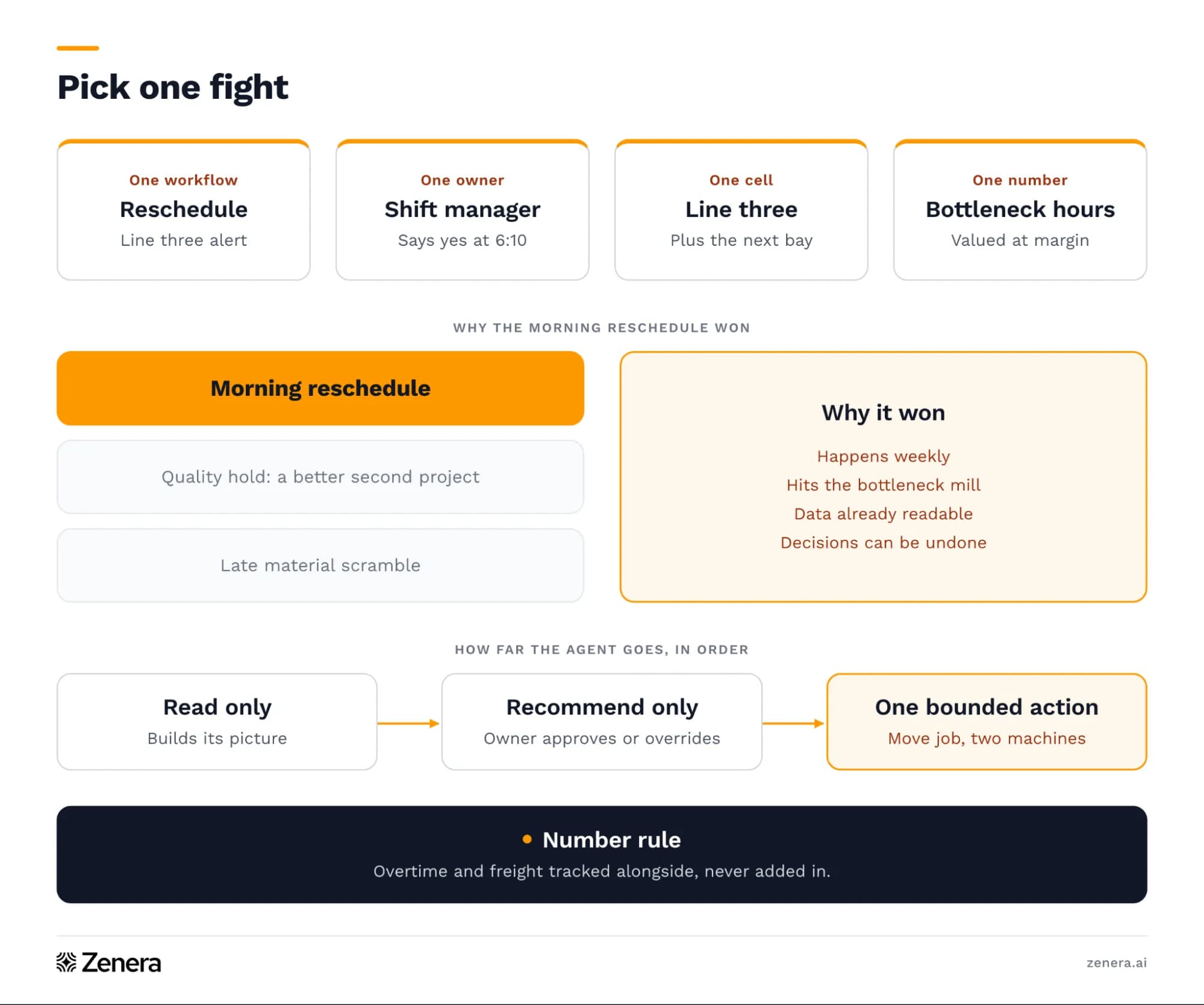
He was right to throw it out. Projects that try to rewire a whole plant at once tend to stall in their second quarter, when the integration work is half done, nobody can show a result, and the people on the floor have stopped believing it will ever arrive. The way to avoid that is to pick one recurring decision, the kind that sits between a disruption and a shipment, and to make the first project about that decision and nothing else. In practice, that means one workflow, one owner, one work cell, and one financial number, and getting each of those four right matters more than any piece of software.

Choosing the workflow comes first, and the plant from this series had three candidates on the whiteboard. The first was the morning reschedule after a machine alert on line three. The second was deciding what to do with batches that land on quality hold. The third was the scramble when material shows up late. All three are real, but the team picked the morning reschedule, for reasons any plant can use. It happens at least once a week, so ninety days gives plenty of chances to measure it. It hits the bottleneck mill directly, so every hour saved shows up in shipped parts. Most of the data it needs is already in systems the agent can now read, and the decisions it involves can be undone if they turn out wrong. The quality hold workflow was tempting, but its decisions involve the customer's sign-off, and the team agreed that was a better second project than a first one.
Choosing the owner is just as important, and the owner has to be one person with the authority to say yes at 6:10 in the morning. Here, that is the first-shift production manager, not a committee and not the IT director, because a pilot without a single owner turns into a meeting about a pilot. The owner decides which recommendations get approved, collects the reasons for every override, and is the person who stands up at the end and says whether it worked.
Choosing the cell keeps the project honest. The agent watches line three and the older machine in the next bay, and nothing else in the building changes. That gives the team a comparison, because the other lines carry on the old way, and if line three improves while they don't, that is much harder to argue with than a plant-wide average that moved for a dozen reasons.
Choosing the number is where the second episode pays off. The team sat down with finance and agreed on one measure, which was bottleneck hours lost on line three after a disruption, valued at contribution margin against real orders, with overtime and premium freight tracked alongside it but never added in. Finance also agreed how to adjust the baseline for product mix and the usual seasonal swing, so nobody can claim a win that was really just a quiet month. We say this in every episode because it is true every time, which is that published results from other plants are directional and the number that matters is the one your finance team has checked.
Finally, the team agreed how far the agent goes and in what order. It starts read-only, watching and building its picture of line three without proposing anything. Then it moves to recommend-only, bringing in ranked plans at 6:10 that the owner approves or overrides. Only near the end, and only after rollback has been tested, does it get permission for one bounded action, such as moving a job between the two approved machines, while ship dates and customer commitments stay with people.So the CEO now has his answer to which problem gets fixed first, and it fits in one sentence. The workflow is the morning reschedule on line three, the owner is the first-shift production manager, the cell is line three plus the next bay, the number is bottleneck hours valued at margin, and the autonomy starts read-only. What he wants next is the calendar. What happens on the first day, what has to be true by day forty-five, and what does the team bring to the boardroom on day ninety to decide whether to keep going, change course, or stop? The last episode lays out those ninety days step by step.
Book a demo. Ramu Sunkara, our CEO, and Dr. Sudesh Kannan offer a complimentary evaluation of one workflow, in which we help your team choose the right first workflow, name its owner, and agree on one financial number with your finance team before any work begins.
If you would rather follow along first, join the mailing list and we will send you the final episode when it is published.
For more information and to download the white paper, The Zenera AI Playbook White Paper, go to zenera.ai/use-cases/manufacturing/ai-playbook.