
Closing the Gap - Episode 8 of 8
How one workflow goes from read-only to a decision your finance team can check.
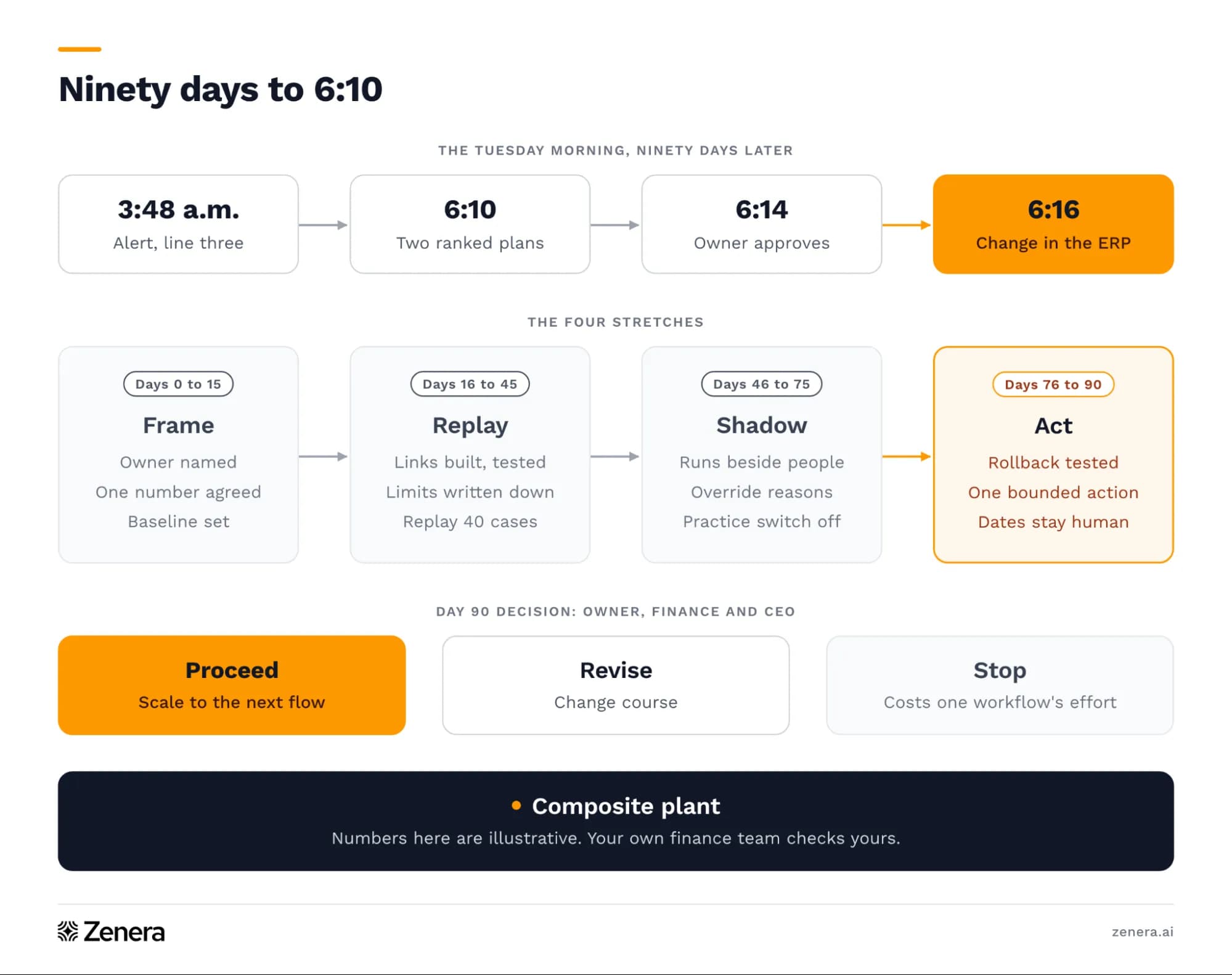
On a Tuesday ninety days later, the vibration sensor on the mill on line three crosses its limit at 3:48 in the morning, and this time the plant manager hears about it the way she wanted to back in the first episode. At 6:10, she opens her laptop to two ranked plans, a short note on why the agent ruled out a third, and a line saying the maintenance lead has already seen the alert. She approves the second plan at 6:14. By 6:16, the job has been moved between the two approved machines, the change has passed the rule check and gone into the ERP in one piece, and the planner is quoting a job sales has been chasing for a week. Getting there took ninety days, in four stretches, and none of them was dramatic.

The first two weeks were about framing, which means agreeing what the project is before anybody builds anything. The first-shift production manager was named the owner, the morning reschedule on line three was named the workflow, and finance signed off on the one number, which was bottleneck hours lost after a disruption, valued at margin. The team pulled the last few months of records to set a baseline, adjusted for product mix and the usual seasonal swing, and agreed that the other lines would carry on unchanged so there was something to compare against. IT set up read-only access to the ERP, the maintenance system and the quality records, and everyone signed off on the boundary the agent would eventually have to stay inside.
From roughly day sixteen to day forty-five, the agents built their connections and the team replayed history. The Meta-Agent wrote and tested its links to the old systems in the sandbox, the drawings for the parts that run on line three were loaded, and the machine, tooling, labor, and quality limits were written down, many of them for the first time. Then the team fed the agent forty or so real disruptions from the past months, one at a time, and checked whether its plans would actually have worked on the floor. They paid less attention to whether it copied what people had done and more to whether it ever proposed something physically impossible, and they counted the false alarms as carefully as the good calls.
From day forty-six to day seventy-five, the agent ran in shadow mode, which means it worked alongside the real plant every morning without touching anything. Its 6:10 plans arrived next to the plans people were making the old way; the owner approved or overrode them, and every override came with a one-line reason. This is where most of the learning from the fourth episode happened, because the reasons kept surfacing rules that lived in nobody's system, like the operator who hadn't been trained on the older machine's fixture. The supervisors also practiced switching the agent off and running the morning by hand, so nobody had to wonder whether they could.
Only in the last two weeks did the agent get permission to act, and only for one thing. After the team tested the rollback on purpose, by forcing a material rejection and watching the agent undo the whole change cleanly, the owner allowed it to move jobs between the two approved machines once she had said yes. Ship dates, customer commitments, and the release of the master schedule stayed with people, exactly as the fifth episode said they would. On day ninety, the owner, finance, and the CEO sat down with the baseline, the results from line three, the comparison with the other lines, and the log of every override, and made one of three decisions, which were to proceed, to revise, or to stop.
We are deliberately not telling you what number this plant got, because it is a composite we built to tell the story and because the number that matters is the one your own finance team checks against your own books. Sites in the World Economic Forum's Lighthouse network, such as ASE in Kaohsiung and GE HealthCare in Beijing, show that focused industrial AI can pay off, and we treat those as directional evidence that the approach can work, not as a forecast for your plant. Stopping on day ninety is also a legitimate outcome, and it costs one workflow's worth of effort instead of a plant-wide program.
So that is the whole series in one morning. The plant was losing money in the gap between a disruption and an authorized response, and that gap was mostly people stitching together data that already existed. Agents that can read drawings and live events and write their own connections can close the gap while the plant sleeps, as long as they start by recommending, stay inside rules your people write, undo cleanly when they miss, and give your planners better work instead of less of it. You prove it on one workflow, with one owner and one number, in ninety days. That leaves only one question, and it is yours rather than ours: which disruption eats the first two hours of your plant's day, and what would it be worth to have the plan waiting at 6:10?
Book a demo. Ramu Sunkara, our CEO, and Dr. Sudesh Kannan offer a complimentary evaluation of one workflow, in which we work with your team to find the disruption that eats your mornings, map its constraints, and scope your own ninety days, so you can answer that question with your own numbers.
If you would rather follow along first, join the mailing list and we will send you field notes from plants running their own ninety days.
For more information and to download the white paper, The Zenera AI Playbook White Paper, go to zenera.ai/use-cases/manufacturing/ai-playbook.