
Keeping AI Agents in Check: Five Controls for Dependable Enterprise Autonomy
An agent that can act inside an enterprise needs more than a strong model and a careful prompt. It needs controls that remain active from design through runtime and self-improvement.
A successful demo is not a production guarantee
An AI agent should never be trusted simply because it passed a demo.
A demonstration usually proves that an agent can complete a selected task under favorable conditions. The data is known, the tools are available, the path is short, and a person is watching. Production is different. The agent encounters incomplete records, ambiguous instructions, unavailable systems, unusual cases, changing permissions, and decisions whose consequences may not be reversible.
The risk also changes when an agent moves from generating an answer to taking action. An assistant that drafts a response can be reviewed before anything happens. An agent that can read enterprise data, call tools, change records, issue a refund, modify infrastructure, or trigger a transaction is participating directly in an operating process. At that point, keeping it in check becomes a lifecycle problem, not a prompt-engineering problem.
The enterprise therefore has to control more than the final output. It must govern what job the agent is built to perform, what information it can use, how it chooses and sequences actions, how important claims are verified, when a person must intervene, and how the agent is allowed to improve. These controls must work together. A gap at any stage can undermine the safeguards applied everywhere else.
Why prompts and permissions are not enough
Prompts are useful instructions, but they are not a complete control system. They can describe expected behavior, yet they do not by themselves enforce data boundaries, validate a multi-step trajectory, prove that a critical fact is correct, preserve an approval, or prevent a later refinement from weakening an important safeguard.
Traditional access controls are necessary as well, but they answer only part of the question. Permission to call a system does not mean every use of that system is appropriate. A claims agent may be authorized to update a record while still needing limits on which fields it may change, under what conditions, for what amount, and with whose approval. Safe autonomy depends on combining technical access with operational intent.
This is why production agents need several independent but coordinated layers of control. Each layer addresses a different failure mode, and together they create a governed path from requirement to action to improvement.

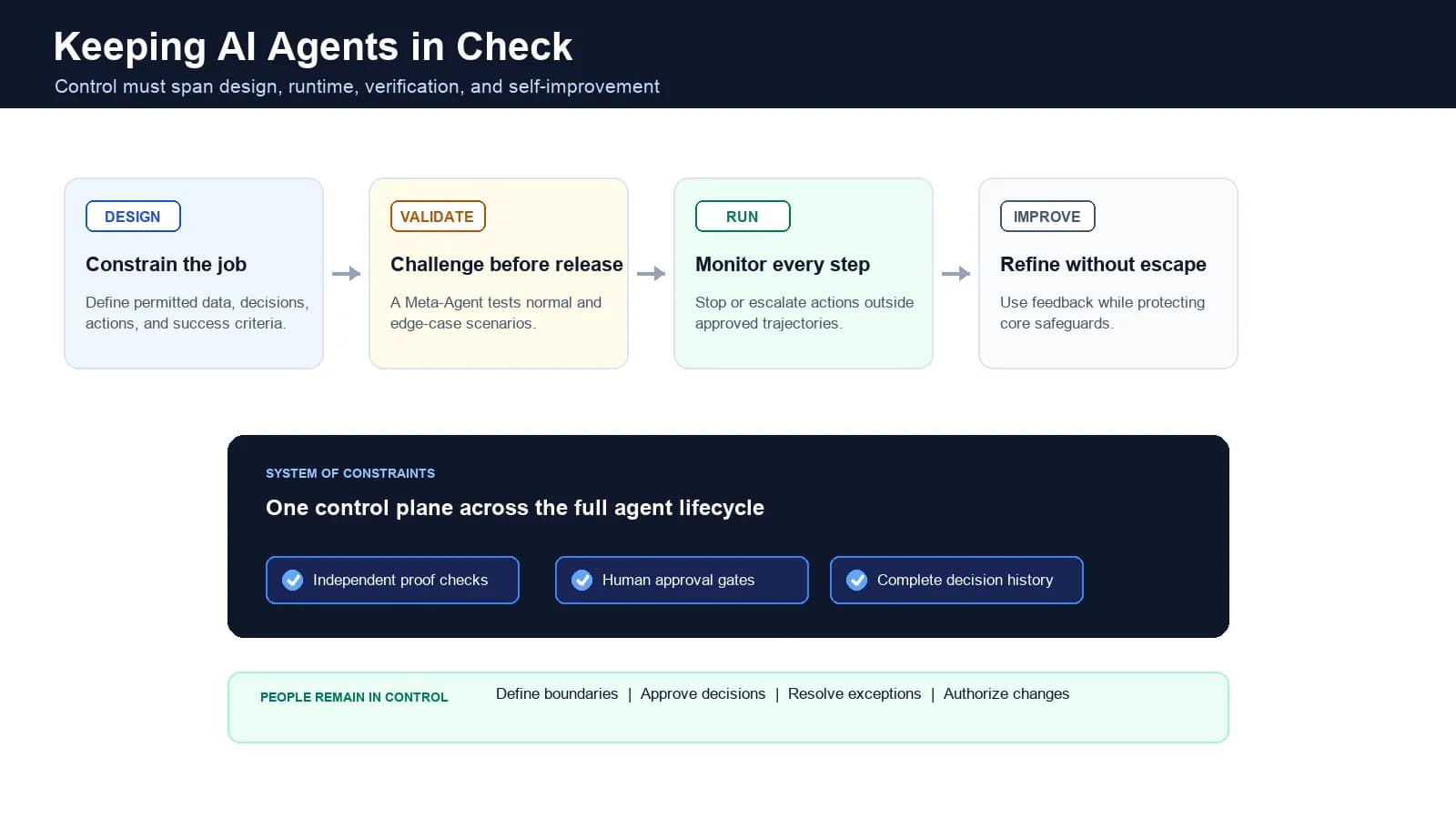
Five coordinated controls govern the agent from design through improvement.
Control 1: Give the agent a specialized job and a System of Constraints
The first control is specialization. A dependable enterprise agent should not begin with an open-ended instruction to help with anything. It should have a defined job, a known operating context, measurable success criteria, and explicit boundaries around the data, decisions, and actions available to it.
Zenera expresses those boundaries through a System of Constraints. The constraints describe what the agent is expected to accomplish and the conditions it must respect while doing so. They can include permitted data sources, allowed tools, transaction limits, required process steps, escalation conditions, approval rules, quality thresholds, and prohibited actions.
This matters because the correct action is rarely determined by a model in isolation. It depends on enterprise policy, role, jurisdiction, process state, customer commitments, and the consequences of being wrong. The System of Constraints turns those requirements into part of the agent's operating architecture instead of leaving them as informal guidance.
Specialization also makes evaluation possible. If the job and its boundaries are vague, success is subjective and exceptions are difficult to classify. When the role is explicit, the enterprise can test whether the agent completed the intended work, remained within its authority, used the right information, and escalated when it should.
Control 2: Challenge the design before release
The second control is build-time validation. A design that works for the expected case may still fail when a field is missing, two sources disagree, an API times out, a user requests an exception, or a proposed action is technically valid but operationally inappropriate.
Zenera uses a Meta-Agent to automatically and systematically challenge the specialized agent before release. The Meta-Agent evaluates the proposed design against normal scenarios, edge cases, failure conditions, and the System of Constraints. The purpose is not only to ask whether the agent can complete the task. It is to find where its boundaries, logic, integrations, or escalation behavior remain underspecified.
This process should produce concrete changes. An ambiguous requirement may become an explicit rule. A risky step may gain a proof check. A missing failure path may become a recovery procedure. A high-impact action may be moved behind a human approval gate. Validation tightens the design before the agent is exposed to live systems and real consequences.
Build-time validation does not eliminate runtime risk. It reduces the number of surprises and gives the runtime controls a clearer specification to enforce.
Control 3: Monitor the agent's trajectory at runtime
The third control operates while the agent is working. Checking only the final answer is too late when the agent can take a sequence of actions. A plausible outcome can hide an unsafe path, and one incorrect intermediate step can affect systems before the final result is reviewed.
Runtime trajectory checks evaluate the agent's progress step by step. The system compares proposed actions with the approved job, current process state, available authority, and applicable constraints. It can allow the action, request additional verification, route the decision to a person, or stop the trajectory when the agent moves outside approved limits.
Trajectory control is particularly important for long-running and branching processes. The right next step may depend on prior actions, newly retrieved information, previous approvals, and exceptions encountered hours or days earlier. The control system must retain that context and apply it consistently rather than treating each model call as an isolated event.
The objective is not to prescribe every keystroke in advance. It is to let the agent adapt within a governed operating envelope. That balance preserves the value of agentic reasoning while preventing flexibility from becoming unbounded authority.
Control 4: Verify critical facts and outputs independently
The fourth control separates generation from proof. Language models can produce convincing explanations, code, classifications, and plans even when an important premise is wrong. For consequential work, confidence and fluency are not verification.
Independent proof checks examine important facts, calculations, code, and high-impact outputs before they are used. The appropriate mechanism depends on the task. A value may be reconciled against a source system. A calculation may be recomputed deterministically. Code may be tested in a sandbox. A document may be checked against required fields and policy rules. A second agent may review a conclusion using separate context or a different method.
Independence is the key principle. Asking the same agent to restate that it is correct provides limited assurance. A useful check should introduce a different source, method, model, or execution environment so that one failure is less likely to validate itself.
Not every output requires the same level of proof. The depth of verification should reflect the consequence of error. A low-risk summary may need a source check, while a financial transaction, production change, or regulated decision may require deterministic validation and explicit human approval.
Control 5: Improve through governed refinement
The fifth control governs change. Agents need to improve as processes evolve and people correct their work. But uncontrolled self-improvement creates a new risk: a system can become less predictable after it has been approved.
Governed refinement treats feedback as a proposed change, not as permission for the production agent to rewrite its own boundaries. Corrections and outcomes are captured, evaluated, and incorporated within the System of Constraints. Material changes can be tested against prior scenarios, reviewed by responsible people, versioned, and approved before release.
This preserves a critical distinction between learning how to perform the job better and learning how to avoid the controls around the job. Core safeguards, prohibited actions, approval requirements, and proof obligations should not disappear because a recent example appeared to reward a shortcut.
A governed refinement process also creates organizational memory. Expert corrections are not lost in chat transcripts or isolated support cases. They become reviewable improvements to the operating system of the agent, with a record of what changed and why.
People remain in control across the lifecycle
Human control is not a single approval button placed at the end of a workflow. People define the requirements, approve the operating boundaries, review critical decisions, resolve exceptions, and authorize material changes. Different roles may own different decisions, but accountability must remain explicit.
A useful human approval gate gives the reviewer enough context to make a real decision. It should show what the agent proposes, what information it used, which constraints apply, what checks passed or failed, and what consequence the action may have. A vague request to approve an opaque result creates ceremony rather than control.
The aim is also not to send every routine step to a person. That would reproduce the manual process and eliminate much of the value of autonomy. The architecture should reserve human attention for consequential decisions, unresolved ambiguity, policy exceptions, and changes to the agent itself. Routine work can proceed automatically when it remains inside approved boundaries and passes the required checks.
One control plane is stronger than disconnected safeguards
These five controls are most effective when they operate as one system. The specialized job defines the boundaries. The Meta-Agent challenges those boundaries before release. Runtime checks enforce them during execution. Independent proof checks validate critical outputs. Governed refinement improves performance without silently changing the rules. Human approval gates and a complete decision history connect the layers.
When controls are assembled as disconnected tools, important context can be lost between stages. A build-time test may not match the runtime policy. A reviewer may not see the verification result. A refinement may update a prompt without rerunning the scenarios that justified approval. A unified control plane keeps the job, constraints, checks, approvals, execution history, and changes aligned across the lifecycle.
That continuity is how an enterprise reduces the risk of an agent going rogue at design time, runtime, or during self-improvement. The term does not require a dramatic act of defiance. In practice, an agent goes rogue whenever it acts outside the enterprise's approved intent, authority, or process, even if the action looked reasonable to the model.
What to require before an agent enters production
Before granting production authority, an enterprise should be able to inspect the control system as clearly as it inspects the agent's capabilities. The review should begin with the job: Is the intended outcome defined? Are permitted data, tools, actions, and transaction limits explicit? Are prohibited actions and escalation conditions unambiguous?
The next question is whether the design has been challenged rather than merely demonstrated. Reviewers should see the normal scenarios, edge cases, failure conditions, and policy exceptions used during validation. They should know which weaknesses were found, how the design changed, and which risks remain subject to human judgment.
Runtime readiness requires equally concrete answers. The enterprise should know which steps are monitored, which outputs receive independent proof checks, what conditions stop an execution, and what information is shown at each approval gate. It should also be possible to reconstruct the trajectory after the fact, including the data used, actions proposed, checks performed, decisions made, and people involved.
Finally, the change process must be part of the production review. The organization should know how feedback is collected, who can propose or approve refinements, which tests are repeated after a change, how versions are recorded, and how a prior configuration can be restored. If those answers are unavailable, the agent may be ready to demonstrate capability, but it is not yet ready to receive durable enterprise authority.
Dependable autonomy is the goal
Controls are sometimes framed as friction that limits AI. For enterprise agents, the opposite is usually true. Clear boundaries and reliable checks make it possible to grant more autonomy with confidence. Without them, organizations are forced to keep agents in advisory roles or surround every action with manual supervision.
Zenera implements these controls as one operating system for specialized agents. Its System of Constraints, Meta-Agent validation, runtime trajectory checks, independent verification, human approval gates, complete decision history, and governed refinement work together across the full agent lifecycle.
The goal is not to slow agents down. It is to make autonomy dependable enough to trust. An enterprise should know not only that an agent can perform a task, but also that it will remain within its job, prove what matters, involve people at the right moments, and improve without escaping the safeguards that earned its authority in the first place.