
Closing the Gap - Episode 4 of 8
What the agent actually does between 4:02 a.m. and the moment someone says yes.
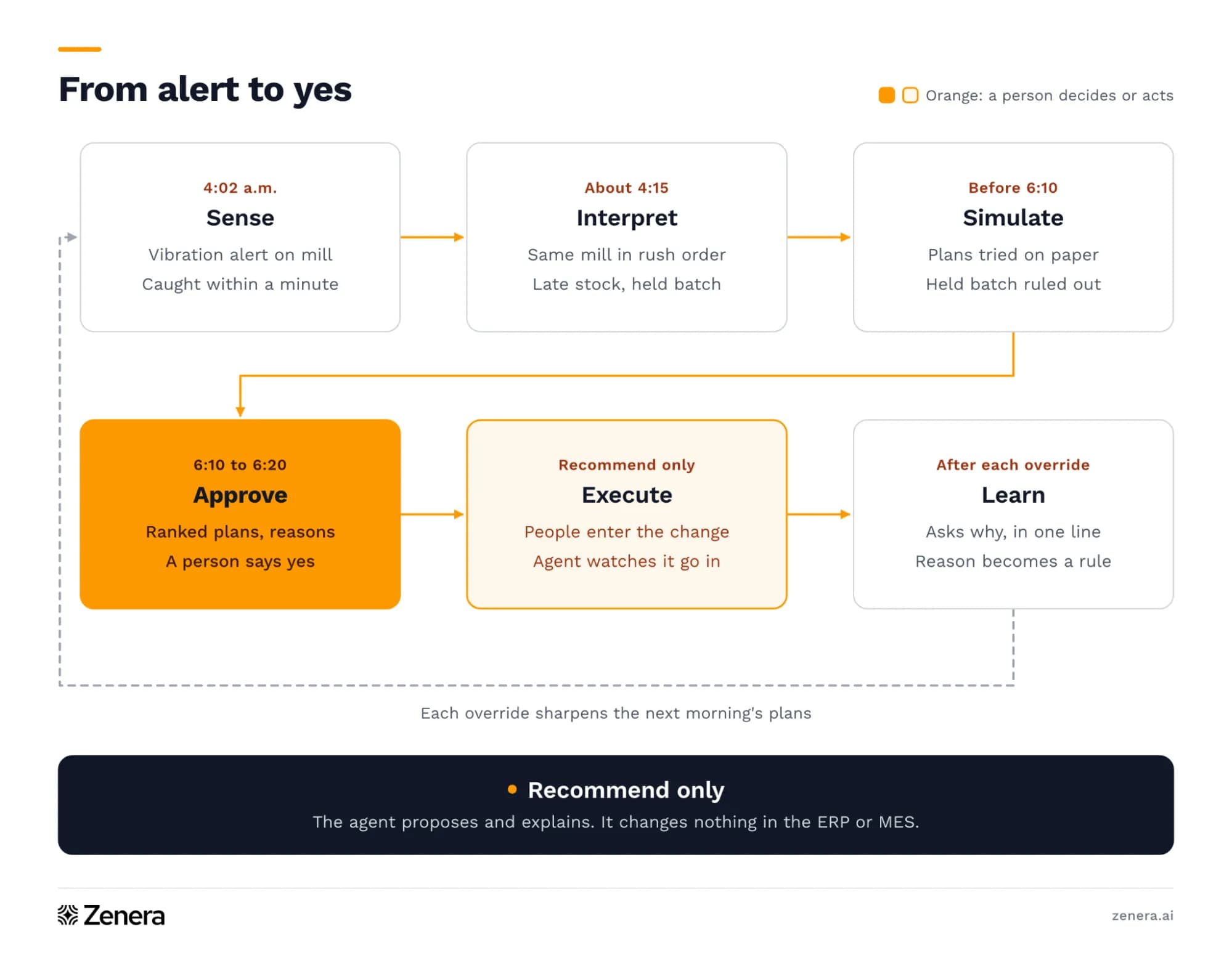
Let's run last Tuesday again, only this time with the agents connected and still in read-only mode. At 4:02 in the morning, the vibration sensor on the horizontal mill on line three crosses its alarm limit, and the maintenance system logs it the way it always has. Nobody is awake to see it, and in the old version of the story, nobody looked at it until the plant manager opened the schedule two hours later. In this version, the agent notices it within a minute, and that first step is what we call sensing, which just means watching the events your systems already record and catching the ones that matter.

The second step is interpreting, which is where the agent works out what the alert means for today rather than in general. It pulls the mill's maintenance history and sees that the last two alerts like this one ended in a bearing replacement. It checks the schedule and finds that the rush order which arrived overnight was routed through that same mill. Then it notices the late bar stock and the housings on hold, and it puts all four facts side by side, because each one changes what the right answer to the others is. By about 4:15, the agent has the same picture the plant manager pieced together by ten o'clock the first time.
The third step is simulating, and this is where the drawings and the constraints from the last episode earn their keep. The agent tries out a handful of plans on paper before anyone touches a machine. One plan pulls the rush order forward and leaves the mill running until the noon break, which works only if maintenance agrees the bearing can last that long. Another moves the rush order to the older machine in the next bay, and the agent checks the customer's approval record and finds that the older machine is approved for this part number but needs a different fixture, which takes forty minutes to set up. A third plan releases the held housings, and the agent rules that one out because the drawing shows the dimension is a critical characteristic, which means the customer has to sign off on any deviation. Each surviving plan comes with its cost in changeovers, overtime, and missed dates, and its reasons are written in plain language.
The fourth step is approving, and it is the one that never moves without a person. When the plant manager opens her laptop at 6:10, she does not see an alert. She sees two ranked plans with their tradeoffs, the one the agent ruled out and why, and the names of the people who need to agree, which this morning means the maintenance lead and the customer quality contact. The agent has ranked the move to the older machine first, but she passes over it and picks the plan that keeps the rush order on the mill until noon, calls the maintenance lead, who agrees the bearing will hold that long, and the decision is made by 6:20.
The fifth step is executing, and at the start it belongs to people too. We begin every plant at what we call recommend-only, which means the agent proposes and explains but never changes anything in the ERP, the MES, or anywhere else. The planner types the schedule change in, the supervisor moves the fixture, and the agent simply watches that the change went in the way it was approved. Later in the series we will talk about letting the agent make some of those changes itself, inside rules your people write.
The sixth step is learning, and it is the one plants usually skip. On Tuesday, the plant manager passed over the agent's top plan because the operator who runs the older machine on first shift hasn't been trained on that fixture, a fact that lives in nobody's system. When she overrides the recommendation, the agent asks for the reason in one line, and that reason becomes a new rule it checks every time after. Over a few weeks, the overrides teach the agent the unwritten constraints that only your supervisors know, and the plans it brings in at 6:10 get closer to the ones your people would have chosen.
So that is what the agent does with everything it can see. It senses the event, interprets what it means today, simulates a few safe plans, waits for a person to approve one, watches the change go in, and learns from every override. Every step before approval happens while the plant sleeps, which is why the gap from the first episode shrinks from hours to minutes, and we offer that as a directional description of how the loop works, not a promise for your plant until your own finance team has measured it. The obvious worry is the one the IT director raised on the way out of the room. If the plant ever lets an agent carry out that fifth step on its own, who decides what it is allowed to touch, and what happens on the morning it gets something wrong? The next episode answers that by showing the boundary the agent has to stay inside and the rollback that undoes a change cleanly when it misses.
Book a demo. Ramu Sunkara, our CEO, and Dr. Sudesh Kannan offer a complimentary evaluation of one workflow, in which we take one recurring disruption from your plant and walk it through this loop with your team, in recommend-only mode, so you can see the plans it would have produced.
If you would rather follow along first, join the mailing list and we will send each of the next four episodes as it is published.
For more information and to download the white paper, The Zenera AI Playbook White Paper, go to zenera.ai/use-cases/manufacturing/ai-playbook.