
Nobody wants to be the one who breaks the system that has worked for thirty years.
You need AI in live operations. You also cannot take down the application that still holds the official record - the system that pays, posts, or ships. Those two facts are not a deadlock. They are the order of work.
Modernization does not start by burying that application. It starts by making it usable: reachable, limited, and recorded. The test is not that you moved it to new machines. The test is that the new path is as correct as the old system, or better - and that you can prove it.
That system is still old. It is expensive. It is poorly documented. People who know the edge cases are retiring. Waiting still costs money every year.

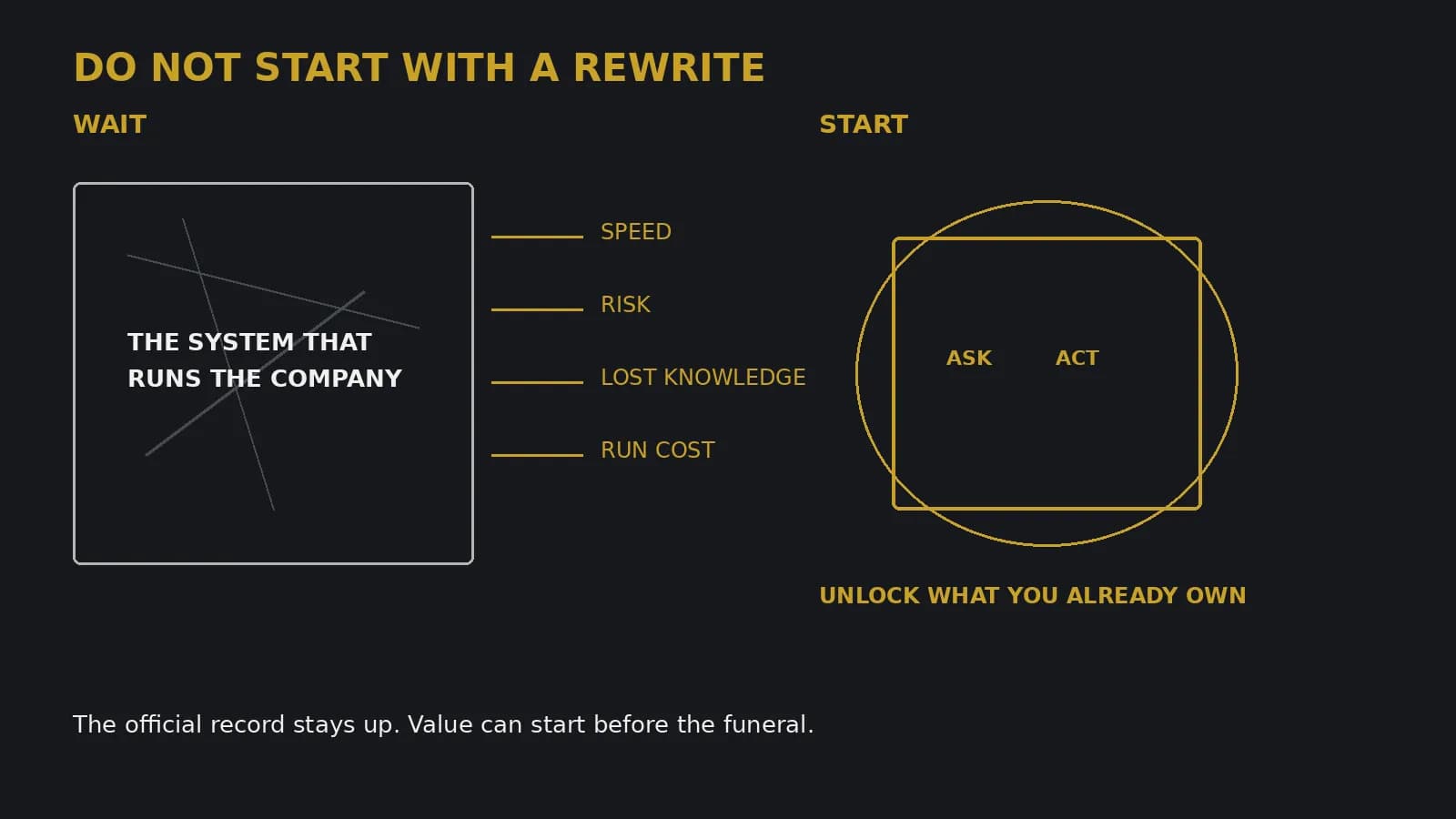
Left: every year you wait, the old system costs more and gets harder to change. Right: unlock it first. It stays the official record.
That is why this is no longer only an IT cleanup. Five pressures sit on the same box:
- Run cost. Old machines, rare skills, and manual support eat budget that should go to new work.
- Speed. A small change takes weeks or months because the real rules live in code, overnight jobs, and people's heads.
- Security. Old software that vendors no longer support widens the hole for audits and attacks.
- Knowledge loss. When the expert leaves, the exception that only they understood becomes a live risk.
- AI readiness. An AI agent cannot act safely on a system it cannot find, cannot be limited on, and cannot leave a record for.
So the work is mandatory. The usual first move is still wrong.
The trap is treating modernization as code conversion - rewrite the language, flip the switch, hope the business still behaves. Code that compiles is not proof. The hard part is the behavior: the rules spread across screens, jobs, database triggers, and the workaround a person still does by hand. Data formats, restart logic, and "old numbers match new numbers" are often harder than the rewrite.
The rule that holds: do not start with "replace everything." Start with the smallest safe change that creates business value and keeps the evidence.

Unlock. New experience on top. Change in waves with a match-and-rollback test. Turn it off when you no longer need it - the new path is sufficient.
Unlock what you already own. Make the old system reachable through clean connections so other software - including AI - can ask it questions and, with approval, take an action. The old system stays the official record.
Give people a better way to work on top of it. New screens. Better reports. Workflows and approvals that the old package would not let you run. The core transactions can stay where they are.
Change the insides only when the blast radius is known. Upgrade the runtime. Fix known holes. Move a bounded piece of the business at a time. Run old and new side by side until the numbers match. Keep a way to roll back.
Turn it off when you no longer need it. The new path is sufficient. Not as the opening move.
There is no single path for every application. A system that still works and must not fail should be wrapped and exposed first. A system that only needs cheaper infrastructure can move first and keep the same behavior. A rewrite is for when the business itself changed and the old logic is obsolete. That last path is the highest risk. Use it only when the requirements are proven.
How you choose: look at capabilities - "pay a claim," "schedule a plant" - not at application names. Score what breaks if you touch it. Test a new connection and a new experience before you replace the core. Pilot a real slice of the business, not a toy program. Make matching results and rollback non-negotiable.
The test of modernization is not "we moved it to the cloud." The test is whether the application became easier to understand, safer to change, possible to govern, possible to check, and cheaper to run - and whether the new path is as correct as the old system, or better, with proof.
If your AI modernization plan starts with a funeral for the official record, it is not a modernization plan. It is a bet you do not need to make on day one.