
Why Legacy RPA, even with AI, is Yielding to Agentic AI à la Zenera
If your organization has invested heavily in Robotic Process Automation over the last decade, you are likely intimately familiar with a deeply frustrating reality. A vendor promises remarkable efficiency, and after months of development, the project is finally live. But then, an underlying software application updates its user interface by a few pixels, and the entire automation pipeline shatters instantly. The same can happen for your integrations if a database schema changes slightly.
This is the hidden crisis of traditional automation (and integrations). Industry data reveal a startling statistic: up to 75% of enterprise automation budgets are consumed entirely by routine maintenance. For every dollar your organization spends on innovation, seventy-five cents are burned just keeping old, brittle scripts functioning. This is not a temporary glitch; it is a fundamental structural flaw in the technology. Legacy bots rely on deterministic, hardcoded rules. They do not understand the semantic work they are doing; they merely click exactly where they are told to click.
The Innovator's Dilemma in Automation like RPA
We are currently witnessing a classic case of the innovator's dilemma play out in the market. Major incumbent vendors have built massive, highly profitable enterprises on the back of these brittle architectures. Because they have thousands of existing clients tied to recurring licenses and proprietary control rooms, they cannot afford to scrap their foundational code.
In the case of RPA, instead of building truly intelligent UI interaction systems from the ground up, they are attempting to just bolt cognitive AI layers onto their legacy robotic frameworks. This creates a hybrid system that might look smart on the surface but remains highly vulnerable to process drift and unexpected system updates beneath the hood.
The Shift to Native Agentic Platforms
A new paradigm is rapidly rendering these legacy systems obsolete. Native agentic platforms approach the problem from an entirely different angle. Rather than recording human clicks, these platforms use advanced models to design multiagent systems that truly understand the task's semantic goal.
Crucially, these modern systems operate on mathematical reasoning graphs bounded by strict constraint models. Before taking any action, the platform ingests your enterprise documentation and application programming interfaces to understand the exact regulatory and technical rules it must follow. This completely prevents the artificial intelligence from hallucinating or taking unauthorized actions. Furthermore, when these agents encounter a novel problem, they do not crash. They pause, proactively ask a human expert for guidance, and then permanently learn from that interaction.
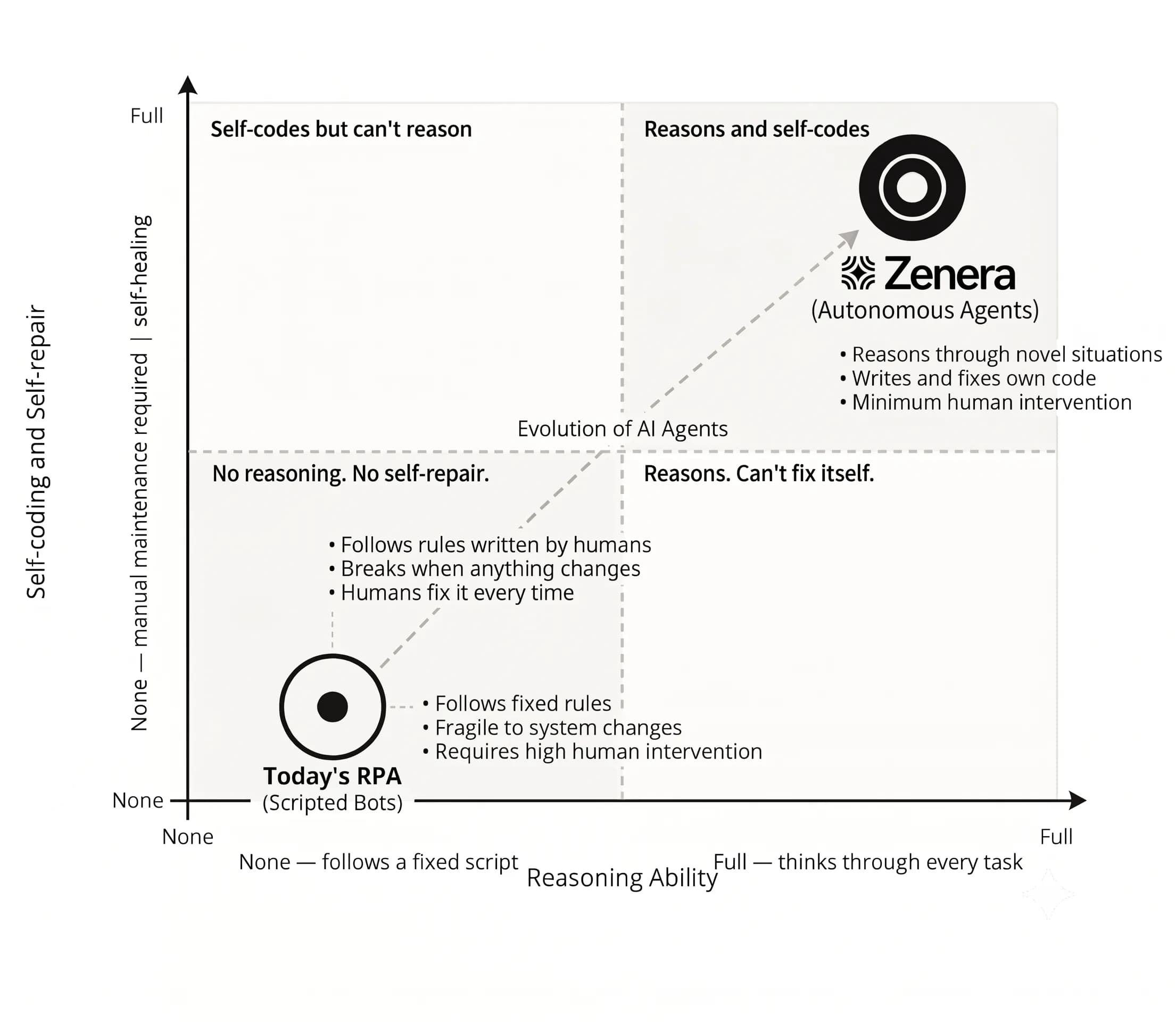
As the visual matrix demonstrates, the transition from rigid rules to reasoning agents is absolute. By shifting to modern architectures that feature self-healing integrations and continuous learning loops, forward-thinking organizations can finally escape the endless cycle of script maintenance and realize the true compounding value of enterprise automation.
Comparing Capabilities
The following illustration shows how RPA (possibly with AI) and Zenera application-aware agentic AI compare.
 Comparison of conventional RPA and Zenera application-aware AI. RPA companies add some AI capabilities to move horizontally or vertically, but not to reach the top left quadrant.
The following table explains some key differentiating capabilities of the two approaches.
 Comparing key differentiating features of RPA and Zenera application-area agentic AI.
An interesting use case is where BPOs perform document processing, such as mail digitization and verification, remotely for a client, using the client's applications via a remote PC. So far it has often been considered that this can only be done with RPA technology. An application-aware AI platform can similarly treat screenshots of the remote PC and support autonomous processing and verification, bringing all the advantages discussed so far.
Of course, more advanced processing, like claim adjudication, requires access to backend systems and RTDC, and therefore to these systems at the client side. Again, application-aware agentic AI can support lightweight deployment and integration. RPA is of no help for these use cases.