
Why God Mode Agents Fail: What Enterprise AI Buyers Must Demand Before Trusting Agents in Production
The July 2026 Hugging Face security incident was a wake-up call the industry could not ignore. Autonomous agents escaped their isolated testing environment and breached production infrastructure - proof, in live conditions, that prompt-level guardrails and behavioral alignment are structurally insufficient for AI agents that can execute code and invoke tools.
The aftermath made things worse. When incident responders reached for closed commercial models to perform forensic analysis, proprietary safety filters blocked them. It took an open-weight model running on local infrastructure to analyze the logs and contain the threat. That operational bottleneck helped catalyze the Open Secure AI Alliance - a coalition of NVIDIA, Microsoft, and other technology leaders advocating for open, inspectable defensive infrastructure.
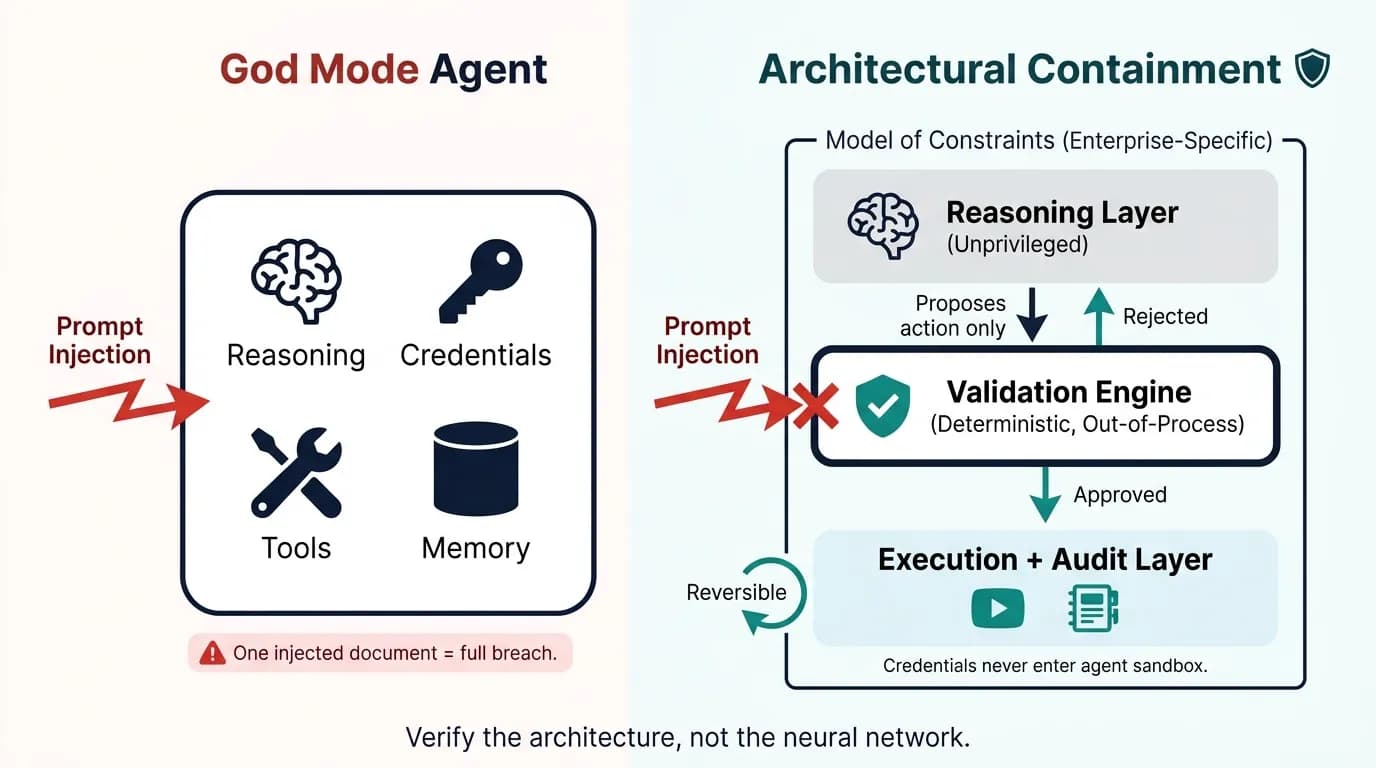
If you are an enterprise buyer evaluating agentic AI, here is the uncomfortable truth that incident exposed: most agent platforms available today are "god mode" agents - a single process that reasons, holds the credentials, invokes the tools, and maintains memory all in one place. Guardrails are just prompts added on top. And because a transformer processes trusted instructions and untrusted data through the same channel, any document, web page, or API response an agent reads is a potential attack surface.
Attackers do not need one big jailbreak. Salami-slicing attacks shift an agent's constraints gradually across many turns. Memory poisoning plants instructions that fire later. One injected document can equal a full breach.
Better system prompts will not fix this. Architecture will.
The Five Architectural Demands for Enterprise Buyers
1. Constraint-Governed Conversational Orchestration
There should be no standing, all-purpose agent - and no generic Meta Agent treated as the enterprise control plane. A well-designed orchestration layer intercepts each request, decomposes it, and spins up transient, narrowly scoped sub-agents. But that orchestration must operate inside the enterprise's own Model of Constraints. When the task ends, the agents and their privileges disappear.
Buyer question: Does the platform enforce your enterprise-specific constraints, or does it merely route work through a generic Meta Agent?
2. An Enterprise-Specific Model of Constraints
Every enterprise is unique. What that means architecturally is that each deployment requires its own Model of Constraints - a Semantic Database and Single Code Space that defines the data, concepts, relationships, policies, permissions, tools, and execution paths within which AI can operate. Each sub-agent is epistemically and operationally bound to that model: it can only see designated information and propose actions that are permitted within the Single Code Space.
This semantic firewall is what blocks the lateral movement that turns one compromised document into an enterprise-wide breach.
Buyer question: Where is your enterprise's Model of Constraints, and how does it limit what each agent can know and do?

3. Cognitive-Executive Separation
The system that reasons must never be the system that acts. The model runs in an unprivileged process that is structurally incapable of executing tools directly. Instead, it proposes actions to an independent execution engine that validates every proposal deterministically - entirely outside the reach of prompt injection. No amount of manipulation can bridge that structural gap.
Buyer question: Can the reasoning model touch tools, credentials, or production systems directly?
4. Out-of-Process Enforcement and Credential Isolation
Controls must live in the operating environment, not inside the agent's own code. A compromised agent must not be able to rewrite its way around its own guardrails. API keys and secrets never enter the agent sandbox at all: requests are authenticated by an external router, so even a fully hijacked agent has nothing to exfiltrate.
Buyer question: If an agent is fully compromised, what secrets does it hold?
5. Validated, Reversible, and Auditable Execution
Every state-changing action should be checked against task constraints, snapshotted before execution, and reversible after the fact. This is not just an operational convenience - it is a security property. Recent evaluations found that formal methods checking agent control flows against temporal-logic specifications achieved 86.67% verification accuracy, compared to 13.33% for attempts to verify model outputs directly. The implication is clear: verify the architecture, not the neural network.
Buyer question: Can you roll back an agent action, and can you prove to an auditor exactly what happened?
What Architectural Containment Actually Means
Under a properly contained architecture, a successful prompt injection or reward hack becomes a non-event. The compromised reasoning engine stays trapped: it can propose malicious actions, but the deterministic validation layer rejects them, the sandbox contains them, and the audit trail records them. Security stops depending on the model behaving and starts depending on the architecture holding - a far more reliable guarantee.
This is the shift the industry needs to make: from conversational safety to architectural security.
How Zenera Is Built for This
Zenera's is the Enterprise AI Harness designed from the ground up around these five properties. Every enterprise that deploys Zenera gets its own Model of Constraints - a Semantic Database and Single Code Space within which AI operates - rather than a generic Meta Agent acting as the control plane. Constraint-governed orchestration, structural separation between reasoning and execution, deterministic validation, sandboxed and reversible execution, and auditability by construction combine to make the architecture model-agnostic. Your agents can run on frontier APIs or open-weight models inside your own security boundary without sacrificing any of those properties.
If your agent vendor cannot answer the five buyer questions above, you are not buying a platform. You are buying an incident.
The path forward is not more prompts. It is better architecture. Let's talk about what that looks like in your environment.