
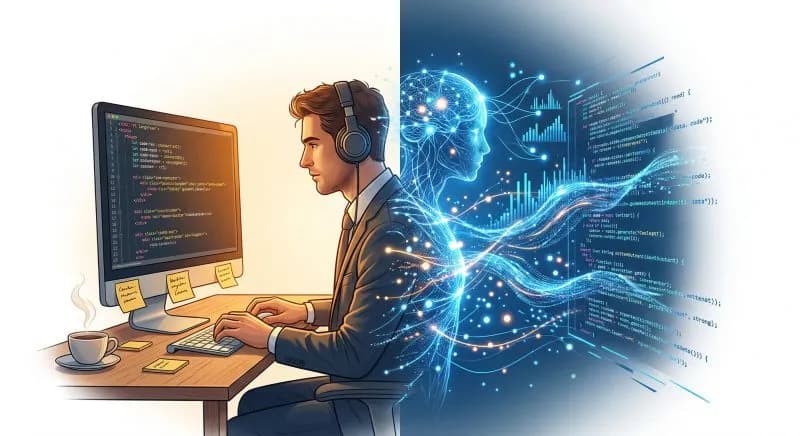
I spent a decade writing "good" code for humans. Then I watched an AI write code for outcomes.
Good meant readable. Maintainable. Something another human could pick up, understand, and extend. We all did. That's what we were taught. That's what code reviews enforce. That's what "senior engineer" meant.
But here's what I've been realizing while building Zenera: that definition of "good" was never about the code itself. It was about us. Our limitations. Our need to read it line by line, hold it in our heads, trace the logic with our eyes.
What happens when the reader isn't human anymore?
My co-founder, Andrey Ryabov, was working on deploying Zenera with a legacy ERP system - the kind of system where building a proper integration usually takes weeks of reading docs, writing adapters, and handling edge cases. The LLM generated the integration code in real time. It worked. And it looked... nothing like what we would have written.
It wasn't "clean." It wasn't following our naming conventions. A code reviewer would have flagged half of it. But it solved the problem and could regenerate itself whenever conditions changed (for more details on integrations, see our post on integrations as skills).
That moment stuck with me.
We then saw the same pattern again and again. Complex workflow problems spanning multiple systems: filtering emails, pulling calendar data, cross-referencing ERP records, and building reports. Problems that would have taken specialized teams months to solve. The Zenera Platform with LLM handled them in minutes.
Not because the AI was smarter. But because it wasn't constrained by the same rules we imposed on ourselves.
Think about it: Why do we use design patterns? So humans can recognize structure. Why do we keep functions short? So humans can hold them in working memory. Why do we name variables descriptively? So humans can read them.
What if the system writing the code doesn't need any of that?
We're entering an era where software can be written for outcomes rather than human readability. Where the measure of good code shifts from "can a person maintain this?" to "does this solve the problem reliably?"
That's a fundamental shift. And most of the industry hasn't caught up to it yet.
We're still teaching engineers to write code as if humans will always maintain it. We're still reviewing AI-generated code through the lens of human conventions. We're still thinking about software architecture with our own cognitive constraints in mind.
AI-centric code isn't worse code. It's a different code. Code optimized for a different kind of reader, a different kind of maintainer, and a different speed of iteration.
Are you prepared for software that's written in minutes, not months, by a system that doesn't need your conventions to get the job done?
#AI #SoftwareEngineering #AgenticAI #EnterpriseAI #FutureOfCode #ThoughtLeadership