
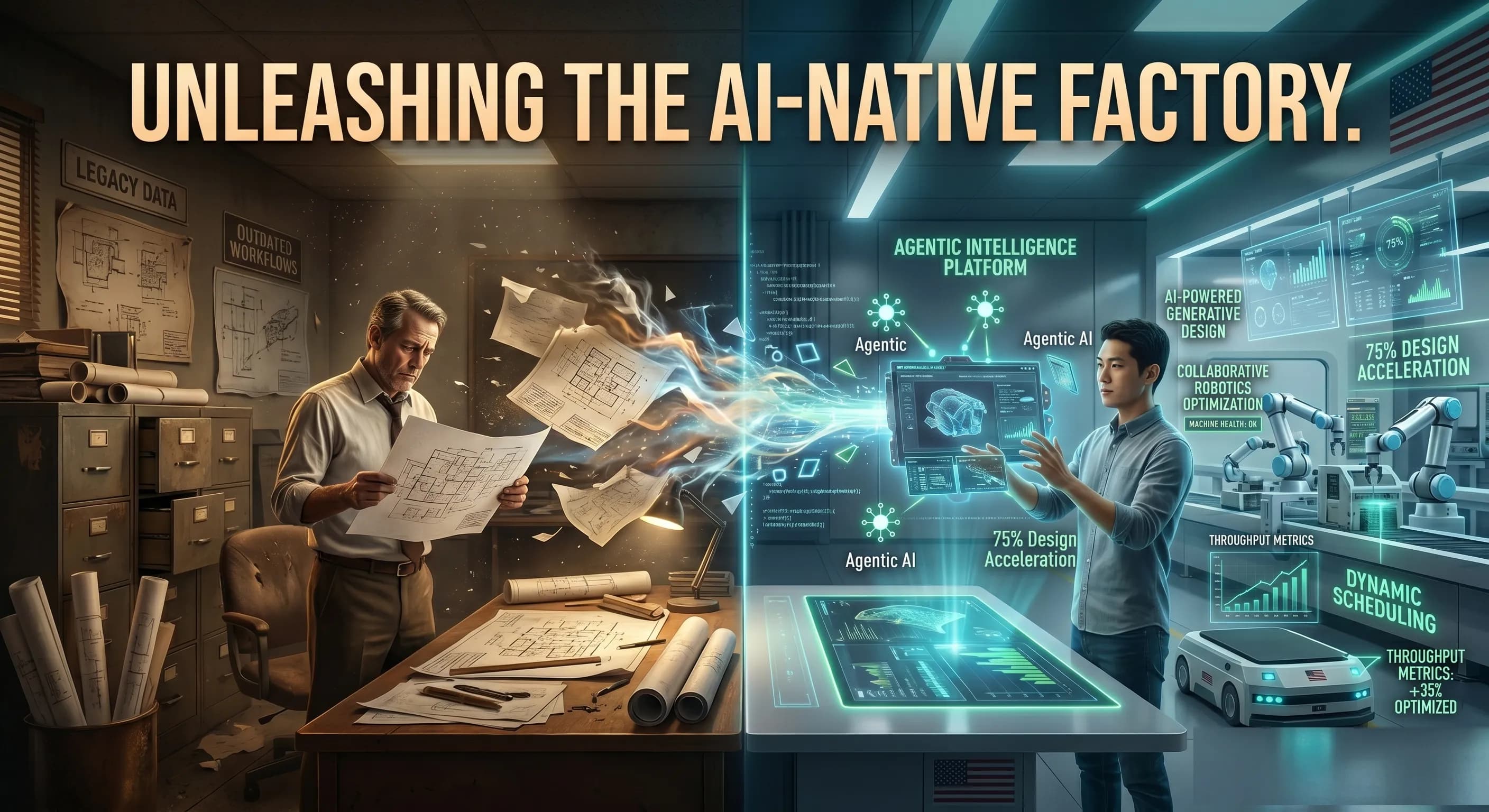
The AI Imperative: Manufacturing CEOs Who Don't Act Now Will Lose Ground They Can't Recover
Let's be direct: the global manufacturing competition is not waiting for you to get comfortable with AI.
Your counterparts in China, Vietnam, and South Korea are combining government-subsidized labor, massive scale, and rapidly accelerating automation to drive costs to levels that U.S. manufacturers cannot match through traditional operational improvement alone. If your strategy is to stay lean, keep the lights on, and wait for the environment to stabilize - your window of opportunity is already closing.
The manufacturers who deploy AI right now will pull ahead. The ones who don't will scramble to catch up - or won't catch up at all.
This is not a technology trend piece. This is a competitive reality check for every CEO running a U.S. industrial manufacturing operation.
The Scale of the Threat Is Larger Than Most CEOs Realize
The numbers are sobering. U.S. manufacturing output in 2024 was $2.9 trillion. China's was $4.7 trillion - 60% larger. Adjusted for purchasing power parity, the gap is even more severe: China at $8.4 trillion versus the U.S. at $2.6 trillion. That is a $5.8 trillion adverse gap - and it is projected to nearly double over the next 20 years.
The labor cost disparity is just as stark:
| Country | Avg. Hourly Manufacturing Wage | Robot Density (per 10k workers) |
|---|---|---|
| United States | $29.51 - $36.08 | 307 |
| China | $6.50 - $6.68 | 166 - rising 17% YoY |
| Vietnam | $0.76 - $0.99 | Under 100 |
China is not resting on cheap labor. It now operates 2 million industrial robots - 4.5 times more than Japan - and accounted for 54% of all robots installed globally in 2024. Asian competitors are automating at massive scale while keeping labor costs a fraction of U.S. rates. That is a combination no lean program or cost-cutting initiative can offset.
The only lever that changes this equation structurally - not incrementally - is AI-driven productivity transformation. For mid-size U.S. manufacturers, the ROI on the right AI deployment is not measured in small percentages. It is measured in orders of magnitude. The productivity gap built up over decades can be closed - but it requires a new kind of AI, built for your world.
The Hidden Tax You're Already Paying
Before we even get to the competitive threat from Asia, there is a massive productivity leak happening inside your operation right now. Two forces are silently draining your margin every single day.
The Manual Data Tax
Your ERP, your CAD system, your scheduling spreadsheets, your quoting tool - none of them talk to each other natively. The "integration" between them is your people manually re-keying data from one system to the next. Research puts the cost of that manual data entry at $28,500 per employee per year. With a 1-4% error rate on manual entry, a single misplaced decimal in a Bill of Materials triggers scrap, rework, and delayed shipments.
Companies that successfully integrate their systems see a 75% reduction in manual re-keying labor and a 47% reduction in product development time. That is not a technology upgrade. That is margin recovery.
The Tribal Knowledge Crisis
Right now, 25% of your manufacturing workforce is 55 or older. By 2033, 2.8 million manufacturing workers are expected to retire - taking with them decades of undocumented operational knowledge. How to read the vibration of a machine that's about to fail. Which supplier to call when the primary one is late. Why that one tolerance can't be tightened even though the drawing says it can.
An estimated 70% of critical manufacturing knowledge is never written down. When the person who holds it retires, it is gone. The financial cost of that knowledge loss has been estimated at $47 million per year per organization - through increased errors, duplicated problem-solving, and extended ramp-up time for new hires (6-9 months, on average). Across the U.S. manufacturing sector, human-error-related downtime alone accounts for $92 billion in annual losses.
These are not abstract risks. They are happening in your operation today.
The Problem Nobody Is Solving Honestly
Here is the part most AI vendors skip over entirely: deploying AI in a real manufacturing operation is nothing like deploying AI at a tech company.
Walk into any U.S. industrial manufacturer and what you find is not a clean modern enterprise. What you find is:
- Visual Basic macros and Excel spreadsheets running quoting, scheduling, and capacity planning
- Aging ERP systems - Infor Visual Enterprise, Epicor, IQMS, JobBOSS - that haven't had a significant update in years
- Paper blueprints, hand-drawn P&ID diagrams, and PDF archives containing decades of irreplaceable engineering knowledge
- An IT team of one or two people stretched across networks, desktops, and production systems
- No industrial engineers on staff to define automation requirements or manage integrations
When generic AI vendors pitch their solutions, they assume you have a clean data lake, a modern API-accessible ERP, and an IT department with bandwidth to implement sophisticated integration frameworks. The reality: 52% of manufacturing developers cite legacy system maintenance as their biggest daily hindrance, and 23% of their work time is consumed by managing technical debt rather than building anything new.
You don't have the clean stack these vendors assume. And frankly, neither does the vast majority of U.S. industrial manufacturing.
The AI technology built for Silicon Valley enterprises does not work in your factory. It was never designed for your world.
What AI-Native Manufacturing Actually Looks Like
Zenera built its Enterprise Agentic Platform specifically for this environment - not for the modern enterprise stack that most AI vendors assume you have. Our platform connects to what you actually have. It reads your spreadsheets. It integrates with your legacy ERP without requiring a full modernization project. It visually parses your blueprints. It does not require your one-person IT team to spend months on integration work before you see any value.
Here is what that looks like in practice:
| Solution | The Challenge You're Living | What Zenera's AI Does | The Result |
|---|---|---|---|
| Intelligent Quoting | Your best estimator is your biggest bottleneck. When they're out, the pipeline stalls. Decades of pricing knowledge is locked in one person's head and buried in spreadsheets no one else fully decodes. | Ingests your historical job data, pricing models, and tribal knowledge. Produces accurate, competitive quotes in hours - your team validates and approves. | Quoting cycles drop from 3-4 weeks to under 24 hours. Win more work. Respond faster. Stop leaving revenue on the table. |
| Dynamic Scheduling | Static schedules break the moment a machine goes down, a supplier is late, or a job fails inspection. Schedulers spend their days firefighting. Every disruption cascades into missed deliveries and eroded margins. | Monitors the floor in real time and continuously re-optimizes the production schedule around constraints, priorities, and deadlines. When disruption hits, the AI recalculates instantly. | Higher OEE. Fewer late deliveries. Less overtime firefighting. More output without adding headcount. |
| Agentic Engineering | Engineers spend more time researching historical designs than innovating. Blueprints are in filing cabinets. CAD files are in folder structures nobody fully understands. The engineer who made the critical design decisions retired three years ago. | Visually parses your entire archive - drawings, PDFs, CAD files - and makes that knowledge instantly queryable. Engineers find historical patterns, identify past failure modes, and generate new designs grounded in your own proven principles. | 75% reduction in design cycle time. Faster time to market. Institutional engineering knowledge preserved and accessible, even as your senior engineers retire. |
| Strategic Intelligence | As a CEO, you wait days for reports that answer questions you had this morning. By the time the data arrives, the decision window has passed. You're steering with lagging numbers. | A conversational interface directly to your business data. Ask which orders are at risk, what your schedule looks like if you take on three new jobs, or where your margin is eroding - and get answers in seconds. | Faster, more confident decisions. Real-time visibility your competitors - still flying on weekly reports - simply do not have. |
The documented ROI benchmarks for AI in manufacturing operations are not hypothetical:
| AI Capability | Mechanism | Benchmark Outcome |
|---|---|---|
| Predictive Maintenance | Sensor data analysis (ML) | 30% reduction in unplanned downtime |
| AI Computer Vision QC | Real-time defect detection | Up to 99% accuracy; significant scrap reduction |
| Agentic Integration | Automated data sync across silos | Elimination of manual re-keying labor |
| Supply Chain AI | Demand forecasting and risk modeling | 32% decrease in supply disruptions |
| Generative Design | Constraint-based algorithm exploration | 47% faster development cycles |
The Window Is Open Now - But Not Forever
The manufacturers moving on AI today are not large OEMs with massive IT departments. They are mid-size shops in the $20M - $200M revenue range who have recognized that the ROI is undeniable and that waiting is a strategic risk, not a safe option.
In 18 months, the gap between AI-enabled manufacturers and those still on spreadsheets will be visible - in win rates, in margins, in the ability to recruit and retain talent that wants to work in a modern operation.
The $5.8 trillion manufacturing gap with Asia is not going to close itself. Traditional efficiency programs have been tried for three decades. The companies that crack this are going to do it by turning their experienced workforce and their decades of operational data into an AI-amplified competitive weapon - not by chasing cost structures they can never match.
The question for every manufacturing CEO is not whether to deploy AI. The question is whether you will be among the leaders who define the new benchmark - or among those who spend the next three years trying to catch up to it.
Zenera Was Built for This
We are not a general-purpose AI company that added manufacturing to our pitch deck. Zenera built our Enterprise Agentic Platform from the ground up to operate in the real manufacturing environment - legacy ERP, Visual Basic macros, spreadsheets, paper blueprints, and all of it. We connect to your world as it exists today, without requiring a multi-year modernization project before you see results.
We are working with U.S. industrial manufacturers right now, delivering measurable outcomes. If you are a manufacturing CEO ready to make AI a genuine competitive weapon, we want to talk.
Contact us at sales@zenera.ai to schedule a conversation.
The manufacturers who act now will win. Let's make sure you are one of them.