
Zenera Pricing & Commercial Model
Value-Based Partnership Pricing
March 2026 · Companion to: Zenera Go-To-Market Strategy
Executive Summary
Zenera’s pricing model is built on a radical premise: we don’t charge for software. We charge for outcomes.
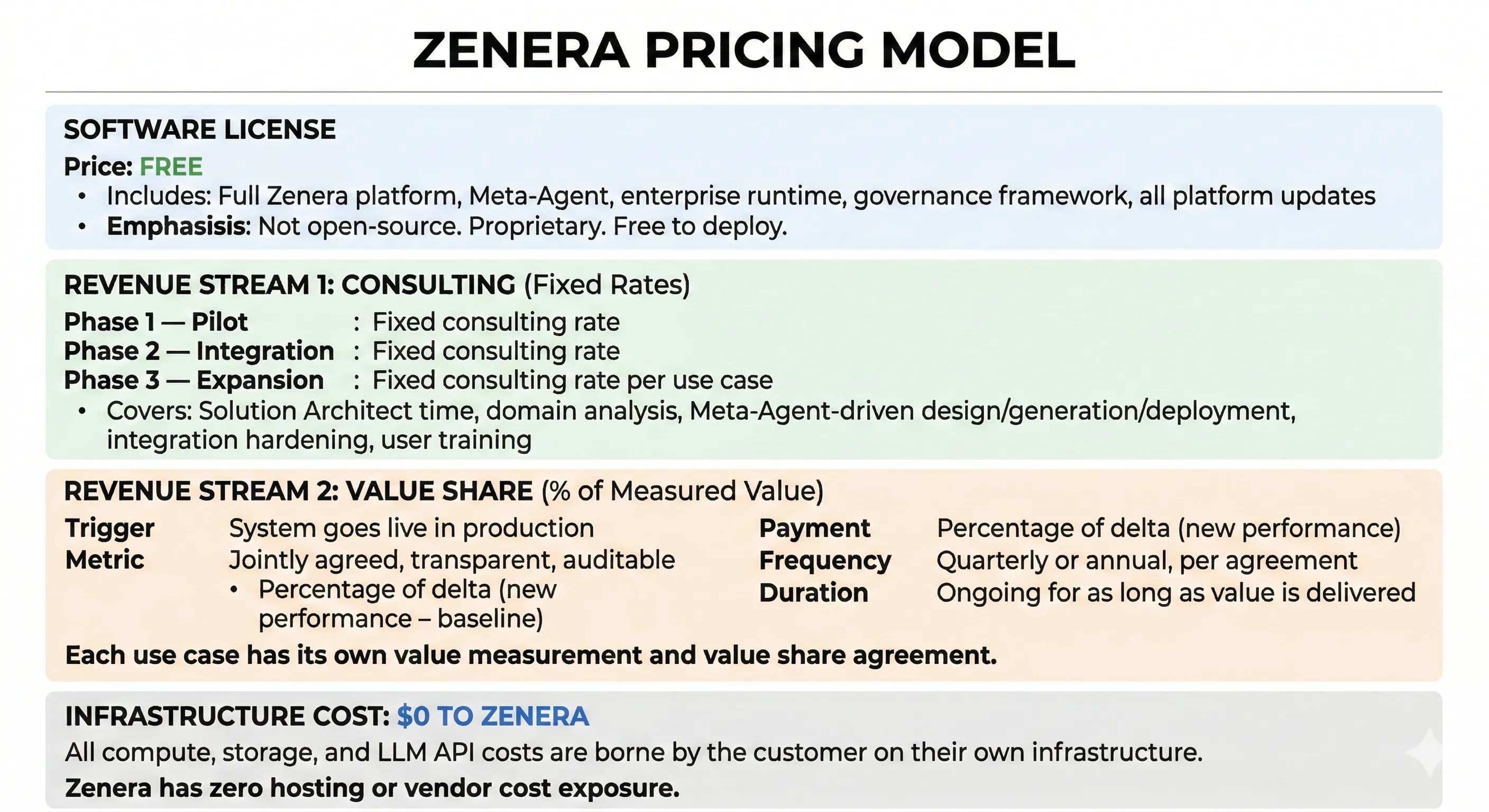
The Zenera platform — including the Meta-Agent, the enterprise runtime, governance framework, and all platform components — is provided to customers at no cost. It is not open-source. It is proprietary software, free to deploy. Zenera earns revenue through consulting engagements and a percentage of the measurable business value the platform creates.
This is not generosity. It is strategy. The model eliminates purchasing risk for the customer, aligns incentives between Zenera and the enterprise, and creates revenue streams that compound with every successful deployment. It is also structurally advantaged: because all software runs on the customer’s own infrastructure — their cloud, their data center, their air-gapped environment — Zenera carries zero infrastructure cost. No hosting. No LLM vendor bills. No compute margin erosion.
The result: a pricing model where the customer pays nothing until they succeed, and Zenera earns more as the customer succeeds more.
Why Value-Based Pricing
The Enterprise AI Buyer’s Dilemma
Enterprise buyers have been burned. The pattern is now familiar:
- 1Vendor promises transformational AI outcomes
- 2Enterprise signs a 12-month SaaS contract ($30–$100+ per user per month)
- 3Six months of implementation, integration, and customization
- 4The system achieves 60% of the promised capability
- 5Enterprise is locked into a contract for a tool that delivers incremental productivity at best
- 6Renewal negotiation becomes adversarial — vendor wants expansion, buyer wants reduction
The result: 72% of enterprises are breaking even or losing money on AI investments. The default emotional state of the enterprise AI buyer in 2026 is skepticism bordering on cynicism.
Every AI vendor says “we’re different.” The buyer has heard this dozens of times. Slides, benchmarks, demo environments — none of it moves the needle. What moves the needle is proof. And the most powerful proof is a pricing model that says: if this doesn’t work, you pay nothing.
The Strategic Logic of Free Software
The software is the platform on which value is created. Charging for it separately creates friction, skepticism, and purchasing delays. Making it free eliminates the procurement barrier entirely. The conversation shifts from “how much does the software cost?” to “how much value can we create together?”
| Conventional SaaS Logic | Zenera’s Logic |
|---|---|
| Charge per seat/month for software access | Software is free — it's the delivery mechanism, not the product |
| Revenue starts at contract signature | Revenue starts when the customer achieves measurable outcomes |
| Customer bears all risk (commits before value is proven) | Risk is shared — Zenera invests consulting time upfront |
| Vendor incentive: maximize seats, minimize support | Zenera incentive: maximize customer success (our revenue depends on it) |
| Misaligned: vendor profits whether customer succeeds or not | Aligned: both sides profit only when the customer wins |
Why This Model Is Advantageous for Both Sides
For the Customer
- Zero risk on software. No upfront license fees. No annual commitment for shelfware. The platform is deployed and running before any significant payment.
- Paying for results, not promises. The customer does not pay a percentage until the system is live and creating measurable business value. If the pilot fails, they’ve paid only the consulting fee for the pilot phase.
- Aligned incentives. Zenera is financially motivated to make every deployment succeed — not to sell more seats, not to upsell features, but to increase the actual business value the system delivers.
- Budget justification is trivial. “We pay 15% of the value the system creates” is the easiest business case any CFO has ever approved. There is no ROI calculation required — the ROI is embedded in the pricing model.
For Zenera
- Eliminates the sales cycle. The biggest objection in enterprise AI sales is “what if it doesn’t work?” Value-based pricing eliminates this objection entirely. Conversion rates increase dramatically when the buyer’s downside is capped.
- Revenue scales with value, not seats. A system that recovers $3.2M in margin variance generates far more revenue for Zenera than a per-seat SaaS model ever could.
- Natural expansion incentive. Every new use case creates additional measurable value → additional revenue for Zenera. The customer and Zenera are jointly motivated to expand.
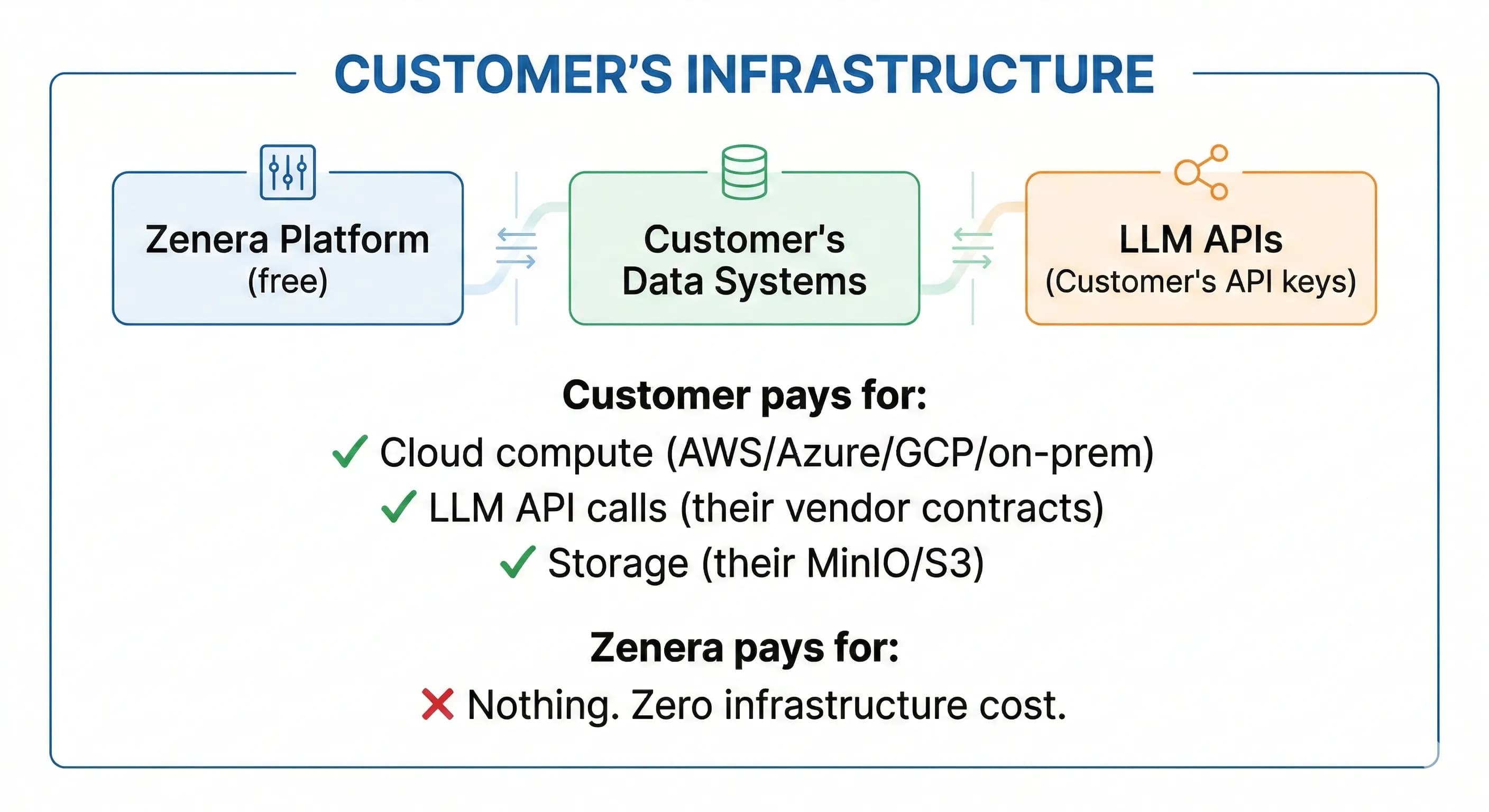
- Zero infrastructure cost exposure. All compute, storage, and LLM API costs are borne by the customer on their own infrastructure. Zenera’s cost basis is purely people (consulting) and IP (the platform). This creates exceptional margin leverage.
- Deep customer lock-in through success, not contracts. A customer paying 15% of $10M in recovered value is not going to switch vendors. The lock-in is economic, not contractual.
The Three-Phase Engagement Model
Zenera engagements follow three distinct phases, each with its own commercial structure.
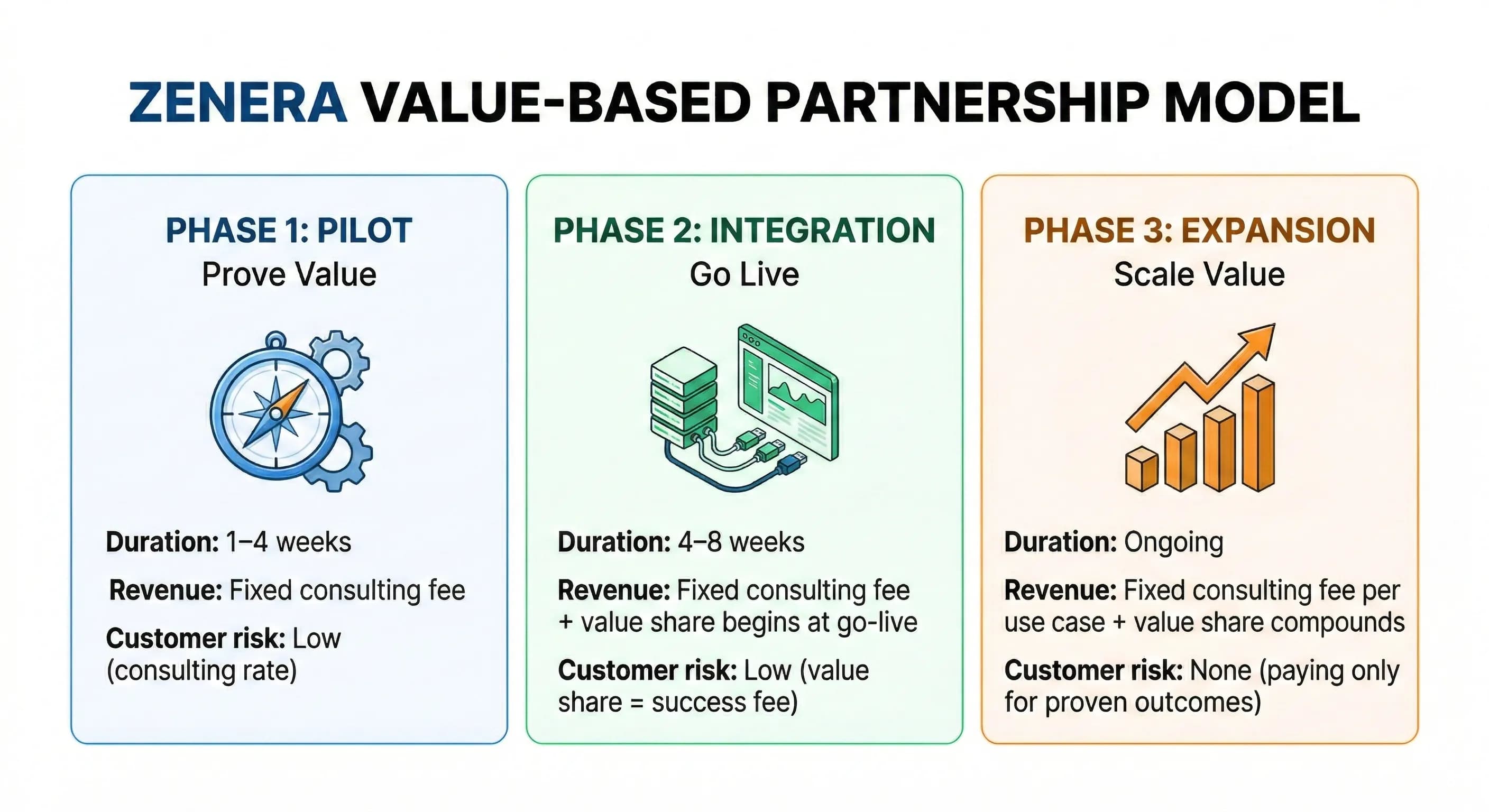
Pilot — Prove Value (1–4 Weeks)
Objective: Demonstrate that Zenera can solve the customer’s highest-priority use case on their actual data, deployed on their infrastructure, with measurable results.
What happens:
- Zenera deploys a Solution Architect (1 person) equipped with the Meta-Agent
- The customer identifies one high-value use case and provides access to relevant systems
- The Meta-Agent designs, generates, verifies, and deploys a complete multi-agent system
- The system runs on the customer’s infrastructure from Day 1 — their cloud, their data, their governance
- At the end of the pilot, both sides evaluate measurable outcomes (e.g., margin recovered, processing time reduced, accuracy achieved)
Commercial terms
| Element | Terms |
|---|---|
| Software | Free (platform deployed at no cost) |
| Consulting rate | Fixed consulting rate for Solution Architect engagement |
| Duration | 1–4 weeks depending on use case complexity |
| Infrastructure | Customer-provided (cloud or on-premise) |
| LLM costs | Customer-provided (their API keys, their models) |
| Deliverable | Running system on customer data with measured outcomes |
| Go/No-Go decision | Customer decides whether to proceed to Phase 2 |
Pricing rationale: The fixed consulting fee covers Zenera’s cost of deploying a Solution Architect. It is deliberately low relative to the value of the use case — the pilot is a “show, don’t tell” event, not a revenue event. The goal is conversion, not margin.
Customer risk: The fixed consulting fee. If the pilot fails to demonstrate value, the customer walks away having paid only the consulting fee. The software remains free. There is no license to unwind, no contract to terminate.
Integration — Go Live (4–8 Weeks)
Objective: Transition the pilot system into a fully production-grade deployment: hardened integrations, governance approvals, RBAC configuration, user training, and go-live.
What happens:
- Zenera’s Solution Architect works with the customer’s IT and compliance teams
- System integrations are hardened (failover, error handling, monitoring)
- RBAC and governance are configured per the customer’s policies
- End users are trained (CFO, CMO, care managers, analysts — whoever the system serves)
- The system goes live on production data with full audit trails
- Value measurement begins — both sides agree on the metric(s) and measurement methodology before go-live
Commercial terms
| Element | Terms |
|---|---|
| Software | Free |
| Consulting rate | Fixed consulting rate for integration engagement |
| Value share | Begins at go-live: Zenera earns a percentage of measured value created |
| Value measurement | Jointly agreed metrics (revenue recovered, cost reduced, time saved, errors eliminated) |
| Measurement methodology | Transparent, auditable, agreed before go-live |
| Infrastructure | Customer-provided |
| LLM costs | Customer-provided |
The value share mechanism
The value share is the core of Zenera’s revenue model. It works as follows:
- Before go-live, Zenera and the customer agree on: the specific metric(s) being measured; the baseline (what the metric was before Zenera); the measurement methodology (how the improvement is calculated); and the value share percentage.
- After go-live, the system creates measurable value. The customer pays Zenera an agreed percentage of the delta — the difference between the baseline and the new performance.
- The measurement is transparent. Both sides see the same data. The Zenera platform’s audit and explainability features make the value calculation verifiable.
Example
| Metric | Before Zenera | After Zenera | Delta | Value Share (15%) |
|---|---|---|---|---|
| VBC margin variance recovered | $0 (variance undetected) | $3.2M recovered annually | $3.2M | $480K/year |
| Claims processing time | 14 days average | 3 days average | 78% reduction = $2.1M saved | $315K/year |
| Regulatory compliance cost | $4.8M/year | $2.9M/year | $1.9M saved | $285K/year |
Expansion — Scale Value (Ongoing)
Objective: Deploy additional use cases across the enterprise, multiplying value and revenue.
What happens:
- Success in Phase 2 generates demand from adjacent teams and departments
- Each new use case follows an accelerated version of Phases 1–2 (faster, because the platform is already deployed and integrated)
- The Meta-Agent generates new agent systems on the existing platform
- Each new use case has its own value measurement and value share agreement
- The enterprise gradually becomes a multi-use-case Zenera customer with compounding value
Commercial terms
| Element | Terms |
|---|---|
| Software | Free (same platform, new use cases) |
| Consulting rate | Fixed consulting rate per new use case (reduced scope since platform is already deployed) |
| Value share | Per use case — each new use case has its own measured value and percentage |
| Expansion cost to customer | Marginal — new use cases leverage existing infrastructure, integrations, and governance |
The Compounding Effect
| Year | Use Cases | Value Created | Value Share | Customer ROI |
|---|---|---|---|---|
| Year 1 | 1 use case | $3.2M | $480K | 6.7x |
| Year 2 | 3 use cases | $8.7M | $1.3M + consulting | 6.7x |
| Year 3 | 6+ use cases | $18M+ | $2.7M+ + consulting | 6.7x |
The customer’s ROI remains consistently high because the value share percentage is fixed. Zenera’s revenue grows because the total value created compounds with each use case.
The Infrastructure Advantage — Zero Cost Exposure
A critical structural feature of this model: Zenera does not host the software, does not pay for compute, and does not pay LLM vendors. Everything runs on infrastructure the customer controls.
Why This Matters
This is not a minor advantage. AI SaaS companies routinely spend 40–60% of revenue on compute and LLM API costs — a margin that compresses as customers scale usage. Zenera has none of this exposure. Revenue scales linearly with value created — and critically, costs do not scale linearly at all. The Meta-Agent ensures that each successive engagement requires less human effort, not more. The margin profile is not just better than SaaS — it improves with every deployment.
| Dimension | SaaS Model (Typical AI Vendor) | Zenera’s Model |
|---|---|---|
| Hosting cost | Vendor pays (major cost center) | Customer pays (already budgeted) |
| LLM API cost | Vendor pays (often 40–60% of COGS) | Customer pays (their API keys) |
| Gross margin | 50–70% (after hosting + LLM costs) | ~95%+ (consulting labor is the only cost) |
| Scaling economics | More customers = more infrastructure cost | More customers = more consulting leverage |
| Data sovereignty | Customer data in vendor's cloud (trust issue) | Customer data never leaves their infrastructure (trust solved) |
| Cost predictability | Vendor exposed to LLM price changes, compute spikes | Zenera immune to all infrastructure cost volatility |
Why Customers Prefer This Model
Enterprise buyers — especially in healthcare, insurance, and manufacturing — want to run AI on their own infrastructure. This is not a cost objection; it is a governance requirement:
- Healthcare: HIPAA mandates that PHI cannot reside on vendor-controlled infrastructure. Running on the customer’s own cloud eliminates this friction entirely.
- Insurance: State-level regulatory requirements often mandate that policyholder data remains within the carrier’s data boundaries.
- Manufacturing: IP-sensitive engineering data (CAD files, process specifications) cannot leave the company’s network.
- Government: FedRAMP, ITAR, and classified environments require on-premise or air-gapped deployment.
"By deploying on the customer's infrastructure, Zenera simultaneously solves the security/governance conversation and eliminates its own cost basis. The customer gets what they want (data sovereignty) and Zenera gets what it wants (zero infrastructure cost)."
The AI-Driven Cost Curve — Why Consulting Costs Approach Zero
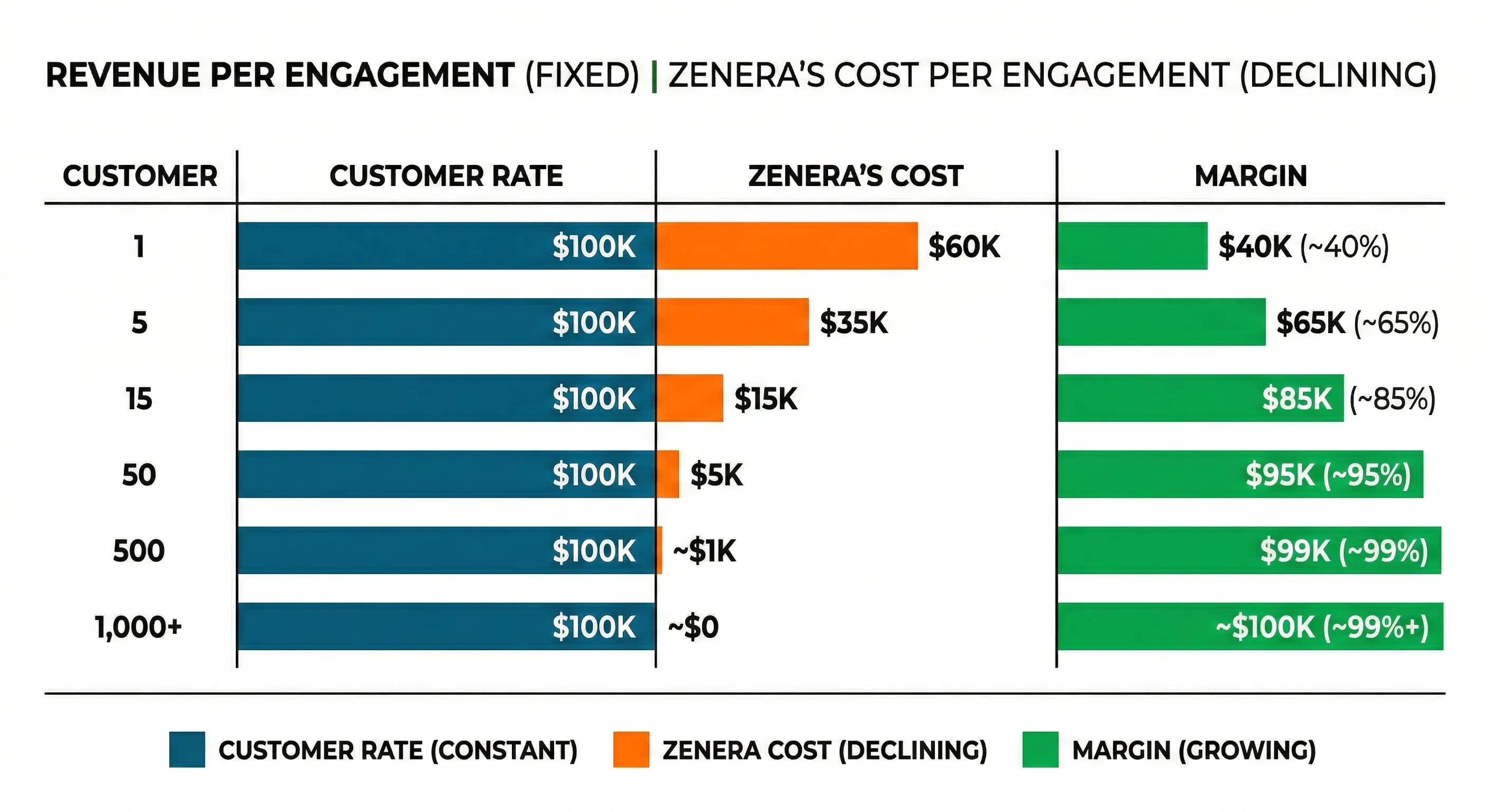
Traditional consulting firms face an inescapable constraint: every new engagement requires roughly the same amount of human labor. Revenue scales, but so do costs. Margins stay flat. Zenera breaks this constraint because the Meta-Agent — the AI system that designs, generates, verifies, and deploys enterprise agent systems — learns from every engagement.
Why This Model Scales to Thousands of Concurrent Clients
A traditional consulting firm needs one consultant per engagement. To serve 1,000 clients, it needs 1,000 consultants. Revenue grows, but so does payroll. Margins stay flat at 30–50%.
Zenera inverts this. The Meta-Agent — not the human — does the engineering. As it accumulates knowledge across hundreds of engagements, the human role shrinks from “engineer” to “supervisor” to “exception handler.” The scaling math becomes:
| Clients | Traditional Consulting | Zenera (with Meta-Agent) |
|---|---|---|
| 10 clients | 10 consultants | 3 Solution Architects |
| 50 clients | 50 consultants | 5 Solution Architects |
| 500 clients | 500 consultants | 15 Solution Architects |
| 1,000+ | 1,000+ consultants | 20–30 Solution Architects (Meta-Agent handles the rest) |
At Customer 50, the Meta-Agent has deep expertise across every major industry vertical and integration pattern. At Customer 500, it has seen virtually every enterprise use case. New engagements are pattern matches, not greenfield projects. The Meta-Agent designs, generates, verifies, and deploys — the Solution Architect reviews and handles edge cases. One person overseeing dozens of AI-driven deployments simultaneously.
What the Meta-Agent Accumulates with Each Customer
| Knowledge Layer | Example | Effect on Cost |
|---|---|---|
| Domain patterns | "VBC margin variance recovery in healthcare follows this agent architecture" | Eliminates design time for similar use cases |
| Integration strategies | "Epic EHR integration uses these API patterns with these error-handling configurations" | Reduces integration from weeks to days |
| Governance templates | "HIPAA-compliant RBAC and audit trail configurations that passed compliance review at 3 health systems" | Compliance setup becomes near-automatic |
| Agent code libraries | Battle-tested agent components generated across prior deployments | New agents are assembled, not built from scratch |
| Failure patterns | "This data schema pattern causes these edge cases — here's the verified fix" | Prevents costly rework and debugging |
The critical insight: Zenera’s internal cost drops, but the customer pays the same rate.
The customer’s fixed consulting rate does not decrease — it reflects the value of the outcome and the expertise delivered, not the hours logged. Whether the Meta-Agent needs 3 weeks or 3 hours to design an agent system, the customer receives the same result: a production-grade, governed, value-creating system deployed on their infrastructure. They pay the same rate for the same outcome.
What changes is Zenera’s cost to deliver that outcome. The Meta-Agent gets smarter with every customer, every use case, every integration. Work that required 3 weeks of Solution Architect time on Customer 1 may require 3 days on Customer 10 and 3 hours on Customer 50. The customer’s rate stays constant. Zenera’s cost collapses. The margin expands.
The Margin Expansion in Numbers
| Stage | Delivery Cost | Customer Rate | Zenera’s Margin |
|---|---|---|---|
| Customer 1–5 | High (Meta-Agent learning, SA guiding every step) | Fixed consulting rate | ~40–50% |
| Customer 5–15 | Medium (Meta-Agent handles most design autonomously) | Same fixed consulting rate | ~65–75% |
| Customer 15–50 | Low (SA focuses on edge cases only) | Same fixed consulting rate | ~85–90% |
| Customer 50+ | Near-zero (Meta-Agent delivers end-to-end) | Same fixed consulting rate | ~95–100% |
The value share follows the same pattern — Zenera earns the same percentage of the same outcomes, but the cost of enabling those outcomes drops with every deployment.
This is not a theoretical future state — it is the structural consequence of having an AI system that performs the engineering work and retains the knowledge.
This is why Zenera is not a consulting company. A consulting company’s margins are capped by labor costs — if a partner bills $500/hour and costs $250/hour, the margin is 50% forever. Zenera’s margins are uncapped because the labor is increasingly performed by AI that improves with every deployment. The customer never sees a price reduction (they are paying for outcomes, not hours), but Zenera’s cost to produce those outcomes trends toward zero. The business model looks like consulting in Year 1. By Year 3, it looks like software — with margins that no software company can match because there are no infrastructure costs either.
Why This Model Wins at This Stage
Zenera is in its formative phase — building the first wave of reference customers, proving the platform in production, and establishing the patterns that will define the business for the next decade. Value-based pricing is optimized for exactly this stage:
Selecting for the right customers.
Free software + value-based pricing naturally attracts customers who have real problems and real data. It repels tire-kickers and procurement-driven evaluations. A customer who agrees to a value-share model is a customer who believes in the use case and is willing to provide the data access, system integrations, and organizational commitment needed to succeed.
Zenera is engaging with a selected few customers — not hundreds. Each engagement is treated as a strategic partnership. The goal is not volume; it is 100% measurable success in every deployment. Five customers who achieved $3M+ in value each are worth more — in revenue, references, and learnings — than fifty customers paying $50K/year in SaaS fees.
Building the proof portfolio.
Every successful value-based engagement produces an unassailable proof point: “Customer X achieved $Y in measurable value, and they paid us Z% of that value.” This is the strongest possible sales collateral for the next customer. Not a case study written by marketing. Not a testimonial quote. An auditable, measured business outcome with a transparent financial relationship.
Compounding the Meta-Agent’s knowledge — and collapsing delivery cost.
Every engagement teaches the Meta-Agent more about the domain. Agent patterns that work. Integration strategies that succeed. Governance configurations that pass compliance review. Value-based pricing ensures that Zenera only deploys in situations where success is viable — which means every deployment generates high-quality knowledge that improves future deployments.
This is not just a quality effect — it is an economic effect. As the Meta-Agent accumulates domain knowledge, the consulting hours required per engagement decline. Customer 1 requires a full Solution Architect engagement over weeks. Customer 20 may require days. The value share revenue remains the same (it is tied to outcomes), but Zenera’s cost to deliver that outcome drops with every engagement. The result: margins that start high and accelerate — a cost curve that no traditional consulting or SaaS model can replicate.
Comparison to Alternative Pricing Models
| Model | How It Works | Assessment |
|---|---|---|
| Per-seat SaaS ($30–$100/user/month) | Charge per user per month | Commoditizes Zenera's value. A system that recovers $3.2M should not generate $36K/year (100 users × $30/month). Also: customers are skeptical of SaaS AI commitments after Copilot disappointments. |
| Platform license ($100K–$500K/year) | Annual flat fee for platform access | Creates purchasing friction. Requires budget approval before value is proven. Wrong signal: "pay us and hope it works." |
| Usage-based (per API call / per agent run) | Metered consumption pricing | Penalizes high-value use cases. A system that runs 1M agent invocations to recover $3.2M should cost based on value, not invocations. Also creates unpredictable bills that enterprises hate. |
| Consulting-only ($200–$500/hour) | Bill for time, no recurring revenue | No scalability. No compounding. Revenue stops when the engagement ends. Zenera becomes a services company, not a platform company. |
| Value-based (free software + consulting + % of value) | What Zenera does | Eliminates risk, aligns incentives, scales with value, compounds with use cases, generates unassailable proof points, zero infrastructure cost. |
Pricing Structure Summary
Illustrative Engagement Economics
Scenario: Mid-Size Healthcare System (3,000 beds, $1.2B revenue)
| Phase | Timeline | Zenera Revenue | Customer Value | Net Benefit |
|---|---|---|---|---|
| Pilot — VBC margin analysis | Weeks 1–3 | Consulting fee (fixed) | Proof of concept: $3.2M variance identified | Value demonstrated, no value share yet |
| Integration — Go live | Weeks 4–10 | Consulting fee (fixed) + value share begins | $3.2M annual margin recovery | $3.2M – consulting – value share |
| Expansion — Clinical pathway compliance | Months 4–6 | Consulting fee (fixed) + value share | $1.8M in compliance cost reduction | $1.8M – consulting – value share |
| Expansion — Staffing optimization | Months 6–9 | Consulting fee (fixed) + value share | $2.3M in staffing efficiency | $2.3M – consulting – value share |
| Year 1 Total | 9 months | Consulting fees + ~15% of $7.3M = ~$1.1M value share | $7.3M in total measured value | $7.3M – ~$1.4M total = $5.9M net |
| Year 2 (6 use cases) | Ongoing | Consulting fees + ~15% of $14M+ | $14M+ in total measured value | $12M+ net benefit |
"Customer ROI: ~5x in Year 1. The CFO signs the next use case cheerfully."
Why the Customer Says Yes
The buyer’s internal conversation:
“The software is free. We run it on our own cloud, so there’s no data sovereignty issue. We pay a fixed consulting fee for the pilot — if it doesn’t work, that’s the maximum we lose. If it works, we pay them 15% of the value they create. They found $3.2M in margin variance we didn’t know existed. We pay them $480K. We keep $2.7M. And they’re motivated to find more value because they get paid more when we get more.”
There is no enterprise purchasing objection that survives this pitch:
| Objection | Answer |
|---|---|
| "What if it doesn't work?" | You pay only the pilot consulting fee. Software is free. |
| "We can't commit to a long-term contract." | No long-term contract. Value share runs as long as value is delivered. Stop the system, stop the payments. |
| "We need to run this on our infrastructure." | That's the only way we deploy. Your cloud. Your data. Your API keys. |
| "How do we justify the cost?" | You're paying 15% of value that didn't exist before Zenera. The ROI is self-evident. |
| "What about security/compliance?" | Your data never leaves your infrastructure. Full RBAC, audit trails, explainability. Your compliance team approves. |
| "Our IT team doesn't have AI skills." | They don't need any. The Meta-Agent does the engineering. Your team provides domain knowledge. |
Strategic Implications
This Model Builds a Services-Plus-IP Company
Zenera’s pricing creates a hybrid business model that takes the best of both consulting and software:
| Dimension | Pure Consulting | Pure SaaS | Zenera (Value-Based) |
|---|---|---|---|
| Revenue predictability | Low (project-based) | High (recurring subscriptions) | Medium-High (recurring value share + consulting pipeline) |
| Gross margin | 30–50% (labor-heavy) | 50–70% (infra-heavy) | ~90%+ (no infra, IP-leveraged consulting) |
| Scalability | Low (linear headcount) | High (code scales) | Very High (Meta-Agent gets smarter per engagement — consulting cost per deployment declines toward zero) |
| Customer lock-in | Low (project ends) | Medium (contract term) | Very High (value + integration + governance) |
| Proof of value | Weak (deliverable-based) | Weak (usage-based) | Extremely strong (measured financial outcomes) |
Transition Path to Platform Pricing
Phase A — Now
Value-based + consulting. Selected few customers. 100% success focus. Build the proof portfolio.
Phase B — 12–18 Months
Introduce optional platform license for customers who prefer predictable costs over value-share. The license price is informed by actual value-share data — Zenera knows exactly what the platform is worth because it has measured it.
Phase C — 24+ Months
Offer both models — value-based for new engagements (keep the “show, don’t tell” conversion advantage) and platform license for mature customers who want budget predictability. The installed base of value-share customers provides extraordinary pricing intelligence for the license model.
This is the inverse of the typical startup trajectory. Most startups guess at pricing and adjust. Zenera measures the value it creates before it ever sets a price. The value-share data from the first 10–20 customers becomes the most accurate pricing oracle in the enterprise AI market.
Competitive Positioning Through Pricing
No competitor in the enterprise AI market offers this model:
| Competitor | Pricing Model | Customer Risk | Zenera’s Advantage |
|---|---|---|---|
| Palantir | Custom enterprise contracts ($1M–$10M+ annually) | High (large upfront commitment) | Zero software cost, value-share aligned |
| Microsoft Copilot | $30/user/month | Medium (low cost, low value) | Free software, outcomes-based — not seat-based |
| LangChain / CrewAI | Open-source (free) + enterprise tier | High (customer bears all engineering risk) | Free software + Zenera does the engineering |
| AI consulting firms | $200–$500/hour (time-based) | High (paying for time, not outcomes) | Fixed consulting + value share — paying for results |
| Zenera | Free software + fixed consulting + % of value | Minimal (pay for outcomes, not promises) | — |
The pricing model itself is a competitive moat. A customer comparing Zenera to Palantir sees: same outcome quality, 10x lower cost, aligned incentives. A customer comparing Zenera to Copilot sees: transformational outcomes vs. incremental productivity. A customer comparing Zenera to open-source sees: working system vs. a toolkit they can’t operationalize.
Safety, Alignment, Success
Zenera’s value-based pricing model is built on three principles:
Safety
The customer risks a consulting fee, not a multi-year software commitment. The software is free. The infrastructure is theirs. If it doesn't work, they walk away. This makes the "yes" decision dramatically easier than any competing model in the market.
Alignment
Both sides are financially motivated to maximize the value the system creates. Zenera doesn't profit from selling seats, features, or uptime. Zenera profits when the customer's operations improve. This alignment is not aspirational — it is structural, embedded in the commercial terms.
Compounding Success
Every successful deployment generates revenue, a reference proof point, and Meta-Agent knowledge that makes the next deployment faster, more accurate, and more valuable. The flywheel is commercial and technical simultaneously.
"We're so confident this works that the software is free, and we only get paid when you succeed."
The enterprises that need AI the most will never buy another AI SaaS product after the disappointments of 2024–2025. They will buy proof. Zenera’s pricing model is the proof: we’re so confident this works that the software is free, and we only get paid when you succeed.
That is the most powerful sales pitch in enterprise AI.