
The 2026 Outlook: Three Pivotal Shifts Defining the New AI Economic Era
As we embark on the AI journey for 2026, it is vital to look back at the economic arc of 2025. It was a year that redefined the industry, moving us from experimental hype to industrial-grade execution. Looking back, three specific observations stand out that signal where the enterprise world is heading.
1. The Dawn of the AI Industrial Age
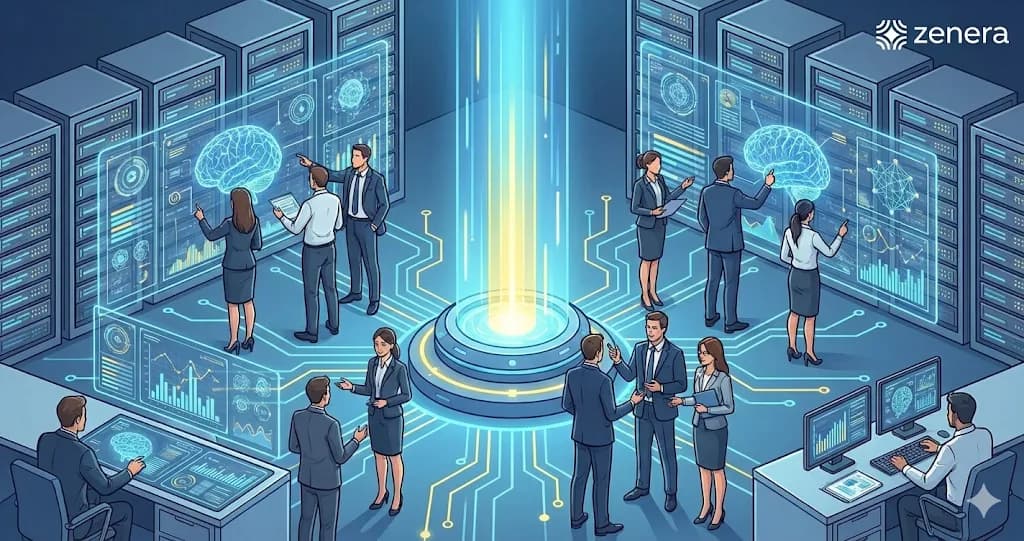
In 2025, we witnessed a fundamental shift in how capital is deployed: AI data centers effectively became the factories of the past. Just as the industrial revolution required massive physical planning, the AI rollout has demanded enormous capital expenditure (capex) for compute, power, and cooling. The "hyper-scalars" - including Google, AWS, Microsoft, and emerging players like Coreweave and Nebius - poured billions into these facilities. This was not just IT spending; it was a multi-year factory build-out designed to secure the production lines of the future.
2. Nvidia: The AI Chip Platform
While the hyper-scalars built the factories, Nvidia cemented its status as the undisputed AI Chip Platform Company. Having already cornered training and post-training workloads, 2025 saw them aggressively target the reduction of inference costs. Their hardware roadmap, evolving rapidly from Hopper to Blackwell and the latest Vera Rubin architectures, delivered 10 to 100X improvements for Generative AI workloads. But their strategy extended beyond just chips. With a strategic $20B deal with Groq, Nvidia evolved its inference capabilities while simultaneously leveraging open-source models across diverse fields: from Physical AI (Cosmos) and Robotics (Grot) to Protein Models (Evo2). There is simply no stopping this train.
3. The AI Model Disruption from the East
Perhaps the most disruptive trend of 2025 came from Chinese open-source models, which evolved rapidly without the massive capital injections seen in the West. A prime example was the breakthrough by DeepSeek and its CEO Wenfeng Liang. For a decade, AI models relied on a single, narrow "express lane" to pass information between internal layers. DeepSeek's new "Manifold-Constrained Hyper-Connections" (mHC) architecture changed the blueprint, turning that single lane into a multi-lane "superhighway". By adding mathematical guardrails to keep data flow stable, they achieved consistent accuracy gains with little added cost. The implication is profound: We now have powerful AI capabilities that can handle complex details but cost almost nothing extra to build or run. This paves the way for high-performance LLMs to run directly on local devices or on-premise infrastructure, potentially disrupting the business models of the hyper-scalars themselves.
Looking Ahead: The "Human + AI" Enterprise
The convergence of these trends, infrastructure costs dropping by 100X and open-source models becoming efficient enough for on-premise deployment, creates a massive opportunity for 2026. At Zenera, we have pioneered AI technologies for Enterprise Applications for the past decade, successfully deploying AI in mission-critical environments. We understand that the winners in this new era will be those who master the shift to "human + AI" operating models. We are ready to be the partner that helps you navigate this evolution and deploy effective, scalable solutions to transform your enterprise into an AI Factory. Let's build the AI-Native future together.